2nd Lieutenant Beresford Joseph NELSON.

53rd BATTALION AIF

2nd Lieutenant: Beresford Joseph NELSON.


Born: April 1894. Dunedin, Otago, New Zealand. 

Married:

Wife:

Died: 19th July 1917. Killed in Action


Father: Walter "Henry" Hanly Nelson. (1860-18/12/1927)

Mother: Mary Ellen Nelson. nee: Nohally. (1867-1927)


INFORMATION

6th October 1916.

Informant: Private 1655 W.G. FISHER. 56th Battalion AIF. "At Leventio on the 19th July I saw 2nd Lieutenant NELSON riddled with Machine Gun Bullets. We had to leave him when he was almost dead. We retired from there about 3:00 am. The Germans didn't pass over the ground and he was probably buried by our men. Identity disc would be lost. From his injuries he was certain to have died. 

No: 35 General Hospital. Calais, France.

Military Records

Under Construction: 29/08/2020.

2nd Lieutenant: Cyril John BOWEN.

Cyril John Bowen

34th BATTALION A.I.F.

 2nd Lieutenant: Cyril John BOWEN.


Born: 18th March 1886. Port Curtis, Springsure, Queensland, Australia.

Died: 15th September 1916. Died of Disease Died at Sea of the Coast of Durban, South Africa.


Father: Police Sergeant: Patrick Bowen. (1848-04/04/1914) died at Cains, Queensland, Australia.

Mother: Marianne Genevieve Bowen. nee: Mahoney. (1859-1925)


INFORMATION
Cyril John Bowen enlisted with the AIF on the 8th September 1915 and was allocated to the 3rd Reinforcements, 34th Battalion when they were raised in January 1916 with the rank on 2nd Lieutenant and commenced training troops at the Rutherford Army Camp at Rutherford.

“The Newcastle Morning Herald and Miner’s Advocate”

"Until the 10th of March, early training and formation of the Battalion was in progress. On that day the Battalion marched to the newly pitched camp at Rutherford and was completed with the exception of the Transport. These joined later and came from the Army Service Corps camp near Sydney. Here strenuous training was carried out. The men were very keen and fit, whilst their comfort and health were made a special study. Food was good and ample and sports and recreation were not overlooked.

Maitland Camp at Rutherford 1916
MAITLAND CAMP RUTHERFORD N.S.W. 1916.
Cyril left Farley Station with the 3rd Reinforcements for Sydney on the 24th of August and embarked on board HMAT 68 "Anchises" that day.

31st August 1918.

Informant; Private: 2713 Alfred HARKNESS. 34th Battalion AIF. "I knew Mr BOWEN well. I went through my training under him at the Rutherford Camp near Maitland. He left before I did as I was ill at the time. He went away as a 3rd Reinforcement to the 34th Battalion and died on board ship just before getting to Durban I think. I was told this in England by Lieutenant. Jeffrey MONFRIES who also went away as a 3rd Reinforcement with Mr BOWEN. I think he died of Meningitis. Mr MONFRIES said that Mr BOWEN was only ill for a short time. Some of the boys also told me about Mr BOWEN. He was buried, I believe at sea.

No:4 Australian General Hospital, Randwick, Australia.

Cyril Died of Disease from Meningitis and was buried at Sea of the Coast of Durban, South Africa on the 15th September 1916 and is remembered with honour and is commemorated in perpetuity by the Commonwealth War Graves Commission at the Hollybrook Memorial, Southampton, England.

Commonwealth War Graves Project
Hollybrook Memorial
Hollybrook Memorial
Hollybrook Memorial, Southampton, England.
Family Information
Cyril was a single 27 year old Bank Accountant from the Bank of New South Wales, Sydney, N.S.W. upon enlistment. Cyril served with the 11th Australian Light Horse prior to enlistment. Entering the Bank as a junior clerk on 20th October 1903, he served a t Cooktown in 1904 and was transferred to Cairns in June 1905. In January 1907, he was promoted to ledgerkeeper and in March 1911, transferred to Croydon, Queensland, as teller. In November 1912, he came on to the Head Office Staff, removing to the Southern Branch in March 1913, and thence to Queanbeyan, N.S.W. as teller in the following June.

The Queanbeyan Leader, 2nd Sep 1915

The Northern Herald 29 Sep 1916

(Newspaper Articles; Bill Durrant; February 2018)

Military Records
World War 1 Records
World War 1 Records
World War 1 Records
World War 1 Records
World War 1 Records
World War 1 Records
World War 1 Records
World War 1 Records
World War 1 Records
World War 1 Records
World War 1 Records
World War 1 Records
World War 1 Records
World War 1 Records
World War 1 Records
World War 1 Records
World War 1 Records
World War 1 Records
World War 1 Records
World War 1 Records
© Commonwealth of Australia (National Archives of Australia)

Under Construction; 19/02/2012-16/02/2018.


Lieutenant: Albert George KILPATRICK.


33rd BATTALION AIF.

Lieutenant: Albert George KILPATRICK.


Born: 23rd September 1890. Islington, New South Wales, Australia. Birth Cert:16037/1890

Died: 12th October 1917. Killed in Action Passchendaele, Belgium.


Father: George James Kilpatrick. (1859-1937) Died at Lane Cove Private hospital, Lance Cove, New south Wales, Australia. 

Mother: Amelia Kilpatrick. nee: Smith.(1862-1936) Died at "The Poplars" Private Hospital, Epping, New South Wales, Australia.


INFORMATION
Albert George Kilpatrick enlisted on the 28th of September 1915 and was posted to the 4th Reinforcements 33rd Battalion and left Sydney on board HMAT A30 "Borda" on the 17th of October 1916. Albert was Killed in Action at Passchendaele on the 12th of October 1917 and is remembered with honour and is commemorated in perpetuity by the Commonwealth War Graves Commission at Ypres (Menin Gate) Memorial Belgium.

As for the Australians, of the two battalions that Monash had now ordered to participate, the 39th had already to a large extent been involved in the fighting, and the 33rd, endeavouring to reach its position of readiness for outflanking Passchendaele, had suffered great loss. No less than 6 of its Officers were killed or mortally wounded. Captain Wilfred Frank Hinton, in command of the forward company, Lieutenant Leonard Rockley Brownlow,  Lieutenant Thomas Acheson Armstrong,   Lieutenant Albert George Kilpatrick, Lieutenant William Rees-Reynolds and Lieutenant Norman Francis Goble.

(BEAN; History of World War 1, Vol IV page 921)

12th October 1917

THE BATTLE OF PASSCHENDAELE I

At 1:30 am rain showers began. By 2:30 am it was raining lightly but steadily, by 3:30 fairly heavily. the infantry moved through the pitch dark in single file. In some battalions each man held on to the equipment of the man ahead of him; if touch was broken, those in front had to come back. The news that the line as reported by the 66th division was not held only just reached the incoming troops. Accordingly, in the right brigade (9th) the leading Company Commanders Captain: Clarence Smith JEFFRIES. V.C. and Captain: Telford Graham GILDER M.C. both of the 34th Battalion stopped their men at the entrance to Broodseinde railway cutting, and themselves went to make sure that their column might not run into the enemy.

At Keerselaarhoek Cemetery they found the tape duly laid, and met the officer of the 36th Battalion who had laid it, and by 3:00 am the time set, the 34th battalion was extended on its jumping-off position. But during the previous halt and afterwards, as it lay on the tape, the battalion was persistently shelled and suffered many casualties.

The first shell killed three signallers. Lieutenant: Albert Leslie WATSON. a signal officer of the 34th Battalion, a brave and enterprising leader who also was at the head of the column was severely wounded and all his staff hit. After establishing a forward command post Lieutenant: Thomas Fraser BRUCE 36th Battalion was also killed. Lieutenant Colonel: John Alexander MILNE. 36th Battalion supervising the assembly was knocked down by a shell but continued to command. Captain, Chaplain: Charles MURPHY was also wounded.

(BEAN; History of World war 1 Vol IV p911) Charles Edwin Woodrow BEAN

Only one Australian Division, the 3rd, was wholly employed in the days offensive. but the division was to capture Passchendaele an in spite of the depressing conditions, it was eager to achieve the distinction of doing so. One unit carried the Australian flag, to be planted in Passchendaele, and although officers and men in general were not enthusiastic concerning such "stunts" the Commander-in-Chief had been informed, and had told General: MONASH that, when this flag was planted, the news would be immediately cabled to Australia.

Some keen spirits looked on the operation simply as a dash for Passchendaele. One young company commander of Monash's reserve battalion, the 33rd, in face of a strict prohibition, led on his company as soon as the barrage fell. Starting from a line 350 yards in rear of the general alignment, the 3rd Division was out of touch with its neighbours from the outset. The heavy shelling on the tapes had made orderly disposition there almost impossible, as German Machine-Guns, undisturbed by the barrage now opened immediately, no opportunity offered of restoring proper formation.

The 9th Brigade went forward in the utmost confusion and a terrible mix up as reported by Captain: Robert Derwent DIXON D.S.O 35th Battalion at 6:40 am and "Great Confusion" was the description given by Captain: Henry Vince CARR 35th Battalion. Even on the ridge, the mud was difficult, the hope, if there ever was one, of catching up before the quick barrage finished.

The 9th Infantry Brigade's intended direction lay not along the ridge and the Passchendeale road, but diagonally across them, and parallel to the railway, which most of the brigade could not see. As the jumping-off line was practically at right angles to the ridge, the brigade tendered to advance alone the heights. The Machine-Gun fire at the start came, on the 9th Brigade's right, from the ruined house near Defy Crossing; on its center from, "Hillside Farm"; and on its left from Augustus Wood.

The pillbox opposite the center was supported from the rear by a trench in which were Germans with Machine-Guns, and here occurred a delay which threatened to wreck to whole attack. it was not until an hour after the program time that these places were rushed by the neighbouring portion of the line under Captain: Henry Vince CARR and Captain: Robert Derwent DIXON. D.S.O of the 35th Battalion. The trench contained 35 Germans and 4 Machine-Guns. Part of the line was also held up by a pillbox close to Passchendaele road near the highest point of the ridge.

Here there was practically no shelter from attack, but Captain Clarence Smith JEFFRIES. V.C. of the 34th Battalion managed to organise a party, with Sergeant: 21 James BRUCE and another N.C.O Corporal: 2036 Vere Cummings STEVENSON and a dozen men, and outflanking it, charged the place from the rear, capturing 25 Germans and 2 Machine-Guns. These actions set free the advance. The pillbox captured by Captain Clarence Smith JEFFRIES. V.C. being not far short of the first objective, the 34th Battalion dug in there.

Great loss had been uncured; the 34th Battalion had only three officers left and there were wide gaps in the line. The right flank had swung far away from the railway, along which the 4th Division was attacking, but on the left Captain: Telford Graham GILDER M.C. of the 34th Battalion who had been wounded by a Machine-Gun bullet, but was carrying on found the 10th Brigade digging in slightly to his left under Captain: LATCHFORD, 38th Battalion, and fell back seventy yards to join it.

The Advance to the second objective was to begin at 8:25, the low clouds had opened, and fleecy cirrus with patches of blue were widening overhead and the sun had come out. The 9th Brigade had been so late in reaching the first objective that, while most of the 34th Battalion dug in, the 35th Battalion, allotted for the second phase, moved straight on. Standing on the Passchendaele road, Captain: Henry Vince CARR and Captain: Robert Derwent DIXON. D.S.O of the 35th Battalion endevoured to decide where the barrage then was; at first Carr thought it may be behind them, but finally decided that it was ahead.

The confusion at the start had split the brigade into mixed parties of all battalions and many of the 34th went on with the 35th, the main body of which, about 100 in all, now advanced along the south-eastern side of the ridge in order to catch the barrage. The hour was probably a little before that for the second advance. A German Machine-Gun in the gap between the brigade's right and the railway immediately opened with deadly effect.

Major: John Bruce BUCHANAN 36th Battalion, the senior forward officer was killed. At this critical juncture Captain: Clarence Smith JEFFRIES. V.C. of the 34th Battalion, again accompanied by Sergeant: 21 James BRUCE, led out a few men from the first objective and made for the gun. it was shooting in short bursts, and he was able to work up fairly close. Seizing a moment when it was firing to the north, he and his men rushed at it from the west. It was switched round, killing him, and sending his men to the ground.

But when its fire eased they worked round it, rushed the position, seized 25 Germans and 2 Machine-Guns. This gallant and effective action Captain: Clarence Smith JEFFRIES. V.C. was posthumously awarded the Victoria Cross for removing the chief danger to the advance along the crest, but as soon as the 35th Battalion crossed to the eastern side of the hill it became the target of a number of field and heavy guns which, from the hedges and other cover in various parts of the landscape, fired over open sights.

After passing a corpse on its right, the 35th Battalion settled down on what its officers took to be the second objective, although on the extreme right they were actually short of the first. Captain: Henry Vince CARR, now the senior officer on the spot, reported; 8:35. On objective, with about 100 Captain: Robert Derwent DIXON. DSO and three officers. Casualties 25 or 30 per cent. Captain: Henry Charles Dight CADELL M.C   Lieutenant: Charles Teesdale MAIN   Lieutenant: Keith Maitland DAY reported killed and Lieutenant: Frank HORNE   Lieutenant: Christopher Kyffin MEARS  Lieutenant: Charles John HENRY were wounded. Prisoners sent back 400-500. Contact on flanks uncertain, being heavily shelled.

Three posts were established under surviving officers, right Lieutenant: Norman Beade D'ARCY M.C centre Lieutenant: Joseph Francis ADAMS left Lieutenant: Harold Sydney WYNDHAM. In this brigade the battalion for the final objective was the 36th, and a report came along that it had gone through. Actually, it had advanced with the 35th, but, on the left, penetrated to the second objective, which bad been reconnoitered during the previous halt by the commander of the company Captain Robert Austin GOLDRICK. M.C.

He went up the road towards Passchendaele. The barrage, he said afterwards was no hindrance to him, although he left the line lying as close to it as possible "or where he thought it was." He was unable to detect the intensification of the barrage for the second phase, but led his men forward at the proper hour.

As no other battalion was there, he now established the line with its left on the road 600 yards from the church, about the point reached by the 66th Division's troops on October 9th. In front of the position Captain: Robert Austin GOLDRICK. M.C. and Lieutenant E.H FLEITER (39th Battalion) found hidden in a shell hole men of the 66th Division. One had a broken arm, the other trench-feet. They took the Australians at first for Germans. When reassured, "we knew the Australians would come," they said, 'We prayed hard."

From the direction of the church, which lay straight down the highway, no fire came. two Germans ran up the road and surrendered. South-east of the village, along the Moorslede road, were the Germans who seemed "very windy," and near the road two 5.9-inch howitzers began to blaze at the troops digging in.

The 9th Brigade had taken its second objective and the 10th its first, but the position of the officers in charge of these advanced lines was full of anxiety. On the eastern slope Captain: Henry Vince CARR 35th Battalion, the senior officer in this part of the 9th Brigade's front, could see the 4th Division somewhat ahead of its right, and by 10:55 he had discovered that the 36th was on the left, but farther left than the 10th Brigade was far behind on its first objective . The German Guns ahead were sniping with dreadful accuracy. Carr on the western slope, sent back for instructions: "what am I to do?"

Word of the true situation reached headquarters slowly. As on the 9th, the first news was all encouraging. General: MONASH in the Ypres ramparts heard shortly after 7 that both brigades were "well away"; but by 8:26 he had ample evidence that the first objective was taken. At 9:25 the intelligence officer examining prisoners (Lieutenant: Frederick Morley CUTLACK Official War Correspondent) reported having heard from the wounded men that the second objective had been reached.

At 10:28 headquarters was informed of a statement of a wounded man, that the 38th Battalion had gone through. A further report that Australians had been seen at Crest Farm although quickly contradicting but probably true nevertheless. Which confirmed Monash's impression that his division was succeeding. Concerning the New Zealand brigade on his left, however, there was no word until, at 10:50, there arrived the tragic information that the New Zealand Division was stopped by the enemy alone the entire front.

Monash has already heard at 9:55 that the 10th Brigade was held up by fire from Bellevue Spur. Believing that his division was still advancing, he asked that every gun that the New Zealand Division could spare should be turned upon that ridge to suppress the fire. Meanwhile, he would order the reserve (39th) battalion of the 10th Brigade to be ready to assist in holding the ground already won. The reserve battalion the (33rd) of the 9th Brigade he was still keeping back to assist in the capture of Passchendaele.

Shortly after noon news of the true situation arrived. Lieutenant Jackson of the 40th Battalion had established at Waterfields pillbox near the Ravebeek a forward report-centre from which a series of messages, admirably accurate, was flashed by lamp to the headquarters of Lieutenant Colonel Lord of the 40th Battalion. Thus Brigadier General McNicoll of the 10th Brigade was able to inform Monash of the precise position of Giblin's Line. He added that the situation was very serious and the casualties very heave. At the same time from the front line of the 9th Brigade arrived a pigeon message, sent by Captain: Richard GADD of the 36th Battalion.

We are on the Blue Line (second objective) with composite force all three battalions, both flanks in the air.

The New Zealand Division was to make a second attempt at 3:00 pm, and Monash was of the opinion that from the 9th Brigade, well forward on the ridge, patrols might still work northward around Crest Farm. His reserve, the 33rd Battalion (9th Brigade), was accordingly ordered to attempt this at 4:30 pm and the 10th Brigade's forward line being meanwhile reinforced by its own reserve, the 39th Battalion.

These orders went out, but none of them were fulfilled. The New Zealand Division had been defeated by obstacles which no hastily renewed bombardment could have overcome. no infantry in the world could have crossed the Ravebeek mud, penetrated the dense wire, and attacked the crowded pillboxes of Bellview with the assistance of a barrage which did not even screen the advance. No blame can attach to the artillery. Its commander, according to the New Zealand official history, had reported on the previous day that his guns might be unable to give efficient support.

This magnificent division, which lost nearly 3,000 men, had been held up in almost exactly the same position as the 49th three days before-the left brigade penetrating half-way to the first objective, the right stopped almost at the start. The Germans were reinforcing. The New Zealand battalion commanders knew that their men had no chance of succeeding by renewed attack, and the order was eventually cancelled.

As for the Australians, of the two battalions that MONASH had now ordered to participate, the 39th had already to a large extent been involved in the fighting, and the 33rd, endevouring to reach its position of readiness for outflanking Passchendaele, had suffered great loss. No less than 6 of its Officers were killed or mortally wounded. Captain: Wilfred Frank HINTON in command of the forward company, Lieutenant Leonard Rockley BROWNLOW  Lieutenant: Thomas Acheson ARMSTRONG   Lieutenant: Albert George KILPATRICK  Lieutenant William REES-REYNOLDS and Lieutenant: Norman Francis GOBLE.

By the time Lieutenant Colonels Henderson DSO 39th Battalion and MORSHEAD attempted to carry Monash's orders, they found that the attacking force of both brigades was back almost at its starting point. What had happened was as follows.

Neither Major: GIBLIN near the Ravenbeek nor Captain: Henry Vince CARR on the ridge had received their messages sent several hours earlier. The 9th Brigade's line was still being battered by the German Guns. Captain: Richard GADD 36th Battalion, whose troops were being wiped out, informed Captain: Henry Vince CARR 35th Battalion that Lieutenant Colonel: John Alexander MILNE D.S.O 36th Battalion had now come forward to Hillside Farm. CARR accordingly sent Captain: Robert Derwent DIXON. D.S.O with GADD to explain to Milne the desperate nature of their situation. Milne said that he would try to get their troops relieved after dark, but till relieved they must hold on.

(BEAN; History of Word War 1 Vol IV page 921) Charles Edwin Woodrow BEAN

Meanwhile, however, the German artillery was annihilating some parts of their line. All leaders of Carr's three posts were out of action. Lieutenant: Joseph Francis ADAMS was Killed in Action and Lieutenant: Norman Beade D'ARCY M.C and Lieutenant: Harold Sydney WYNDHAM were wounded. Of the remaining officers of the 36th Battalion, Major: John Bruce BUCHANAN and Lieutenant: Fredrick William PUTNEY had been Killed in Action and Captain: Robert Austin GOLDRICK M.C wounded. Farther back Lieutenant: Sydney COOK had been Killed in Action and Lieutenant: William WAND and Lieutenant: Herbert Reginald MAILER were wounded.

At 3 o'clock rain began to fall steadily. at 3:15 pm Captain: Richard GADD 36th Battalion, thought agreeing with  Captain: Henry Vince CARR 35th Battalion that to hold on meant annihilation, refused, in view of his Colonel's orders, to retire. Carr consented to wait while Gadd again sent word to Lieutenant Colonel: John Alexander MILNE D.S.O. Carr himself at 12: 30 had sent Captain Robert Derwent DIXON.  D.S.O to the headquarters of the 35th Battalion at " Seine", from which no word had been received all day.

At 3:45 pm, no reply having come from Milne, and Dixon not having returned as he had been kept at 35th Battalion headquarters awaiting the arrival of an order from brigade headquarters concerning the projected operation by the reserve battalion, Gadd agreed to withdraw and Carr sent along the line a note: The 35th Battalion will retire.

When visiting Gadd, Carr had warned the troops of the probable order to withdraw, and he now saw that the left had already begun to retire. He told men whom he passed to get back as fast as they could to the 34th Battalion (which he believed to be on the first objective). Captain: William James GORDON M.C 36th Battalion, strongly dissatisfied with the order, went straight to Lieutenant Colonel: John Alexander MILNE D.S.O urged that the forward position was tenable, and with Milne and Major: John Martin HAWKEY M.C rushed out to stop the withdrawal. But it was too late.

The 34th was not, as Captain: Henry Vince Carr 35th Battalion, believed, on the first objective. The Commander of the line, Captain: John William RICHARDSON 34th Battalion, on hearing of the extreme weakness of the force at the second objective, had reinforced it. He and his only remaining officer's Lieutenant: James Clement BURGES  Lieutenant: Bruce Gray McKENZIE   Lieutenant: John Abbott LONGWORTH had all been Killed in Action while organizing on the first objective, and the first objective now lay empty. The retiring troops, being without orders as to the position to be taken up, streamed back past Milne's headquarters.

All that Hawkey, Gordon, Gadd, and others could then do was to lead a fraction of them forward again to the first objective, where they remained during the night. Captain: Robert Derwent DIXON.  D.S.O. with Captain: John Grieve PATERSON adjutant of the 35th, went up to organize the 35th there, but could find none of it's men. When eventually re-formed the remnant of the 35th was temporarily attached as a Company to the 33rd Battalion.

9th-12th October 1917 saw the 3rd Division, 9th and 10th Infantry Brigade in action during the Battle of Passchendaele, which saw massive losses and suffering in the Australian ranks. The casualties numbered 3,199 men in 24 hours during the height battle. The 34th Battalion lost every officer that day, either killed or wounded including their Medical Officer, Major: Gother Robert Carlisle CLARKE and some of his staff were killed while dressing the wounded. The spirit of some of the wounded is illustrated by the case of Corporal: 3170 Winsleigh Alexander MURRAY   35th Battalion, (formerly a Methodist Minister from Newcastle) gave up his place in a queue waiting for stretcher bearers and was never heard of again.

The Battle of Passchendaele saw 60 Officers and 1,322 other ranks loose their lives.

9th Infantry Brigade Casualties.

33rd Battalion. AIF 11 Officers 273 Other ranks
34th Battalion. AIF 15 Officers 323 Other ranks
35th Battalion. AIF 18 Officers 296 Other ranks
36th Battalion. AIF 15 Officers 383 Other ranks
9th Machine Gun Company. AIF 1 Officer 36 Other ranks
9th Light Trench Mortar Battery. - Officer 11 Other ranks

FAMILY INFORMATION
George and Amelia Kilpatrick were married in 1886 at Walacia, N.S.W. Marriage Cert:6877/1886 had 9 children. 3 Boys and 6 Girls. Helen E Kilpatrick born 1887 at Walachia N.S.W. Cert: 31723/1887. Grace E Kilpatrick born 1889 at Walachia N.S.W. Cert:31404/1889. Albert George Kilpatrick born at Hamilton N.S.W. Cert:16037/. William J Kilpatrick born 1893 at Walachia N.S.W. Cert:36153/. Alice M Kilpatrick born 1894 Walachia N.S.W. Cert:34603/1894. Ella H Kilpatrick born 1896 at Walachia N.S.W. Cert:35432/1896. Jean M Kilpatrick born 1899 at Walachia N.S.W. Cert:25925/. Alexander George Kilpatrick born 1902 at Walachia N.S.W. Cert:7734/1902. Mary Kilpatrick born 1903 at Walachia N.S.W. Cert:35080/1903.

Albert was a single 23 year old Post Master from "Eastwood" Walacia upon enlistment.

Military Records
Australian National Archives

Under Construction; 28/09/2008-14/02/2026.


Lieutenant: 379 Norman Francis GOBLE.

8th BATTALION - 33rd BATTALION AIF.

Lieutenant: 379 Norman Francis GOBLE.


Born: 1894. Victoria, Australia.

Died: 14th October 1917. Died of Wounds Passchendaele, Belgium.


Father: George Albert William Goble. (1863-1944) Died in Surry Hills, Victoria, Australia. 

Mother: Ann Elizabeth Goble. nee: Walton. (1866-1930) Died in Richmond, Victoria, Australia.


INFORMATION
Norman Francis Goble enlisted with the Australian Medical Corps on the 18th of August 1914 and was attached to the 8th Battalion AIF with the rank of Corporal and left Melbourne on board HMAT A24 "Benalla" on the 19th of October 1914. He was later transferred to the 33rd Battalion. Norman was from Richmond, Victoria upon enlistment. Norman was Mortally Wounded in Action during the battle of Passchendaele on the 12th of October 1917 and Died of Wounds on the 14th of October.

As for the Australians, of the two battalions that Monash had now ordered to participate, the 39th had already to a large extent been involved in the fighting, and the 33rd, endeavouring to reach its position of readiness for outflanking Passchendaele, had suffered great loss. No less than 6 of its Officers were killed or mortally wounded. Captain Wilfred Frank HINTON in command of the forward company, Lieutenant: Leonard Rockley BROWNLOW   Lieutenant: Thomas Acheson ARMSTRONG   Lieutenant: Albert George KILPATRICK   Lieutenant William REES-REYNOLDS and Lieutenant: Norman Francis GOBLE.

(BEAN; History of World War 1, Vol IV page 921)

MENIN GATE WAR MEMORIAL
Norman is remembered with honour and is Commemorated in perpetuity by the Commonwealth War Graves Commission at Ypres (Menin Gate) Memorial Belgium.

Family Information
Norman was a single from West Richmond, Victoria upon his enlistment with the AIF

Military Records
Australian National Archives

Under Construction; 10/07/2008-14/02/2026.


Lieutenant: Thomas Acheson ARMSTRONG

Thomas Acheson ARMSTRONG

33rd BATTALION AIF.

Lieutenant: Thomas Acheson ARMSTRONG.


Born: 9th July 1891. Mackay, Queensland, Australia.

Died: 12th of October 1917. Killed in Action Passchendaele, Belgium.


Father: Robert Armstrong. (1861-1942) Died at Mackay, Queensland. 

Mother: Elizabeth Sarah Thompson Armstrong. nee: Madill. (1871-1929) Died at Mackay, Queensland.


INFORMATION

Thomas Acheson Armstrong enlisted with C Company 33rd Battalion AIF on the 16th of March 1916 and was an original member of the Battalion and left Sydney on board HMAT A74 "Marathon" on the 4th of May 1916 and disembarked at Devonport England on the 9th July 1916 where the Battalion was en trained to the Durrington Army Camp at Larkhill. Thomas was was transferred to the Gosport Defence School on the 21st of August and upon his completion of Instruction at Gosport, proceeded overseas for France on the 21st November 1916.

7th June 1917.

THE BATTLE OF MESSINES

The 3rd Australian Divisions first major offensive was at Messines Ridge on the 7th June 1917. The Australian 3rd Division was a part of the II Anzac Corps which was allotted to the first assault. The 25th New Zealand, 3rd Australian Division with the 4th Australian Division in reserve. The 4th Division were battle hardened troops who had fought many major battles. The 3rd Australian Division were having problems getting to the "jump off" point. The day before the 9th and 10th Infantry Brigades were bombarded by German Gas-Shells around Hill 63 and Ploegsteert Wood. Many of the Aussies were not wearing gas masks, but despite this they pressed on even though they received 500 casualties.

They made it to the "jump off" point but only just with some of the men from the 9th and 10th going straight over the top without stopping. The mines went up and the attack commenced behind a protective barrage. The II Anzac Corps were attacking on the right with their objective being the southern shoulder of the ridge which included Messines, the Dover and St Yves areas as far south to the east of Ploegsteert Wood.

Major General Sir John MONASH's 3rd Division had to contend with a tricky 3 mile approach out of Ploegsteert Wood and after the German gas attack, but they were not deterred. The 9th Infantry Brigade under Brigadier General: Alexander JOBSON and the 10th Infantry Brigade under Brigadier General W R NICHOLL had just made the jumping off point but some of the men did not stop, going straight into the assault from the approach march.

Their objective lay between St Yves and the Douve. The mines at Trench 127 and Trench 12 at Factory Farm were laid to aid this task. The explosions erupted a few seconds before zero hour and created craters of 200 feet in diameter, completely obliterating the German defence line as the 9th and 10th Infantry Brigades went over the top. The mine crates forced the 9th and 10th Brigades to veer to the left and right which caused some confusion with the main assault. It is testimony to the quality of training that every man knew the ground, tasks and objectives so well.

Private: 1804 John CARROLL 33rd Battalion, rushed the enemy's trench and bayoneted four of the German occupants. He then noticed a comrade in difficulties and went to his assistance, killing another German. He then attacked single handed a German Machine Gun Team, killing all three of them and capturing the gun. He later rescued two of his comraded who had been buried alive by German Shell Fire, and in spite of heavy shelling and machine gun fire he dug them out alive and saved them from certain death. John was awarded the Victoria Cross.

The German forward zone was completely engulfed and taken by the main assault. The two supporting battalions of each brigade then passed the leading battalion to continue the advance. The men were constantly re-supplied and the ridge was taken. There were many German prisoners taken during the offensive. The 3rd Division was well ahead with the 9th Infantry Brigade pushing on beyond Grey Farm, and on the right the 10th Infantry Brigade were veering left towards Septieme Barn north of Douve.

The German resistance was heavy but was generally brushed aside by tanks and artillery before the infantry had to become too involved. The 4th Bavarian Divisions Artillery had made little impact, but as the day wore on the 3rd Division and later the 4th Australian Division received many casualties from German artillery. (70% of all casualties during WW1 were from artillery).

By 9:00am nearly 6 hours after the assault began the Germans were in disarray, but there was a major problem as the Australians received less casualties as anticipated and when ordered to dig into the ridge they had so many men, that some could not find shelter. the 35th battalion were dug in around Seaforth Farm.

The second phase of the operation was to take the Oosttaverne Line. The 3rd Australian Division would now be in reserve with the 4th Division attacking. The 9th Infantry Brigade (33-34-35-36Bn) were near Thatched Cottage facing Warneton. The river Lys was to their right and the Ploegsteert Wood was now behind them.

Once their objectives were taken the troops consolidated. A barrage to stop and counter attack was shortened and caught three battalions which had to retire. By 9:00pm this part of the Oosttaverne Line was abandoned. At 10:45pm General Godley ordered the 3rd and 4th Divisions to retake it. This they did by the early hours of the 8th of June.

The Battle for Messines Ridge during May-June 1917 saw 35 officers and 1,631 other ranks loose their lives.

9th Infantry Brigade Casualties.

33rd Battalion. AIF 8 Officers 382 Other ranks
34th Battalion. AIF 10 Officers 378 Other ranks
35th Battalion. AIF 5 Officers 431 Other ranks
36th Battalion. AIF 9 Officers 421 Other ranks
9th Machine Gun Company. AIF 2 Officer 17 Other ranks
9th Light Trench Mortar Battery. 1 Officer 2 Other ranks

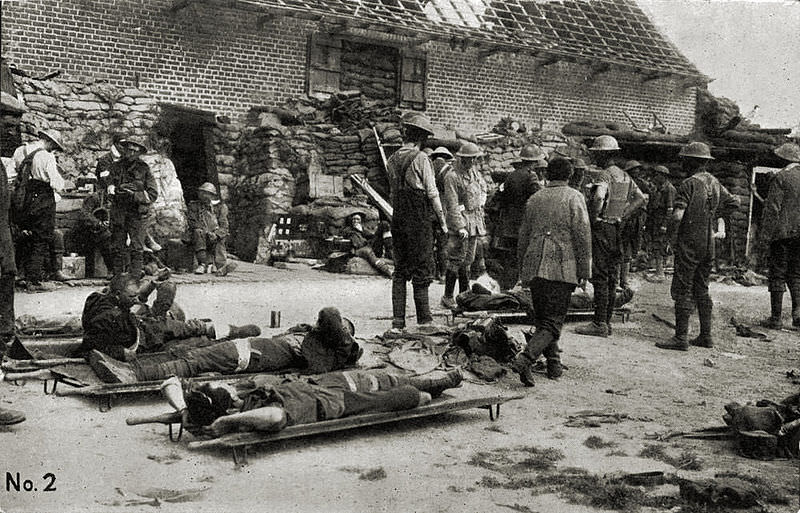
FIELD DRESSING STATION, MESSINES 7th June 1917.

Thomas was Wounded in Action during this action whist with the 3rd Division Headquarters where he received a Gun Shot Wound to his Right Shoulder and was treated at the field Dressing Station before he was evacuated to Estaples the next day. Thomas embarked for England on the 10th of June on board the Hospital Ship S.S. "Pieter de Connick" disembarking in England the same day.

S.S. Pieter de Connick

Hospital Ship. S.S. "Pieter de Connick"

Thomas was admitted to the Reading war Hospital where he remained until his discharge on the 30th of July where he was transferred to Perham Downs before again proceeding overseas for France on the 10th of August 1917. After disembarking at Harve the next morning Thomas went into Billets until he was marched out on the 14th of August to rejoin his unit which he did on the 16th of August.

12th October 1917.

As for the Australians, of the two Battalions that Monash had now ordered to participate, the 39th had already to a large extent been involved in the fighting, and the 33rd, endeavouring to reach its position of readiness for outflanking Passchendaele, had suffered great loss. No less than 6 of its Officers were killed or mortally wounded. Captain: Wilfred Frank HINTON in command of the forward company, Lieutenant: Leonard Rockley BROWNLOW  Lieutenant: Thomas Acheson ARMSTRONG   Lieutenant: Albert George KILPATRICK  Lieutenant: William REES-REYNOLDS and Lieutenant: Norman Francis GOBLE.

(BEAN; History of World War 1, Vol IV page 921)  Charles Edwin Woodrow BEAN

12th October 1917.

THE BATTLE OF PASSCHENDAELE I

At 1:30 am rain showers began. By 2:30 am it was raining lightly but steadily, by 3:30 fairly heavily. the infantry moved through the pitch dark in single file. In some battalions each man held on to the equipment of the man ahead of him; if touch was broken, those in front had to come back. The news that the line as reported by the 66th division was not held only just reached the incoming troops. Accordingly, in the right brigade (9th) the leading Company Commanders Captain: Clarence Smith JEFFRIES. V.C. and Captain: Telford Graham GILDER M.C. both of the 34th Battalion stopped their men at the entrance to Broodseinde railway cutting, and themselves went to make sure that their column might not run into the enemy.

At Keerselaarhoek Cemetery they found the tape duly laid, and met the officer of the 36th Battalion who had laid it, and by 3:00 am the time set, the 34th battalion was extended on its jumping-off position. But during the previous halt and afterwards, as it lay on the tape, the battalion was persistently shelled and suffered many casualties.

The first shell killed three signallers. Lieutenant: Albert Leslie WATSON. a signal officer of the 34th Battalion, a brave and enterprising leader who also was at the head of the column was severely wounded and all his staff hit. After establishing a forward command post Lieutenant: Thomas Fraser BRUCE 36th Battalion was also killed. Lieutenant Colonel: John Alexander MILNE. 36th Battalion supervising the assembly was knocked down by a shell but continued to command. Captain, Chaplain: Charles MURPHY was also wounded.

(BEAN; History of World war 1 Vol IV p911) Charles Edwin Woodrow BEAN

Only one Australian Division, the 3rd, was wholly employed in the days offensive. but the division was to capture Passchendaele an in spite of the depressing conditions, it was eager to achieve the distinction of doing so. One unit carried the Australian flag, to be planted in Passchendaele, and although officers and men in general were not enthusiastic concerning such "stunts" the Commander-in-Chief had been informed, and had told General: MONASH that, when this flag was planted, the news would be immediately cabled to Australia.

Some keen spirits looked on the operation simply as a dash for Passchendaele. One young company commander of Monash's reserve battalion, the 33rd, in face of a strict prohibition, led on his company as soon as the barrage fell. Starting from a line 350 yards in rear of the general alignment, the 3rd Division was out of touch with its neighbours from the outset. The heavy shelling on the tapes had made orderly disposition there almost impossible, as German Machine-Guns, undisturbed by the barrage now opened immediately, no opportunity offered of restoring proper formation.

The 9th Brigade went forward in the utmost confusion and a terrible mix up as reported by Captain: Robert Derwent DIXON D.S.O 35th Battalion at 6:40 am and "Great Confusion" was the description given by Captain: Henry Vince CARR 35th Battalion. Even on the ridge, the mud was difficult, the hope, if there ever was one, of catching up before the quick barrage finished.

The 9th Infantry Brigade's intended direction lay not along the ridge and the Passchendeale road, but diagonally across them, and parallel to the railway, which most of the brigade could not see. As the jumping-off line was practically at right angles to the ridge, the brigade tendered to advance alone the heights. The Machine-Gun fire at the start came, on the 9th Brigade's right, from the ruined house near Defy Crossing; on its center from, "Hillside Farm"; and on its left from Augustus Wood.

The pillbox opposite the center was supported from the rear by a trench in which were Germans with Machine-Guns, and here occurred a delay which threatened to wreck to whole attack. it was not until an hour after the program time that these places were rushed by the neighbouring portion of the line under Captain: Henry Vince CARR and Captain: Robert Derwent DIXON. D.S.O of the 35th Battalion. The trench contained 35 Germans and 4 Machine-Guns. Part of the line was also held up by a pillbox close to Passchendaele road near the highest point of the ridge.

Here there was practically no shelter from attack, but Captain Clarence Smith JEFFRIES. V.C. of the 34th Battalion managed to organise a party, with Sergeant: 21 James BRUCE and another N.C.O Corporal: 2036 Vere Cummings STEVENSON and a dozen men, and outflanking it, charged the place from the rear, capturing 25 Germans and 2 Machine-Guns. These actions set free the advance. The pillbox captured by Captain Clarence Smith JEFFRIES. V.C. being not far short of the first objective, the 34th Battalion dug in there.

Great loss had been uncured; the 34th Battalion had only three officers left and there were wide gaps in the line. The right flank had swung far away from the railway, along which the 4th Division was attacking, but on the left Captain: Telford Graham GILDER M.C. of the 34th Battalion who had been wounded by a Machine-Gun bullet, but was carrying on found the 10th Brigade digging in slightly to his left under Captain: LATCHFORD, 38th Battalion, and fell back seventy yards to join it.

The Advance to the second objective was to begin at 8:25, the low clouds had opened, and fleecy cirrus with patches of blue were widening overhead and the sun had come out. The 9th Brigade had been so late in reaching the first objective that, while most of the 34th Battalion dug in, the 35th Battalion, allotted for the second phase, moved straight on. Standing on the Passchendaele road, Captain: Henry Vince CARR and Captain: Robert Derwent DIXON. D.S.O of the 35th Battalion endevoured to decide where the barrage then was; at first Carr thought it may be behind them, but finally decided that it was ahead.

The confusion at the start had split the brigade into mixed parties of all battalions and many of the 34th went on with the 35th, the main body of which, about 100 in all, now advanced along the south-eastern side of the ridge in order to catch the barrage. The hour was probably a little before that for the second advance. A German Machine-Gun in the gap between the brigade's right and the railway immediately opened with deadly effect.

Major: John Bruce BUCHANAN 36th Battalion, the senior forward officer was killed. At this critical juncture Captain: Clarence Smith JEFFRIES. V.C. of the 34th Battalion, again accompanied by Sergeant: 21 James BRUCE, led out a few men from the first objective and made for the gun. it was shooting in short bursts, and he was able to work up fairly close. Seizing a moment when it was firing to the north, he and his men rushed at it from the west. It was switched round, killing him, and sending his men to the ground.

But when its fire eased they worked round it, rushed the position, seized 25 Germans and 2 Machine-Guns. This gallant and effective action Captain: Clarence Smith JEFFRIES. V.C. was posthumously awarded the Victoria Cross for removing the chief danger to the advance along the crest, but as soon as the 35th Battalion crossed to the eastern side of the hill it became the target of a number of field and heavy guns which, from the hedges and other cover in various parts of the landscape, fired over open sights.

After passing a corpse on its right, the 35th Battalion settled down on what its officers took to be the second objective, although on the extreme right they were actually short of the first. Captain: Henry Vince CARR, now the senior officer on the spot, reported; 8:35. On objective, with about 100 Captain: Robert Derwent DIXON. DSO and three officers. Casualties 25 or 30 per cent. Captain: Henry Charles Dight CADELL M.C   Lieutenant: Charles Teesdale MAIN   Lieutenant: Keith Maitland DAY reported killed and Lieutenant: Frank HORNE   Lieutenant: Christopher Kyffin MEARS  Lieutenant: Charles John HENRY were wounded. Prisoners sent back 400-500. Contact on flanks uncertain, being heavily shelled.

Three posts were established under surviving officers, right Lieutenant: Norman Beade D'ARCY M.C centre Lieutenant: Joseph Francis ADAMS left Lieutenant: Harold Sydney WYNDHAM. In this brigade the battalion for the final objective was the 36th, and a report came along that it had gone through. Actually, it had advanced with the 35th, but, on the left, penetrated to the second objective, which bad been reconnoitered during the previous halt by the commander of the company Captain Robert Austin GOLDRICK. M.C.

He went up the road towards Passchendaele. The barrage, he said afterwards was no hindrance to him, although he left the line lying as close to it as possible "or where he thought it was." He was unable to detect the intensification of the barrage for the second phase, but led his men forward at the proper hour.

As no other battalion was there, he now established the line with its left on the road 600 yards from the church, about the point reached by the 66th Division's troops on October 9th. In front of the position Captain: Robert Austin GOLDRICK. M.C. and Lieutenant E.H FLEITER (39th Battalion) found hidden in a shell hole men of the 66th Division. One had a broken arm, the other trench-feet. They took the Australians at first for Germans. When reassured, "we knew the Australians would come," they said, 'We prayed hard."

From the direction of the church, which lay straight down the highway, no fire came. two Germans ran up the road and surrendered. South-east of the village, along the Moorslede road, were the Germans who seemed "very windy," and near the road two 5.9-inch howitzers began to blaze at the troops digging in.

The 9th Brigade had taken its second objective and the 10th its first, but the position of the officers in charge of these advanced lines was full of anxiety. On the eastern slope Captain: Henry Vince CARR 35th Battalion, the senior officer in this part of the 9th Brigade's front, could see the 4th Division somewhat ahead of its right, and by 10:55 he had discovered that the 36th was on the left, but farther left than the 10th Brigade was far behind on its first objective . The German Guns ahead were sniping with dreadful accuracy. Carr on the western slope, sent back for instructions: "what am I to do?"

Word of the true situation reached headquarters slowly. As on the 9th, the first news was all encouraging. General: MONASH in the Ypres ramparts heard shortly after 7 that both brigades were "well away"; but by 8:26 he had ample evidence that the first objective was taken. At 9:25 the intelligence officer examining prisoners (Lieutenant: Frederick Morley CUTLACK Official War Correspondent) reported having heard from the wounded men that the second objective had been reached.

At 10:28 headquarters was informed of a statement of a wounded man, that the 38th Battalion had gone through. A further report that Australians had been seen at Crest Farm although quickly contradicting but probably true nevertheless. Which confirmed Monash's impression that his division was succeeding. Concerning the New Zealand brigade on his left, however, there was no word until, at 10:50, there arrived the tragic information that the New Zealand Division was stopped by the enemy alone the entire front.

Monash has already heard at 9:55 that the 10th Brigade was held up by fire from Bellevue Spur. Believing that his division was still advancing, he asked that every gun that the New Zealand Division could spare should be turned upon that ridge to suppress the fire. Meanwhile, he would order the reserve (39th) battalion of the 10th Brigade to be ready to assist in holding the ground already won. The reserve battalion the (33rd) of the 9th Brigade he was still keeping back to assist in the capture of Passchendaele.

Shortly after noon news of the true situation arrived. Lieutenant Jackson of the 40th Battalion had established at Waterfields pillbox near the Ravebeek a forward report-centre from which a series of messages, admirably accurate, was flashed by lamp to the headquarters of Lieutenant Colonel Lord of the 40th Battalion. Thus Brigadier General McNicoll of the 10th Brigade was able to inform Monash of the precise position of Giblin's Line. He added that the situation was very serious and the casualties very heave. At the same time from the front line of the 9th Brigade arrived a pigeon message, sent by Captain: Richard GADD of the 36th Battalion.

We are on the Blue Line (second objective) with composite force all three battalions, both flanks in the air.

The New Zealand Division was to make a second attempt at 3:00 pm, and Monash was of the opinion that from the 9th Brigade, well forward on the ridge, patrols might still work northward around Crest Farm. His reserve, the 33rd Battalion (9th Brigade), was accordingly ordered to attempt this at 4:30 pm and the 10th Brigade's forward line being meanwhile reinforced by its own reserve, the 39th Battalion.

These orders went out, but none of them were fulfilled. The New Zealand Division had been defeated by obstacles which no hastily renewed bombardment could have overcome. no infantry in the world could have crossed the Ravebeek mud, penetrated the dense wire, and attacked the crowded pillboxes of Bellview with the assistance of a barrage which did not even screen the advance. No blame can attach to the artillery. Its commander, according to the New Zealand official history, had reported on the previous day that his guns might be unable to give efficient support.

This magnificent division, which lost nearly 3,000 men, had been held up in almost exactly the same position as the 49th three days before-the left brigade penetrating half-way to the first objective, the right stopped almost at the start. The Germans were reinforcing. The New Zealand battalion commanders knew that their men had no chance of succeeding by renewed attack, and the order was eventually cancelled.

As for the Australians, of the two battalions that MONASH had now ordered to participate, the 39th had already to a large extent been involved in the fighting, and the 33rd, endevouring to reach its position of readiness for outflanking Passchendaele, had suffered great loss. No less than 6 of its Officers were killed or mortally wounded. Captain: Wilfred Frank HINTON in command of the forward company, Lieutenant Leonard Rockley BROWNLOW  Lieutenant: Thomas Acheson ARMSTRONG   Lieutenant: Albert George KILPATRICK  Lieutenant William REES-REYNOLDS and Lieutenant: Norman Francis GOBLE.

By the time Lieutenant Colonels Henderson DSO 39th Battalion and MORSHEAD attempted to carry Monash's orders, they found that the attacking force of both brigades was back almost at its starting point. What had happened was as follows.

Neither Major: GIBLIN near the Ravenbeek nor Captain: Henry Vince CARR on the ridge had received their messages sent several hours earlier. The 9th Brigade's line was still being battered by the German Guns. Captain: Richard GADD 36th Battalion, whose troops were being wiped out, informed Captain: Henry Vince CARR 35th Battalion that Lieutenant Colonel: John Alexander MILNE D.S.O 36th Battalion had now come forward to Hillside Farm. CARR accordingly sent Captain: Robert Derwent DIXON. D.S.O with GADD to explain to Milne the desperate nature of their situation. Milne said that he would try to get their troops relieved after dark, but till relieved they must hold on.

(BEAN; History of Word War 1 Vol IV page 921) Charles Edwin Woodrow BEAN

Meanwhile, however, the German artillery was annihilating some parts of their line. All leaders of Carr's three posts were out of action. Lieutenant: Joseph Francis ADAMS was Killed in Action and Lieutenant: Norman Beade D'ARCY M.C and Lieutenant: Harold Sydney WYNDHAM were wounded. Of the remaining officers of the 36th Battalion, Major: John Bruce BUCHANAN and Lieutenant: Fredrick William PUTNEY had been Killed in Action and Captain: Robert Austin GOLDRICK M.C wounded. Farther back Lieutenant: Sydney COOK had been Killed in Action and Lieutenant: William WAND and Lieutenant: Herbert Reginald MAILER were wounded.

At 3 o'clock rain began to fall steadily. at 3:15 pm Captain: Richard GADD 36th Battalion, thought agreeing with  Captain: Henry Vince CARR 35th Battalion that to hold on meant annihilation, refused, in view of his Colonel's orders, to retire. Carr consented to wait while Gadd again sent word to Lieutenant Colonel: John Alexander MILNE D.S.O. Carr himself at 12: 30 had sent Captain Robert Derwent DIXON.  D.S.O to the headquarters of the 35th Battalion at " Seine", from which no word had been received all day.

At 3:45 pm, no reply having come from Milne, and Dixon not having returned as he had been kept at 35th Battalion headquarters awaiting the arrival of an order from brigade headquarters concerning the projected operation by the reserve battalion, Gadd agreed to withdraw and Carr sent along the line a note: The 35th Battalion will retire.

When visiting Gadd, Carr had warned the troops of the probable order to withdraw, and he now saw that the left had already begun to retire. He told men whom he passed to get back as fast as they could to the 34th Battalion (which he believed to be on the first objective). Captain: William James GORDON M.C 36th Battalion, strongly dissatisfied with the order, went straight to Lieutenant Colonel: John Alexander MILNE D.S.O urged that the forward position was tenable, and with Milne and Major: John Martin HAWKEY M.C rushed out to stop the withdrawal. But it was too late.

The 34th was not, as Captain: Henry Vince Carr 35th Battalion, believed, on the first objective. The Commander of the line, Captain: John William RICHARDSON 34th Battalion, on hearing of the extreme weakness of the force at the second objective, had reinforced it. He and his only remaining officer's Lieutenant: James Clement BURGES  Lieutenant: Bruce Gray McKENZIE   Lieutenant: John Abbott LONGWORTH had all been Killed in Action while organizing on the first objective, and the first objective now lay empty. The retiring troops, being without orders as to the position to be taken up, streamed back past Milne's headquarters.

All that Hawkey, Gordon, Gadd, and others could then do was to lead a fraction of them forward again to the first objective, where they remained during the night. Captain: Robert Derwent DIXON.  D.S.O. with Captain: John Grieve PATERSON adjutant of the 35th, went up to organize the 35th there, but could find none of it's men. When eventually re-formed the remnant of the 35th was temporarily attached as a Company to the 33rd Battalion.

9th-12th October 1917 saw the 3rd Division, 9th and 10th Infantry Brigade in action during the Battle of Passchendaele, which saw massive losses and suffering in the Australian ranks. The casualties numbered 3,199 men in 24 hours during the height battle. The 34th Battalion lost every officer that day, either killed or wounded including their Medical Officer, Major: Gother Robert Carlisle CLARKE and some of his staff were killed while dressing the wounded. The spirit of some of the wounded is illustrated by the case of Corporal: 3170 Winsleigh Alexander MURRAY   35th Battalion, (formerly a Methodist Minister from Newcastle) gave up his place in a queue waiting for stretcher bearers and was never heard of again.

The Battle of Passchendaele saw 60 Officers and 1,322 other ranks loose their lives.

9th Infantry Brigade Casualties.

33rd Battalion. AIF 11 Officers 273 Other ranks
34th Battalion. AIF 15 Officers 323 Other ranks
35th Battalion. AIF 18 Officers 296 Other ranks
36th Battalion. AIF 15 Officers 383 Other ranks
9th Machine Gun Company. AIF 1 Officer 36 Other ranks
9th Light Trench Mortar Battery. - Officer 11 Other ranks

Thomas was Killed in Action at Passchendaele, Belgium on the 12th of October 1917 and is remembered with honour and is commemorated in perpetuity by the Commonwealth War Graves Commission, Ypres (Menin Gate) Memorial Belgium.

MENIN GATE WAR MEMORIAL

Family Information

Thomas was a single 24 year old University Student and served with the Sydney University Scouts and the 26th Infantry Militia prior to his enlistment with the AIF. His parents lived at Bolden, Mackay, Queensland. Thomas was Commissioned with the 26th Infantry Regiment

Military Records

World War 1 RecordsWorld War 1 RecordsWorld War 1 RecordsWorld War 1 RecordsWorld War 1 RecordsWorld War 1 RecordsWorld War 1 RecordsWorld War 1 RecordsWorld War 1 RecordsWorld War 1 RecordsWorld War 1 RecordsWorld War 1 RecordsWorld War 1 RecordsWorld War 1 RecordsWorld War 1 RecordsWorld War 1 RecordsWorld War 1 RecordsWorld War 1 RecordsWorld War 1 RecordsWorld War 1 RecordsWorld War 1 RecordsWorld War 1 RecordsWorld War 1 RecordsWorld War 1 RecordsWorld War 1 RecordsWorld War 1 RecordsWorld War 1 RecordsWorld War 1 RecordsWorld War 1 RecordsWorld War 1 RecordsWorld War 1 RecordsWorld War 1 RecordsWorld War 1 RecordsWorld War 1 RecordsWorld War 1 RecordsWorld War 1 RecordsWorld War 1 RecordsWorld War 1 RecordsWorld War 1 RecordsWorld War 1 RecordsWorld War 1 RecordsWorld War 1 RecordsWorld War 1 RecordsWorld War 1 RecordsWorld War 1 RecordsWorld War 1 RecordsWorld War 1 Records

© Commonwealth of Australia (National Archives of Australia)

Under Construction; 28/09/2006-14/02/2026.


Captain: 2390 Wilfred Frank HINTON

18th BATTALION - 33rd BATTALION AIF

Captain: 2390 Wilfred Frank HINTON.


Born: 1887. Wagga Wagga, New South Wales. Birth Cert: 28553/1887

Died: 13th October 1917. Killed in Action Passchendaele, Belgium.


Father: William George Hinton. (1853-1925) Died at Wagga Wagga, New South Wales, Australia. 

Mother: Mary Grace Hinton. nee: Beeson. (1859-1944) Died at Chatswood via Sydney, New South Wales, Australia.


INFORMATION

Wilfred Frank Hinton enlisted on the 31st of July 1915 and was allocated to the 5th reinforcements 18th Battalion but was transferred to D Company 33rd Battalion AIF with the rank of Lieutenant and was an original member of the battalion. He left Sydney on board HMAT A74 "Marathon" on the 4th of May 1916. Wilfred was promoted to the rank of Captain. He was in Command of Forward Company 33rd Battalion when Wounded in Action.

27th October 1917.

Informant; Private: 2922 Victor Harold MACKIE I have heard Captain: Wilfred Frank HINTON (33rd Battalion A Company) speak about Captain: Charles Henry LINKLATER (33rd Battalion C Company) who was missing one night. Some of our men went out to take a strong point and got into difficulties. Captain: LINKLATER went out to find them and was lost. We all think he must be a prisoner. I was not there myself and can not give the date or place.

3rd Southern General Hospital, Cowley Section, Oxford.

Family Information

Wilfred was an single 28 year old Accountant from Wagga Wagga, New South Wales upon enlistment.

Military Records


© Commonwealth of Australia (National Archives of Australia)

Under Construction 24/09/2006-14/02/2026.


Private: 970 Donald Cranston MURRAY. M.M.

33rd BATTALION AIF

Corporal: 970 Donald Cranston MURRAY. M.M.


Born: 5th November 1881. Inverell, New South Wales, Australia. Birth Cert:19310/1881.

Died: 23rd July 1917. Killed in Action. Messines, Belgium.


Father: William Cranston Murray.

Mother: Mary Ann Murray.


INFORMATION

Donald Cranston Murray, C Company 33rd Battalion AIF at Armidale, N.S.W.

HMAT A74 "Marathon"

9th April 1917.

On the 9th the 33rd once again took over the front line, again at L'Epinette. They moved to Senninghem on the 12th where they were headquartered until the 25th. Then once again they were on the march, via Renescure and Pradelle to Armentieres, Where, on the 28th they gained a well earned rest. On the 21st May the men of the 33rd were moved to Le Touquet to Ploegsteert Wood for the usual working parties, trench maintenance being high on the agenda for the coming offensive. 

(Never a Backward Step; Edwards 1996)

Don was treated by the 11th Austrian Field Ambulance on the 1st of May where he was evacuated suffering from Influenza


7th June 1917.

THE BATTLE OF MESSINES

The 3rd Australian Divisions first major offensive was at Messines Ridge on the 7th June 1917. The Australian 3rd Division was a part of the II Anzac Corps which was allotted to the first assault. The 25th New Zealand, 3rd Australian Division with the 4th Australian Division in reserve. The 4th Division were battle hardened troops who had fought many major battles.The 3rd Australian Division were having problems getting to the "jump off" point. The day before the 9th and 10th Infantry Brigades were bombarded by German Gas-Shells around Hill 63 and Ploegsteert Wood. Many of the Aussies were not wearing gas masks, but despite this they pressed on even though they received 500 casualties.

They made it to the "jump off" point but only just with some of the men from the 9th and 10th going straight over the top without stopping. The mines went up and the attack commenced behind a protective barrage. The II Anzac Corps were attacking on the right with their objective being the southern shoulder of the ridge which included Messines, the Dover and St Yves areas as far south to the east of Ploegsteert Wood.

Major General Sir John MONASH's 3rd Division had to contend with a tricky 3 mile approach out of Ploegsteert Wood and after the German gas attack, but they were not deterred. The 9th Infantry Brigade under Brigadier General: Alexander JOBSON and the 10th Infantry Brigade under Brigadier General W R NICHOLL had just made the jumping off point but some of the men did not stop, going straight into the assault from the approach march.

Their objective lay between St Yves and the Douve. The mines at Trench 127 and Trench 12 at Factory Farm were laid to aid this task. The explosions erupted a few seconds before zero hour and created craters of 200 feet in diameter, completely obliterating the German defense line as the 9th and 10th Infantry Brigades went over the top. The mine crates forced the 9th and 10th Brigades to veer to the left and right which caused some confusion with the main assault. It is testimony to the quality of training that every man knew the ground, tasks and objectives so well.

Private: 1804 John CARROLL 33rd Battalion, rushed the enemy's trench and bayoneted four of the German occupants. He then noticed a comrade in difficulties and went to his assistance, killing another German. He then attacked single handed a German Machine Gun Team, killing all three of them and capturing the gun. He later rescued two of his comrades who had been buried alive by German Shell Fire, and in spite of heavy shelling and machine gun fire he dug them out alive and saved them from certain death. John was awarded the Victoria Cross.

The German forward zone was completely engulfed and taken by the main assault. The two supporting battalions of each brigade then passed the leading battalion to continue the advance. The men were constantly re-supplied and the ridge was taken. There were many German prisoners taken during the offensive. The 3rd Division was well ahead with the 9th Infantry Brigade pushing on beyond Grey Farm, and on the right the 10th Infantry Brigade were veering left towards Septieme Barn north of Douve.

The German resistance was heavy but was generally brushed aside by tanks and artillery before the infantry had to become too involved.The 4th Bavarian Divisions Artillery had made little impact, but as the day wore on the 3rd Division and later the 4th Australian Division received many casualties from German artillery. (70% of all casualties during WW1 were from artillery).

By 9:00am nearly 6 hours after the assault began the Germans were in dissaray, but there was a major problem as the Australians received less casualties as anticipated and when ordered to dig into the ridge they had so many men, that some could not find shelter. the 35th battalion were dug in around Seaforth Farm.

The second phase of the operation was to take the Oosttaverne Line. The 3rd Australian Division would now be in reserve with the 4th Division attacking. The 9th Infantry Brigade (33-34-35-36Bn) were near Thatched Cottage facing Warneton. The river Lys was to their right and the Ploegsteert Wood was now behind them.

Once their objectives were taken the troops consolidated. A barrage to stop and counter attack was shortened and caught three battalions which had to retire. By 9:00 pm this part of the Oosttaverne Line was abandoned. At 10:45 pm General: Alexander John GODLEY ordered the 3rd and 4th Divisions to retake it. This they did by the early hours of the 8th of June.

The Battle for Messines Ridge during May-June 1917 saw 35 officers and 1,631 other ranks loose their lives.

9th Infantry Brigade Casualties.

33rd Battalion. AIF 8 Officers 382 Other ranks
34th Battalion. AIF 10 Officers 378 Other ranks
35th Battalion. AIF 5 Officers 431 Other ranks
36th Battalion. AIF 9 Officers 421 Other ranks
9th Machine Gun Company. AIF 2 Officer 17 Other ranks
9th Light Trench Mortar Battery. 1 Officer 2 Other ranks

Field Dressing Station, Messines 07/06/1917

FIELD DRESSING STATION, MESSINES 7th June 1917.

Recommended:  MILITARY MEDAL.

970 Private DONALD CRANSTON MURRAY - For conspicuous gallantry and devotion to duty during the Battle of Messines from June 7th to June 11th.  In the charge Private Murray's section leader was killed, and Murray immediately assumed command and led his party forward with considerable dash and courage.  He organised his men well and promptly got on with the consolidation. Throughout the heavy and constant shelling he kept his men well in hand, and his cheerfulness and coolness inspired them all with confidence.  On June 10th during a particularly heavy barrage when all available stretcher bearers were at work, he carried a man back to company headquarters heedless of all danger, and thereby saved his life.

12th June 1917

Nueve Eglise was the billeting area for the battle-weary remnants of the 33rd Battalion, when finally they were relieved from Messines on June 12th 1917. After 2 short days of rest they were again marched to new billets at Douleu, where they stayed for the next ten days. By then Command must have considered them sufficiently rested for they were ordered back into the front line, to relieve the 10th Cheshire Battalion on June 23rd.

(Never a Backward Step; Edwards 1996)

12th July 1917.

MESSINES Relieved 41st Battalion in Sector u.11.b to u-5-b as per Bn 0.0.47 d/9/7/17 and Intelligence summary d/127/17. Enemy Shelled road south of MESSINES and caught tail of relief Killing two. Two men killed and others wounded. Trenches found to be in very bad condition. They had been very badly sited no attention having been paid to conformation of ground. The first principles of trench siding had not been observed and no attention paid to drainage. Communication trenches were straight, shallow and through not having been duck boarded when dug had become quite impassable in places an account of mud. Front Line had rifle on us field of fire and both it and the Support line were crude observation from WARNETON from whence they were directly exploded in places.

(33rd Battalion War Diary)

Printed in ‘The Armidale Express & New England General Advertiser’, dated 25th Sep 1917 (transcribed by Bill Durrant – 15 Feb 2017)

The following are some extracts from a letter received by Mrs. W. C. Murray from, her son, Corpl. D. C. Murray, M.M., 33rd Battalion. The letter was written on June 17, a few weeks before the noble young hero was killed in action:

"We were in the thick of the fighting last week; l will give you a brief outline of the advance. We were all in our place, ready to hop over at 3 a.m. We had mines laid at intervals under Fritz’s line, with thousands of tons of explosives in them. They were all fired simultaneously, and I can tell you it was some explosion; the ground rocked like a boat, and the air was full of dust and clods. Then our artillery opened fire, and we got the signal to hop over. I can’t describe what it was like. I had not gone far when a shell exploded about three yards from me. I heard it coming, and dropped flat on the ground; by doing so I escaped, but was nearly choked with the fumes of it. I got going again, and then I saw a chap fall. I went over to him and found it was young Cliff Chaffey, from Moonbi, shot through the chest. The poor boy couldn’t speak, and I saw his case was hopeless; so I made him comfortable in a shell hole and went on. The enemy seemed half dazed, and I don't, wonder, for the artillery was terrific.

Some of the Fritz's were crying 'Mercy Kamarad’ but they had kept us cooped in wet and muddy trenches for six months and killed our mates, so we were not going to show them much mercy. I shot two at close range, and then found Jack Grattan with a bullet through his thigh. By this time we had reached our objective and started to dig in. We had to work at top speed, for Fritz's snipers were potting at us and he was shelling us for all he was worth, and that's where a lot of our boys got knocked. However, we got dug in and held the position for 96 hours until we were relieved. You may guess we were pretty weary, unshaven, and black with sweat and dust. The last night we were in we advanced another 1000 yards, rooting Fritz out of his new position. Our artillery is much superior to his now and we send over about ten shells to his one. I have been recommended for something I did in the push, and may get a medal; perhaps it was for carrying one of my wounded mates back to the dressing station, when we couldn't get a stretcher-bearer. My section came through the push with only one killed and one wounded; they were both good men. The one who is wounded got his eye knocked out. He is in England now, and I hope he gets back to Australia, for he has a wife and three children at Tingha.

In a later letter, dater 29th June, the young soldier says: You will be pleased to hear that I have won the Military Medal. I was presented with the ribbon yesterday, and will get the Medal later.
Mr. W. C. Murray, of ‘Twinbrook,' Bendemeer, has received the following information from Lieut.-Colonel Morshead, being an extract from routine order No. 320, dated 29tb June, 1917:

Corpl. Donald Cranston Murray — For conspicuous gallantry and devotion to duty during the battle of Messines Ridge, from the 7th to 11th June 1917. In the charge Corpl. Murray's section leader was killed, and Murray immediately assumed command and led his party forward with considerable dash and courage. He organised his men well and promptly got on with his consolidation. Throughout the heavy and constant shelling he kept his men well in hand, and his cheerfulness and coolness inspired them all with confidence. On June 10, during a particularly heavy barrage, when all available stretcher-bearers were at work, he carried a man back to headquarters, heedless of all danger, and thereby saved his life. The Corps Divisional and Brigade Commanders desire their congratulation conveyed to the recipient. The Commanding Officer also desires to congratulate the recipient." L. J. Morshead, Commanding, Lieut.-Col:
Dear Mr. Murray,—I wish to offer you my heartiest congratulation on your son's achievement. He did splendidly. -

L. J. Morshead.


Row C; Grave Number: 21A

Don is buried alongside Sergeant:769 Petrus FLICK who he tried to save on the 23rd July 1917.

Bethleem Farm West Cemetery, Messines, Belgium.

(Glennys Gow 2010)

Family Information

Don was a single 34 year old Grazier from Barraba, N.S.W. upon enlistment.

Brother; Private: 1028 James Henderson Murray. 1st Light Horse.

Hello David

Thanks for your response.  I'm not sure if you need any detail about my family member Donald Cranston Murray - if it is of any use below is what I submitted to the In Memories website of Pierre Vandervelden of Belgium:
http://www.inmemories.com/Cemeteries/bethleemwest.htm

Thank you for all your work, your site is quite remarkable.   It is wonderful to see images that would not be available otherwise and to be able to access so much detail.

In 2010 my late husband and I spent days driving ourselves around the Western Front battlefields so we could visit all the family graves/wall panels that we were aware of at the time (sadly, quite a number) - a deeply moving experience.  Given that he came from a property on the New England just out of Bendemeer, I took some comfort that Donald Cranston Murray's resting place is still a working farm.  If it had to be, that he lies in the middle of a paddock surrounded by a crop seems far more appropriate for a country fellow than a town cemetery.

Kind regards
Glennys Gow

November 2017.

https://www.aif.adfa.edu.au/showPerson?pid=219111

Bendemeer Cemetery; Memorial Plaque.

Military Records

Under Construction; -14/11/2017


Corporal: 2140 Frederick Arthur THURSTON. M.M and 2 BAR.

33rd BATTALION AIF

Corporal: 2140 Frederick Arthur THURSTON. M.M and 2 BAR.


Born: 24 September 1893. Summer Hill via Sydney, New South Wales, Australia.

Died: 30 August 1918. Killed in Action. near Mont St Quentin.


Father: James Thurston. (1861-1920)

Mother: Sophia Thurston. née: Ashworth. (1863-1942)


INFORMATION

Australian Dictionary of Biography Frederick Arthur Thurston

Posted 21 May 2008 by R. J & R.L Tindal

THURSTON, FREDERICK ARTHUR (1893-1918), clerk and soldier, was born on 24 September 1893 at Summer Hill, Sydney, second child of James Thurston, monumental mason, and his wife Sophia, née Ashworth, both English born. Employed as a clerk, Thurston enlisted in the Australian Imperial Force on 10 April 1916 and was posted as a reinforcement to the 33rd Battalion. He arrived in England on 11 October and joined his battalion, part of the newly formed 3rd Division. The 33rd reached France on 22 November and entered the line in the quiet sector at Chappelle d'Armentières. For the next few months it took part in raids on German positions and maintained its defences against determined counter-attacks. The trenches in the Armentières area were long established, but winter service was still harsh.

In June 1917 the battalion fought in the battle of Messines, Belgium. Thurston won the Military Medal for conspicuous bravery at Messines Ridge on 19 June during operations which cost his battalion 11 officers and 357 men. Soon after the battle he was appointed temporary corporal and on 4 July this rank was confirmed. On the 28th he was wounded in action near Messines and sent to hospital. He rejoined his unit, then at Campagne Lez Boulonnais, on 8 November and took part in the winter operations on the Somme, France. On 4-5 March 1918 he was a member of a party which raided trenches near Warneton. Thurston had charge of a Lewis-gun covering the deepest point of penetration of the German trench system. The enemy counter-attacked fiercely during the night; with carefully and coolly directed Lewis-gun fire, supported by rifle grenades and rifle fire, Thurston broke up the German attack, thus ensuring the safety of the raiding Australians. He was awarded a Bar to his M.M. for his gallantry during this operation.

A second Bar followed on 30 March during the counter-attack by the 33rd Battalion on the Marcelcave-Aubercourt line. Although badly wounded in the thigh, Thurston led his men forward through heavy machine-gun and rifle fire, refusing to be evacuated until his company had consolidated on recaptured ground. He resumed duty on 16 May and in July-August attended a course at an officer cadet unit. On 30 August 1918 he was killed in operations near Mont St Quentin. He was unmarried.

Thurston was a cheerful and optimistic leader whose steadfast qualities were an inspiration to his mates. In a few months of active campaigning he had been thrice decorated (with a rare combination of medals) and twice wounded. Death intervened to deny him the advancement in rank which his achievements would have warranted.

Military Medal

Service Number 2140 Service Army Rank Private Unit 33rd Bn Conflict First World War
Date of London Gazette16 August 1917, page 8428, position 127
Date of Commonwealth of Australia Gazette 20 December 1917, page 3378, position 96

Bar to Military Medal

Service Number 2140 Service Army Rank Corporal Unit 33rd Bn Conflict First World War
Date of London Gazette 25 April 1918, page 5031, position 1

Date of Commonwealth of Australia Gazette 7 August 1918, page 1657, position 36

2nd Bar to Military Medal

Service Number 2140 Service Army Rank Corporal Unit 33rd Bn Conflict First World War
Date of London Gazette 29 August 1918, page 10109, position 3
Date of Commonwealth of Australia Gazette 2 January 1919, page 1, position 1
Frederick was Killed in Action on the 30th August 1918 and is remembered with honour and is commemorated in perpetuity by the Commonwealth War Graves Commission at the Peronne Communal Cemetery Extension/ War Memorial. Plot 4 Row P Grave 6. He was buried on the 2nd September 1918 by Reverend: Walter Emra BURKITT. 
PERONNE COMMUNAL CEMETERY EXTENSION / WAR MEMORIAL
Family Information
Frederick was a single 22 year old Clerk from Union Street, Tempe, N.S.W. upon his enlistment with the AIF.
Drawing by Frederick Arthur Thurston to his mother during the Great War.
The Dreamer 10th February 1917
10th February 1917
Military Records

Under Construction: 28/09/2021

Sergeant: 985 Clement Fairfax MORRISBY. M.M.

33rd BATTALION AIF.

Sergeant: 985 Clement Fairfax MORRISBY. M.M.


Born: 1898. Goulburn, New South Wales, Australia. Birth Cert:21363/1898.

Died: 4th September 1918. Died of Wounds Rouen, France.


Father: Cecil Du Cane Morrisby.

Mother: Louisa Matilda Morrisby. nee: Cottrell.


INFORMATION
Cecil Fairfax Morrisby enlisted with C Company, 33rd Battalion A.I.F on the 20th of December 1915 and was an original member of the Battalion. He left Sydney on board HMAT A74 "Marathon" on the 4th of May 1916 and disembarked at Devonpot, England on the 9th of July and was marched to Larks Hill. Cecil was Charged whilst at Larks Hill on the 15th of September for being Absent Without Leave for 3 Days from the 12th of September. He forfeited 10 Days Pay by Lieutenant Colonel: Leslie James MORSHEAD Commanding Officer of the 33rd Battalion.

Cecil proceeded overseas on the 21st of November 1916 for France and was Taken on Strength in the field. Cecil injured his right knee on the 24th of February 1917 and was treated at the 10th Australian Field Ambulance. He was sent back to the Rest Depot to recover and returned to the front line on the 21st of March. He was promoted to Lance Corporal on the 10th of April and then Corporal on the 2nd of June after Corporal: 867 Harry SHATWELL was Wounded in Action

Private: 911 John Thomas WYNN was promoted to Lance Corporal on the 13th of July 1917 after Clement was Wounded in Action; 1st occasion. on the 7th of June. The next day Lance Corporal John WYNN Died of Wounds. after his leg was amputated.

24th June 1917

MILITARY MEDAL
Corporal: 985 Clement Fairfax Morrisby, 33rd Battalion AIF

London Gazette 21st August 1917. Page 8647 Position 32.

Commonwealth of Australia Gazette 20th of December 1917. Page 3379 Position 8.

Cecil rejoined the 33rd on the 13th of July from ROUELLES and was again promoted to Sergeant after Sergeant: 842 Sidney Raymond NELSON was Wounded in Action on the 4th of August 1917. Cecil was Wounded in Action; 2nd occasion on the 17th of April 1918 after being Gassed and was sent to the Rest Depot at ROUEN on the 1st of May. He rejoined the 33rd on the 1st of June 1918 and remained in and out of action for the next 2 months.

Cecil was again Wounded in Action; 3rd occasion receiving a Gun-Shot Wound to the Head on the 31st of August but later whilst at the 3rd Stationary Hospital Died of Wounds and is buried at the St-Sever Cemetery at ROUEN.

TRIO TO MONT ST QUENTIN CASUALTY: Military Medal (GVR) Type 1; British War Medal 1914-18; Victory Medal 1914-19. 985 Cpl C.F.Morrisby, 33/Aust:Inf: on first medal, 985 Sgt. C.F.Morrisby 33 Bn. A.I.F. on last two medals. All medals impressed. Uncirculated. Place Bid Together with; 1. Mother's and Widow's Ribbon with two stars, no.26022 on reverse of suspender bar. 2. Memorial Plaque named to Clement Fairfax Morrisby. 3. St James Holy Bible, inside endorsed, 'Presented to/C Morrisby/Christmas 1911/All Saints S S Moree/Jas Brand/Supt'. 4. Church of England Common Prayer Hymns A & M, inside written, 'C.F.Morrisby/S.C.E.G.School/North Sydney/C.F.Morrisby/Auburn St./Moree./N.S.Wales'. 5. Booklet titled, 31 Views The Cities of Our Allies & Our Enemies, McCathies Ltd War Publications, souvenir of The Great War of 1914, printed in Australia by Marchant & Co Ltd. 6. Program for In Memoriam 'Order of Service' held at Commonwealth Parliament Houses, Thanksgiving Sunday, 17th November 1918 after signing of Armistice in memory of fallen Australian soldiers (last page missing). MM: LG 21/8/1917, p8647, posn 32; CAG 20/12/1917, p3379, posn 8. Mentioned in RO237 (21.3.17) 'for bravery and dashing and fearless behaviour in a raid on the night of the 24-25 Feb 1917.' Mentioned in RO312 (19.6.17) 'for conscientious bravery and gallantry in offensive 7-11/6/17.' Clement Fairfax Morrisby, age 18, station hand, born at Goulburn, NSW; Enl.20Dec1915 at Moree; Emb.04May1916 ex Sydney; L/Cpl 10Apr1917; Cpl 02Jun1917; T/Sgt 04Aug1917; Sgt 01Nov1917; WIA on three occasions the last time a GSW to the head on 31Aug1918 during fighting near Mont St Quentin; DOW 04Sep1918 at 3rd Stationery Hospital, Boulogne; In a report on his death, one of his fellow soldiers, Cpl H.H.Weekes, 976, 33Bn C Coy made the following statement, 'He was leading his men at the time he was hit; the enemy were in a trench about 30 yards in front. He was a good, game soldier.'; Buried at St Sever Cemetery Extension, Rouen. With research.

Family Information
Clement was a single 18 year old Station Hand from Moree upon enlistment with the AIF. His parents Cecil Du Cane and Louisa Matilda Morrisby were married in 1897 at Young, N.S.W. Marriage Cert:8797/1897 and had 4 children, 3 boys and 1 girl. Clement Fairfax Morrisby born 1898 at Goulburn, N.S.W. Birth Cert:21363/1898 and died 1918, France. Lesley Fairfax Morrisby born 1900 at Goulburn, N.S.W. Birth Cert:3363/1900. Phyllis Morrisby born 1901 at Goulburn, N.S.W. Birth Cert:12770/1901. Percy Fairfax Morrisby born 1902 at Goulburn, N.S.W. Birth Cert:22022/1902 and died 1902 at Goulburn, N.S.W. Death Cert:9211/1902.

Military Records


Australian National Archives

Under Construction; 16/10/2007-12/10/2021.


Lieutenant: 389 Clive Stanley CROWLEY. DCM

33rd BATTALION AIF

Lieutenant: 389 Clive Stanley CROWLEY. DCM


Born: 2nd August 1890. Bingara, New South Wales, Australia. Birth Cert:

Died: 25th June 1918. Died of Wounds, France.


Father: John Crowley. (1847-1925)

Mother: Alice Crowley. nee: Bridger. (1859-1949)


INFORMATION

Clive Stanley CROWLEY enlisted with the AIF on the 4th January 1916 and was allocated to B Company 33rd Battalion.

Private: 389 Clive Stanley CROWLEY - Private: 390 Arthur Burton CROWLEY - Private: 463 Norman Marshall KING. 33rd Battalion 1916.

Distinguished Conduct Medal.

For conspicuous gallantry and devotion to duty when in command of his platoon. He organised the consolidation and captured an advanced post and a field gun with great dash, afterwards holding the captured post under heavy shell fire and keeping his men well in hand by his cheerfulness and optimism.

'Commonwealth Gazette' No. 219.

Longeau British Cemetery

Longeau British Cemetery, Plot I, Row F, Grave No. 3. France.

Lieutenant: 389 Clive Stanley CROWLEY. DCM (1890-1918)

The Sydney Morning Herald LATE MR. J. CROWLEY. (1847-1925) 1st September 1925.

The estate of the late Mr. John Crowley. Grazier, of Cobbadah, who died on July 18 last, has, for probate purposes, been valued at £80,139, of which £17,656 represented realty. The testator, who was 78 years of age, left the whole of his property to his widow, children, and grandchildren.

LATE MR. J. CROWLEY.

Military Records

Under Construction: 23/12/1916-09/07/2021.