Lieutenant: 777 George Edward HODGES.

 34th BATTALION A.I.F.

Captain: 777 George Edward HODGES.


Born: 1895. Greta, New South Wales, Australia. Birth Cert:32697/1895.

Married: 1923 Rockdale, New South Wales, Australia. Marriage Cert:14213/1923.

Wife: Bartha M Hodges. nee: Love.

Died:


Father: William Alfred Hodges.

Mother: Phoebe E Hodges. nee Buck.


INFORMATION

George Edward Hodges served with the 14th Infantry Regiment before enlisting with C Company, 34th Battalion AIF and was an original member of the Battalion and left Sydney on board HMAT A20 "Hororata" on the 2nd May 1916 with the rank of Sergeant and was the Bandmaster of the Military Band. 

4th-5th April 1918

The First VILLERS-BRETONNEUX

The Strength of the 9th Infantry Brigade was about 2,250 but their casualties during the 2 days of fighting numbered 30 Officers and 635 men either killed in action or missing.

9th Infantry Brigade Casualties.4th-5th April 1918

33rd Battalion. AIF 3 Officers 82 Other ranks
34th Battalion. AIF 5 Officers 120 Other ranks
35th Battalion. AIF 9 Officers 282 Other ranks (including 44 missing)
36th Battalion. AIF 12 Officers 133 Other ranks (including 1 missing)
9th Machine Gun Company. AIF 1 Officer 18 Other ranks (including 4 missing)

Whilst here the Battalion was congratulated on its grand work in the attack on 4th April, by Major General: Sir John MONASH and Brigadier General: Charles ROSENTHAL. In addition to those already mentioned the following Officers, who were either gassed or wounded, were evacuated during April. Lieutenants:- Lieutenant: 4 Thomas Clifton PITTAWAY  Lieutenant: 777 George Edward HODGES Lieutenant: 714 Thomas BELLAMY. Lieutenant: Edgar Ernest BRUNKER. Lieutenant: Percy Warrick BEAUCHAMP  Lieutenant: Francis Henry Samuel LEE and Lieutenant: 1514 Frank William GIFFORD.

16th July 1918.

8:00 am. Trenches in very bad condition owing to continues rain. Wellington and Owl Trenches 2" to 2.6" of water. 10:55 am. Enemy put a heavy barrage 4.25 & 5.95 arraigned and along Wellington and Owl Trenches. No casualties but great deal of material damage to trenches Desultory fire continues all day. 2:00 pm to 6:00 pm. Our 4.5" Hows & 6" Hows were turned on to destroy 3 German Strong Points, which were causing considerable trouble to A Company and several casualties from bombs & small calibre Miner Werfers thrown into front line from these positions.

Arrangements had been made for a minor enterprise to capture these strong points at 10:00 pm tonight. At 9:00 pm the C.O rang up Brigade and informed the Brigadier that the artillery had failed to hit the strong points and requested that a minor operation be postponed. Instructions were received at 9:15 pm to go on with the enterprise. At 10:00 pm Lieutenant: Edward George HODGES and 45 men and 2 Lewis Guns attacked the Strong Points. Immediately this party left out trench, they were met with a barrage of Machine-Gun fire, bomb and grenades from the Strong points. The party pushed on with great determination until they came to CINEMA ROAD.

Here they were exposed to enfilade Machine-Gun fire, and found that the Strong Points were filled with the enemy standing shoulder to shoulder awaiting the attack. Lieutenant HODGES successfully arranged the withdrawal of his party under very difficult circumstances. At 10:58 pm Captain: Robert Joseph STEWART. reported the enemy heavily bombarding front support lines of A (Right) Company and there was early indications of an attack by the enemy. He fired the S.O.S. and our answering barrage prevented the development of the enemy's attack. Casualties for minor enterprise were Killed 2, Wounded 10.

(34th Battalion War Diary)

7th February 1919

MENTIONED in DISPATCHES

Major: Harry Lambert Edward Dixon WHEELER.  Lieutenant: George Edward HODGES Lieutenant: 108 Reginald Thomas KERSLAKE.

34th BATTALION AIF.

London Gazette 11th July 1919. Page Position .

Commonwealth of Australia Gazette 30th of October 1919. Page Position .

Captain of C Company 34th Battalion
Cessnock War Memorial

Cessnock War Memorial

Cessnock War Memorial

Family Information

George was a single 20 year old Coal Miner from High Street, Cessnock upon enlistment. He served with the 14th Infantry Militia prior to world War 1. His parents William and Phoebe Hodges were married in 1894 at Greta, N.S.W. Marriage Cert:3973/1894. 

Hodge Cousins pre World War 1

Military Records

World War 1 RecordsWorld War 1 RecordsWorld War 1 RecordsWorld War 1 RecordsWorld War 1 RecordsWorld War 1 RecordsWorld War 1 RecordsWorld War 1 RecordsWorld War 1 RecordsWorld War 1 RecordsWorld War 1 RecordsWorld War 1 RecordsWorld War 1 RecordsWorld War 1 RecordsWorld War 1 RecordsWorld War 1 RecordsWorld War 1 RecordsWorld War 1 Records

© Commonwealth of Australia (National Archives of Australia)

Under Construction 26/07/2007-29/05/2024.


Lieutenant: James Clement BURGES.

34th BATTALION A.I.F.

Lieutenant: James Clement BURGES.


Born: 8th July 1875. Parkes, New South Wales, Australia. Birth Cert: 10989/1875

Married: 1899. Glebe, New South Wales, Australia. Marriage Cert: 1042/1899

Wife: Jessie "Mina" W.A. Burges. nee: Thompson.

Died: 12 of October 1917. Killed in Action Passchendaele, Belgium


Father: Richard Burges.

Mother: Margaret Teresa Burges. nee:.


INFORMATION

James Clement Burges enlisted with the 6th Reinforcements, 34th Battalion AIF on the 25th of July 1916 and left Sydney on board HMAT A72 "Beltana" on the 25th of November 1916 and disembarked at Devonport, England on the 29th of January 1917. James continued his training with the 9th Training Battalion at the Durrington Army Camp at Larks Hill and was sent to the Range Finding School at Kayling Island on the 23rd of April 1917. James proceeded overseas for France on the 24th of August and was Taken on in Strength in the field with the 34th Battalion. James was Killed in Action during action at Passchendaele, Belgium on the 12th of October 1917.

12th October 1917

The 34th was not, as Captain: Henry Vince CARR 35th Battalion, believed, on the first objective. The Commander of the line, Captain: John William RICHARDSON 34th Battalion, on hearing of the extreme weakness of the force at the second objective, had reinforced it. He and his only remaining officer's Lieutenant: James Clement BURGES, Lieutenant: Bruce Gray McKENZIE , and Lieutenant: John Abbott LONGWORTH had all been Killed in Action while organising on the first objective, and the first objective now lay empty.

(BEAN; History of World War 1 Vol IV page 922) Charles Edwin Woodrow BEAN

12th October 1917

THE BATTLE OF PASSCHENDAELE II

At 1:30 am rain showers began. By 2:30 am it was raining lightly but steadily, by 3:30 fairly heavily. the infantry moved through the pitch dark in single file. In some battalions each man held on to the equipment of the man ahead of him; if touch was broken, those in front had to come back. The news that the line as reported by the 66th division was not held only just reached the incoming troops. Accordingly, in the right brigade (9th) the leading Company Commanders Captain: Clarence Smith JEFFRIES. V.C. and Captain: Telford Graham GILDER M.C. both of the 34th Battalion stopped their men at the entrance to Broodseinde railway cutting, and themselves went to make sure that their column might not run into the enemy.

At Keerselaarhoek Cemetery they found the tape duly laid, and met the officer of the 36th Battalion who had laid it, and by 3:00 am the time set, the 34th battalion was extended on its jumping-off position. But during the previous halt and afterwards, as it lay on the tape, the battalion was persistently shelled and suffered many casualties.

The first shell killed three signallers. Lieutenant: Albert Leslie WATSON. a signal officer of the 34th Battalion, a brave and enterprising leader who also was at the head of the column was severely wounded and all his staff hit. After establishing a forward command post Lieutenant: Thomas Fraser BRUCE 36th Battalion was also killed. Lieutenant Colonel: John Alexander MILNE. 36th Battalion supervising the assembly was knocked down by a shell but continued to command. Captain, Chaplain: Charles MURPHY was also wounded.

(BEAN; History of World war 1 Vol IV p911) Charles Edwin Woodrow BEAN

Only one Australian Division, the 3rd, was wholly employed in the days offensive. but the division was to capture Passchendaele an in spite of the depressing conditions, it was eager to achieve the distinction of doing so. One unit carried the Australian flag,to be planted in Passchendaele, and although officers and men in general were not enthusiastic concerning such "stunts" the Commander-in-Chief had been informed, and had told General: MONASH that, when this flag was planted, the news would be immediately cabled to Australia.

Some keen spirits looked on the operation simply as a dash for Passchendaele. One young company commander of Monash's reserve battalion, the 33rd, in face of a strict prohibition, led on his company as soon as the barrage fell. Starting from a line 350 yards in rear of the general alignment, the 3rd Division was out of touch with its neighbours from the outset. The heavy shelling on the tapes had made orderly disposition there almost impossible, as German Machine-Guns, undisturbed by the barrage now opened immediately, no opportunity offered of restoring proper formation.

The 9th Brigade went forward in the utmost confusion and a terrible mix up as reported by Captain: Robert Derwent DIXON D.S.O 35th Battalion at 6:40 am and "Great Confusion" was the description given by Captain: Henry Vince CARR 35th Battalion. Even on the ridge, the mud was difficult, the hope, if there ever was one, of catching up before the quick barrage finished.

The 9th Infantry Brigade's intendered direction lay not along the ridge and the Passchendeale road, but diagonally across them, and parallel to the railway, which most of the brigade could not see. As the jumping-off line was practically at right angles to the ridge, the brigade tendered to advance alone the heights. The Machine-Gun fire at the start came, on the 9th Brigade's right, from the ruined house near Defy Crossing; on its centre from, "Hillside Farm"; and on its left from Augustus Wood.

The pillbox opposite the centre was supported from the rear by a trench in which were Germans with Machine-Guns, and here occurred a delay which threatened to wreck to whole attack. it was not until an hour after the programme time that these places were rushed by the neighbouring portion of the line under Captain: Henry Vince CARR and Captain: Robert Derwent DIXON. D.S.O of the 35th Battalion. The trench contained 35 Germans and 4 Machine-Guns. Part of the line was also held up by a pillbox close to Passchendaele road near the highest point of the ridge.

Here there was practically no shelter from attack, but Captain Clarence Smith JEFFRIES. V.C. of the 34th Battalion managed to organise a party, with Sergeant: 21 James BRUCE and another N.C.O Corporal: 2036 Vere Cummings STEVENSON and a dozen men, and outflanking it, charged the place from the rear, capturing 25 Germans and 2 Machine-Guns. These actions set free the advance. The pillbox captured by Captain Clarence Smith JEFFRIES. V.C. being not far short of the first objective, the 34th Battalion dug in there.

Great loss had been uncured; the 34th Battalion had only three officers left and there were wide gaps in the line. The right flank had swung far away from the railway, along which the 4th Division was attacking, but on the left Captain: Telford Graham GILDER M.C.of the 34th Battalion who had been wounded by a Machine-Gun bullet, but was carrying on found the 10th Brigade digging in slightly to his left under Captain: LATCHFORD, 38th Battalion, and fell back seventy yards to join it.

The Advance to the second objective was to begin at 8:25, the low clouds had opened, and fleecy cirrus with patches of blue were widening overhead and the sun had come out. The 9th Brigade had been so late in reaching the first objective that, while most of the 34th Battalion dug in, the 35th Battalion, allotted for the second phase, moved straight on. Standing on the Passchendaele road, Captain: Henry Vince CARR and Captain: Robert Derwent DIXON. D.S.O of the 35th Battalion endevoured to decide where the barrage then was; at first Carr thought it may be behind them, but finally decided that it was ahead.

The confusion at the start had split the brigade into mixed parties of all battalions and many of the 34th went on with the 35th, the main body of which, about 100 in all, now advanced along the south-eastern side of the ridge in order to catch the barrage. The hour was probably a little before that for the second advance. A German Machine-Gun in the gap between the brigade's right and the railway immediately opened with deadly effect.

Major: John Bruce BUCHANAN 36th Battalion, the senior forward officer was killed. At this critical juncture Captain: Clarence Smith JEFFRIES. V.C. of the 34th Battalion, again accompanied by Sergeant: 21 James BRUCE, led out a few men from the first objective and made for the gun. it was shooting in short bursts, and he was able to work up fairly close. Seizing a moment when it was firing to the north, he and his men rushed at it from the west. It was switched round, killing him, and sending his men to the ground.

But when its fire eased they worked round it, rushed the position, seized 25 Germans and 2 Machine-Guns. This gallant and effective action Captain: Clarence Smith JEFFRIES. V.C.was posthumously awarded the Victoria Cross for removing the chief danger to the advance along the crest, but as soon as the 35th Battalion crossed to the eastern side of the hill it became the target of a number of field and heavy guns which, from the hedges and other cover in various parts of the landscape, fired over open sights.

After passing a corpse on its right, the 35th Battalion settled down on what its officers took to be the second objective, although on the extreme right they were actually short of the first. Captain: Henry Vince CARR, now the senior officer on the spot, reported; 8:35. On objective, with about 100 Captain: Robert Derwent DIXON. DSO and three officers. Casualties 25 or 30 per cent. Captain: Henry Charles Dight CADELL M.C   Lieutenant: Charles Teesdale MAIN   Lieutenant: Keith Maitland DAY reported killed and Lieutenant: Frank HORNE   Lieutenant: Christopher Kyffin MEARS  Lieutenant: Charles John HENRY were wounded. Prisoners sent back 400-500. Contact on flanks uncertain, being heavily shelled.

Three posts were established under surviving officers, right Lieutenant: Norman Beade D'ARCY M.C center Lieutenant: Joseph Francis ADAMS left Lieutenant: Harold Sydney WYNDHAM. In this brigade the battalion for the final objective was the 36th, and a report came along that it had gone through. Actually, it had advanced with the 35th, but, on the left, penetrated to the second objective, which bad been reconnoitered during the previous halt by the commander of the company Captain Robert Austin GOLDRICK. M.C.

He went up the road towards Passchendaele. The barrage, he said afterwards was no hindrance to him, although he left the line lying as close to it as possible "or where he thought it was." He was unable to detect the intensification of the barrage for the second phase, but led his men forward at the proper hour.

As no other battalion was there, he now established the line with its left on the road 600 yards from the church, about the point reached by the 66th Division's troops on October 9th. In front of the position Captain: Robert Austin GOLDRICK. M.C. and Lieutenant E.H FLEITER (39th Battalion) found hidden in a shell hole men of the 66th Division. One had a broken arm, the other trench-feet. They took the Australians at first for Germans. When reassured,"we knew the Australians would come," they said, 'We prayed hard."

From the direction of the church, which lay straight down the highway, no fire came. two Germans ran up the road and surrendered. South-east of the village, along the Moorslede road, were the Germans who seemed "very windy," and near the road two 5.9-inch howitzers began to blaze at the troops digging in.

The 9th Brigade had taken its second objective and the 10th its first, but the position of the officers in charge of these advanced lines was full of anxiety. On the eastern slope Captain: Henry Vince CARR 35th Battalion, the senior officer in this part of the 9th Brigade's front, could see the 4th Division somewhat ahead of its right, and by 10:55 he had discovered that the 36th was on the left, but farther left than the 10th Brigade was far behind on its first objective . The German Guns ahead were sniping with dreadful accuracy. Carr on the western slope, sent back for instructions: "what am I to do?"

Word of the true situation reached headquarters slowly. As on the 9th, the first news was all encouraging. General: MONASH in the Ypres ramparts heard shortly after 7 that both brigades were "well away"; but by 8:26 he had ample evidence that the first objective was taken. At 9:25 the intelligence officer examining prisoners (Lieutenant: Frederick Morley CUTLACK Official War Correspondent) reported having heard from the wounded men that the second objective had been reached.

At 10:28 headquarters was informed of a statement of a wounded man, that the 38th Battalion had gone through. A further report that Australians had been seen at Crest Farm although quickly contradicting but probably true nevertheless. Which confirmed Monash's impression that his division was succeeding. Concerning the New Zealand brigade on his left, however, there was no word until, at 10:50, there arrived the tragic information that the New Zealand Division was stopped by the enemy alone the entire front.

Monash has already heard at 9:55 that the 10th Brigade was held up by fire from Bellevue Spur. Believing that his division was still advancing, he asked that every gun that the New Zealand Division could spare should be turned upon that ridge to suppress the fire. Meanwhile, he would order the reserve (39th) battalion of the 10th Brigade to be ready to assist in holding the ground already won. The reserve battalion the (33rd) of the 9th Brigade he was still keeping back to assist in the capture of Passchendaele.

Shortly after noon news of the true situation arrived. Lieutenant Jackson of the 40th Battalion had established at Waterfields pillbox near the Ravebeek a forward report-centre from which a series of messages, admirably accurate, was flashed by lamp to the headquarters of Lieutenant Colonel Lord of the 40th Battalion. Thus Brigadier General McNicoll of the 10th Brigade was able to inform Monash of the precise position of Giblin's Line. He added that the situation was very serious and the casualties very heave. At the same time from the front line of the 9th Brigade arrived a pigeon message, sent by Captain: Richard GADD of the 36th Battalion.

We are on the Blue Line (second objective) with composite force all three battalions, both flanks in the air.

The New Zealand Division was to make a second attempt at 3:00 pm, and Monash was of the opinion that from the 9th Brigade, well forward on the ridge, patrols might still work northward around Crest Farm. His reserve, the 33rd Battalion (9th Brigade), was accordingly ordered to attempt this at 4:30 pm and the 10th Brigade's forward line being meanwhile reinforced by its own reserve, the 39th Battalion.

These orders went out, but none of them were fulfilled. The New Zealand Division had been defeated by obstacles which no hastily renewed bombardment could have overcome. no infantry in the world could have crossed the Ravebeek mud, penetrated the dense wire, and attacked the crowded pillboxes of Bellview with the assistance of a barrage which did not even screen the advance. No blame can attach to the artillery. Its commander, according to the New Zealand official history, had reported on the previous day that his guns might be unable to give efficient support.

This magnificent division, which lost nearly 3,000 men, had been held up in almost exactly the same position as the 49th three days before-the left brigade penetrating half-way to the first objective, the right stopped almost at the start.The Germans were reinforcing. The New Zealand battalion commanders knew that their men had no chance of succeeding by renewed attack, and the order was eventually cancelled.

As for the Australians, of the two battalions that MONASH had now ordered to participate, the 39th had already to a large extent been involved in the fighting, and the 33rd, endevouring to reach its position of readiness for outflanking Passchendaele,had suffered great loss. No less than 6 of its Officers were killed or mortally wounded.Captain: Wilfred Frank HINTON in command of the forward company, Lieutenant Leonard Rockley BROWNLOW  Lieutenant: Thomas Acheson ARMSTRONG   Lieutenant: Albert George KILPATRICK  Lieutenant William REES-REYNOLDS and Lieutenant: Norman Francis GOBLE.

By the time Lieutenant Colonels Henderson DSO 39th Battalion and MORSHEAD attempted to carry Monash's orders, they found that the attacking force of both brigades was back almost at its starting point. What had happened was as follows.

Neither Major: GIBLIN near the Ravenbeek nor Captain: Henry Vince CARR on the ridge had received their messages sent several hours earlier. The 9th Brigade's line was still being battered by the German Guns. Captain: Richard GADD 36th Battalion, whose troops were being wiped out, informed Captain: Henry Vince CARR 35th Battalion that Lieutenant Colonel: John Alexander MILNE D.S.O 36th Battalion had now come forward to Hillside Farm. CARR accordingly sent Captain: Robert Derwent DIXON. D.S.O with GADD to explain to Milne the desperate nature of their situation. Milne said that he would try to get their troops relieved after dark, but till relieved they must hold on.

(BEAN; History of Word War 1 Vol IV page 921) Charles Edwin Woodrow BEAN

Meanwhile, however, the German artillery was annihilating some parts of their line. All leaders of Carr's three posts were out of action. Lieutenant: Joseph Francis ADAMS was Killed in Action and Lieutenant: Norman Beade D'ARCY M.C and Lieutenant: Harold Sydney WYNDHAM were wounded. Of the remaining officers of the 36th Battalion, Major: John Bruce BUCHANAN and Lieutenant: Fredrick William PUTNEY had been Killed in Action and Captain: Robert Austin GOLDRICK M.C wounded. Farther back Lieutenant: Sydney COOK had been Killed in Action and Lieutenant: William WAND and Lieutenant: Herbert Reginald MAILER were wounded.

At 3 o'clock rain began to fall steadily. at 3:15 pm Captain: Richard GADD 36th Battalion, thought agreeing with  Captain: Henry Vince CARR 35th Battalion that to hold on meant annihilation, refused, in view of his Colonel's orders, to retire. Carr consented to wait while Gadd again sent word to Lieutenant Colonel: John Alexander MILNE D.S.O. Carr himself at 12: 30 had sent Captain William Derwent DIXON.  D.S.O to the headquarters of the 35th Battalion at " Seine", from which no word had been received all day.

At 3:45 pm, no reply having come from Milne, and Dixon not having returned as he had been kept at 35th Battalion headquarters awaiting the arrival of an order from brigade headquarters concerning the projected operation by the reserve battalion, Gadd agreed to withdraw and Carr sent along the line a note: The 35th Battalion will retire.

When visiting Gadd, Carr had warned the troops of the probable order to withdraw, and he now saw that the left had already begun to retire. He told men whom he passed to get back as fast as they could to the 34th Battalion (which he believed to be on the first objective). Captain: William James GORDON M.C 36th Battalion, strongly dissatisfied with the order, went straight to Lieutenant Colonel: John Alexander MILNE D.S.O urged that the forward position was tenable, and with Milne and Major: John Martin HAWKEY M.C rushed out to stop the withdrawal. But it was too late.

The 34th was not, as Captain: Henry Vince Carr 35th Battalion, believed, on the first objective. The Commander of the line, Captain: John William RICHARDSON 34th Battalion, on hearing of the extreme weakness of the force at the second objective, had reinforced it. He and his only remaining officer's Lieutenant: James Clement BURGES  Lieutenant: Bruce Gray McKENZIE   Lieutenant: John Abbott LONGWORTH had all been Killed in Action while organising on the first objective, and the first objective now lay empty. The retiring troops, being without orders as to the position to be taken up, streamed back past Milne's headquarters.

All that Hawkey, Gordon, Gadd, and others could then do was to lead a fraction of them forward again to the first objective, where they remained during the night. Captain: Robert Derwent DIXON.  D.S.O. with Captain: John Grieve PATERSON adjutant of the 35th, went up to organise the 35th there, but could find none of it's men. When eventually re-formed the remnant of the 35th was temporarily attached as a Company to the 33rd Battalion.

9th-12th October 1917 saw the 3rd Division, 9th and 10th Infantry Brigade in action during the Battle of Passchendaele, which saw massive losses and suffering in the Australian ranks. The casualties numbered 3,199 men in 24 hours during the height battle. The 34th Battalion lost every officer that day, either killed or wounded including their Medical Officer, Major: Gother Robert Carlisle CLARKE and some of his staff were killed while dressing the wounded. The spirit of some of the wounded is illustrated by the case of Corporal: 3170 Winsleigh Alexander MURRAY   35th Battalion, (formerly a Methodist Minister from Newcastle) gave up his place in a queue waiting for stretcher bearers and was never heard of again.

The Battle of Passchendaele saw 60 Officers and 1,322 other ranks loose their lives.

9th Infantry Brigade Casualties.

33rd Battalion. AIF 11 Officers 273 Other ranks
34th Battalion. AIF 15 Officers 323 Other ranks
35th Battalion. AIF 18 Officers 296 Other ranks
36th Battalion. AIF 15 Officers 383 Other ranks
9th Machine Gun Company. AIF 1 Officer 36 Other ranks
9th Light Trench Mortor Battery. - Officer 11 Other ranks


MENTIONED in DISPATCHES

For conspicuous gallantry and devotion to duty, these officers were KILLED in the battle of YPRES on the 12th of October 1917 one and a half hours before ZERO. The Battalion was subjected to heavy enemy artillery fire. These Officers displayed great courage and a splendid example to their men by their coolness and courage they led their platoons forward to the attack and although exposed to enemy gun fire, organized the digging in of their units until KILLED.

Lieutenant: Bruce Gray McKENZIE. 34th Battalion AIF.

Lieutenant: John Abbott LONGWORTH. 34th Battalion AIF.

Lieutenant: James Clement BURGES. 34th Battalion AIF.

James is remembered with honour and is commemorated in perpetuity by the Commonwealth War Graves Commission at Ypres (Menin Gate) Memorial Belgium.

Menin Gate War Memorial

MENIN GATE WAR MEMORIAL

Family Information.

James was married 41 year old School Teacher from Lawes Street, East Maitland, New South Wales. His wife Mina lived at 19 wetherall Street, Croydon, New South Wales after the war. He served as captain with the Junior Cadets from 1897-1902 & 1906-1911 and Captain of the Senior Cadets from 1911-1916 14th Infantry Militia as Commanding Officer. Captained the Winning Company, Senior Cadets (East Maitland High School, where he was French Master), in the Brigade Championship, 1911-12, 1912-13

Military Records

Australian National Archives

Under Construction; 30/09/2006-03/08/2017.


Captain: Ray WOLSTENHOLME.

34th BATTALION A.I.F.

Captain: Ray WOLSTENHOLME.


Born: 28th April 1894. Maitland, New South Wales, Australia. Birth Cert:19939/1894.

Defacto: Elizabeth Humphries.

Died: 3rd October 1943. Tamworth, New South Wales, Australia. Death Cert:31047/1943.


Father: James Wolstenholme. (1842-1910)

Mother: Ada Blanche Wolstenholme. nee: Markwell. (1861-1940) Died, West Maitland, N.S.W. Death Cert:17767/1940.


INFORMATION

Ray Wolstenholme served with the 14th Infantry (Hunter Valley) prior to his enlistment with C Company, 34th Battalion AIF on the 30th April 1916 and was an original member of the Battalion. "Early training and formation of the Battalion was in progress. On that day the Battalion marched to the newly pitched camp at Rutherford and was completed with the exception of the Transport. These joined later and came from the Army Service Corps camp near Sydney. Here strenuous training was carried out. The men were very keen and fit, whilst their comfort and health were made a special study. Food was good and ample and sports and recreation were not overlooked.

A Girl's League was formed to cater for the comforts of the Battalion, under the supervision of Miss Violet MACKAY, who took a keen interest from the beginning, having, with the Mayor of Maitland met the men of the Wallaby March at East Greta and prepared dinner for them on their arrival. On 1st May 1916, the Battalion left by Train from Farley Station for the Showground in Sydney, equipped with kit bags and necessary clothing, and was reviewed in Moore Park by General: Gustave Mario RAMACCOTTI. On the following morning, 2nd May 1916 the men embarked on the transport HMAT A20 "HORORATA" and sailed at 4:00 pm".

The voyage to England was without any unusual incidents and a good passage throughout. The first port of call was Albany, where three days were spent. Columbo was reached on Empire Day, 24th May. Here two days were taken up coaling and taking on provisions, etc. During the stay the Battalion carried out a route march through the town. Suez was reached on 8th June, where a party of Light Horse and some details were disembarked. Arriving at Port Said on 9th, the ship coaled and proceeded to Alexandria which was reached on 11th June 1916.

Here the Battalion transferred to S.S."Aragon", E867. Some Australian Details were on board, also a number of Tommie's going to England on Furlough. Devonport was reached on the 23rd June, the Battalion disembarked at Plymouth at 1:00 pm and en trained during the afternoon for Amesbury, arriving at midnight and marching to hutments at No: 1 Camp, Larkhill. Here the Battalion settled down to hard training, which included Route Marching, Trench Digging, Bomb Practice, Musketry and general Camp Routine. Later the Battalion moved to the No: 25 Camp and finished off their training, which included six days' battle practice and field work at the Bustard Trenches.

Four days' disembarkation leave was given from 6th to 10th July and later King's Leave from November 5th to 9th. Whilst here the Official Colours were issued. Purple over Green (Oval), these replacing the Colours presented to the Battalion (Old Gold on Shoulder Straps) by the Ladies of West Maitland. A Signal Section was formed at Larkhill under Lieutenant: Harold Henry McMINN. The weather in England was mostly fine until the latter part of training, when a good deal of rain and snow caused inconvenience. In October the 34th Battalion was reviewed at a Divisional Parade by His Majesty King George V at Bulford.

The 34th Battalion left Larkhill on the 21st November and en trained at Amesbury for Southampton, embarking on the S.S "Arundel". The transport section left by S.S. "Princess Victoria". The Battalion arrived at Le Harve, France on the 22nd November 1916. Disembarkation commenced at 8:00 am and the Battalion marched to No;1 camp on the Hill, arriving at 2:00 pm. The men carried heavy loads, in some cases amounting to miniature Q.M.' Stores. The march over cobblestones was very tiring, notwithstanding the many route marches which had been carried out at Larkhill. However, after bathing their feet and receiving treatment, as well partaking of a good meal, some spent a comfortable night.

The following morning the Battalion moved to Le Harve Railway Station, leaving D Company behind. On arrival at the Station en training commenced at 8:00 am and the train left at 11:15 am. The journey was slow and occupied until 4:30 pm on the 24th. On arrival at Bailleul the men de trained and marched to Outtersteene. D Company arrived at 4:00 pm the following day. The Battalion rested here in billets for two days previous to taking over garrison duties in the Line at Armenties. The Commanding Officer Lieutenant Colonel. Malcolm St John LAMB. with the Adjutant, Company commanders, N.C.O's and Specialists went into the Line to inspect Trenches, Stores, Plans and to arrange for the taking over this Section of the line on the following day.

The specialists and N.C.O's remained in the Line. On 27th November the Battalion went into the Line in the L'Epinette Sector. The men were taken up by motor lorries as far as the Square near Houplines Station, and marched via Butterne Avenue and Willow Walk to the Line, carrying their packs and blankets into the trenches. Lewis Gun ammunition was taken into the Line with the tin cases. The going was difficult owing to the conditions of the Trenches and the heavy and bulky loads. Later the blankets were dumped near Tussage Dump, from which most of them disappeared. This was the main incident of our relief in the Line.

The Sector taken over had been held by the Northumberland Fusiliers whom the 34th Battalion relieved. Specialists of this Regiment remained for a couple of days to arrange and assist in the routine. We were greeted with a display of Verey Lights and, apparently anxious to see the newcomers, the enemy searched our Sector with his searchlights throughout the night, which was misty and dark. Our Artillery and Trench Mortars put over a heavy barrage, either to let Fritz know we had arrived or to cover the change over; this was the signal for increased activity of enemy Machine Gun and Rifle fire to which the Battalion energetically replied.

During the night Patrols were sent out, Listening Posts established and wiring was commenced. Dawn broke with a thick mist hanging over the Sector and our men could get very little idea of the new frontage. Our Artillery and Trench Mortars were busy registering on the enemy positions throughout the day and Fritz retaliated with Machine Gun and Rifle fire. The first day passed with no special incidents.

The first Casualty occurred on the morning of the 3rd of December at sunrise when Private: 148 William PECK was sniped with an explosive bullet through the forehead. Counter battery work, Machine Gun firing and sniping were fairly active during our first term in the Line.

Considerable damage was done to our Trenches and parapets and one of our Listening Posts was destroyed. Some enemy Patrols were dispersed by our snipers. Enemy working parties were fairly active on our front and his patrols were strong. Considerable road and rail transport was noticeable behind the enemy lines. The Battalion livened things up generally in the Sector which of late had been fairly quiet and Fritz did not appreciate the change. Just before being relieved we presented them with an issue of Gas. The Trenches were in a very wet and muddy condition. The water in the bottom of them being frequently frozen, the ice had to be broken to provide sufficient cover for the men, as the parapets were not high enough to allow walking on the ice. Thus the men had to stand in the freezing water and mud, with the result that the constant wet and cold caused many evacuations with trench feet.

The 33rd Battalion was on our left and the New Zealanders were on our flank during this period. After six days in the Line we were relieved and marched to Billets in Armentieres. The Battalion Headquarters were at No: 6 Rue de Strasburg, the Quarter Master's Store at No: 28. Billet routine from the 4th to 10th December 1916 consisted of a general clean up and Bath Parades to Erquinghem.

On the 11th December 1916 the 34th Battalion went into the Line again. "B" Company occupying the Subsidiary line instead of "D" Company, as in the first period. The weather was still cold and misty. The usual counter battery work was carried out by the Artillery and Trench Mortars. Some shells from our own "Heavies" dropped short and fell into our front Line. Sniping on both sides was again active. Extra Patrols were sent out to engage the strong fighting enemy Patrols in No Man's Land. The enemy was busy with his Working Parties and good work was also done by the wiring parties. Two extra Lewis Guns were added to the Front Line for the purpose of sweeping the enemy parapets and wire, in retaliation for enemy sniping which had become most active and causing trouble.

This was the beginning of continuous sweeping of parapets on both sides during the whole period of holding this Sector of the Line. The 34th Battalion Patrols were contesting No Man's Land, which up to this time Fritz considered belonged to him. Heavy bombardments were carried out which caused considerable damage to the Trenches and Supports on both sides. quite a number of Men were being evacuated with trench feet through standing in the cold and wet, notwithstanding that dry socks were issued every day to the troops. during this period there were a number of casualties, including 6 K.I.A.and Lieutenant: Stephen Matthew HARRIS was the first Officer wounded.Captain: Walter Hedland Valentine BAKER. and Lieutenant: Frederick Llewllyn EAST. and a number of men were also evacuated sick.

(Illawarra Press; 1957)

Family Information

Ray was a single 22 year old Clerk from 19 Hannan Street, West Maitland, N.S.W upon enlistment. Ray served with the 14th Infantry Malitia prior to World War 1. Ray served during World War II. Service Number:N270582 enlisting at Paddington, N.S.W. his parents James and Ada Wolstenholme were married in Sydney, N.S.W. Marriage Cert:864/1885 and had 7 children. Bertha M Wolstenholme born 1885 at Newtown, N.S.W. (No Birth Cert) and died 1885 at Newtown, N.S.W. Death Cert:4695/1885. Millie F Wolstenholme born 1886 at West Maitland, N.S.W. Birth Cert:26044/1886 and died 1887 at West Maitland, N.S.W. Death Cert:10068/1887. Jem Wolstenholme. born 1891 at West Maitland, N.S.W. Birth Cert:21021/1891. Ray Wolstenholme born 1894 at West Maitland, N.S.W. Birth Cert:19939/1894 and died 1943 at Tamworth, N.S.W. Death Cert:31047/1943. Darrell Wolstenholme born 1895 at West Maitland, N.S.W. Birth Cert:33935/1895 and died 1970 at Maitland, N.S.W. Birth Cert:36446/1970. Mollie J Wolstenholme born 1898 at West Maitland, N.S.W. Birth Cert:22736/1898. Enid A Wolstenholme. born 1900 at West Maitland, N.S.W. Birth Cert:4640/1900.

Ray enlisted during World War 2. Service number N.270582 with the 16th Supply Depot, Australian Army Service corps with the rank of Corporal and is buried at the Tamworth Cemetery.

Military Records

© Commonwealth of Australia (National Archives of Australia)

Under Construction; 02/04/2011-03/12/2020.


Captain: Clarence Smith JEFFRIES. Victoria Cross.

Jeffries Victoria Cross


34th BATTALION A.I.F. 

Captain: Clarence Smith JEFFRIES. Victoria Cross.


Born: 26th October 1894. Wallsend, New South Wales, Australia. Birth Cert:34973/1894.

Died: 12th October 1917. Killed in Action Passchendaele, Belgium.


Father: Joshua Jeffries. (1873-1943) Charlestown via Newcastle, N.S.W. Death Cert:1618/1943.

Mother: Barbara Jeffries. nee: Steele. (1873-1954) Hamilton via Newcastle, N.S.W. Death Cert:5040/1954.


INFORMATION

Clarence Smith Jeffries enlisted with the D Company 34th Battalion AIF on the 1st of February 1916 and left Sydney on board HMAT A20 "Hororata" on the 2nd of May 1916. Clarence was the 23 year old Manager of the Survey Department at Abermain Collieries upon his enlistment. Clarence joined the Senior Cadets when aged only 14 years and enlisted with the 14th Infantry (Hunter River) Regiment in July 1912 as a Private and was promoted to Sergeant later that year. On the 22nd of August 1914, Clarence received his Commission as a Second Lieutenant when he was mobilized with the AIF at Newcastle and appointed to the 34th Battalion AIF.

34th BATTALION AIF, MAITLAND SHOWGROUND prior to their departure 

HMAT A20 Hororata

Devonport was reached on the 23rd June, the Battalion disembarked at Plymouth at 1:00 pm and en trained during the afternoon for Amesbury, arriving at midnight and marching to hutments at No: 1 Camp, Larkhill. Here the Battalion settled down to hard training, which included Route Marching, Trench Digging, Bomb Practice, Musketry and general Camp Routine. Later the Battalion moved to the No: 25 Camp and finished off their training, which included six days' battle practice and field work at the Bustard Trenches.

Four days' disembarkation leave was given from 6th to 10th July and later King's Leave from November 5th to 9th. Whilst here the Official Colours were issued. Purple over Green (Oval), these replacing the Colours presented to the Battalion (Old Gold on Shoulder Straps) by the Ladies of West Maitland. A Signal Section was formed at Larkhill under Lieutenant: Harold Henry McMINN. The weather in England was mostly fine until the latter part of training, when a good deal of rain and snow caused inconvenience. In October the 34th Battalion was reviewed at a Divisional Parade by His Majesty King George V at Bulford.

The 34th Battalion left Larkhill on the 21st November and en trained at Amesbury for Southampton, embarking on the S.S "Arundel". The transport section left by S.S. "Princess Victoria". The Battalion arrived at Le Harve, France on the 22nd November 1916. Disembarkation commenced at 8:00 am and the Battalion marched to No;1 camp on the Hill, arriving at 2:00 pm. The men carried heavy loads, in some cases amounting to miniature Q.M.' Stores. The march over cobblestones was very tiring, notwithstanding the many route marches which had been carried out at Larkhill. However, after bathing their feet and receiving treatment, as well partaking of a good meal, some spent a comfortable night.

The following morning the Battalion moved to Le Harve Railway Station, leaving D Company behind. On arrival at the Station en training commenced at 8:00 am and the train left at 11:15 am. The journey was slow and occupied until 4:30 pm on the 24th. On arrival at Bailleul the men de trained and marched to Outtersteene. D Company arrived at 4:00 pm the following day. The Battalion rested here in billets for two days previous to taking over garrison duties in the Line at Armenties. The Commanding Officer Lieutenant Colonel. Malcolm St John LAMB. with the Adjutant, Company Commanders, N.C.O's and Specialists went into the Line to inspect Trenches, Stores, Plans and to arrange for the taking over this Section of the line on the following day.

The specialists and N.C.O's remained in the Line. On 27th November the Battalion went into the Line in the L'Epinette Sector. The men were taken up by motor lorries as far as the Square near Houplines Station, and marched via Butterne Avenue and Willow Walk to the Line, carrying their packs and blankets into the trenches. Lewis Gun ammunition was taken into the Line with the tin cases. The going was difficult owing to the conditions of the Trenches and the heavy and bulky loads. Later the blankets were dumped near Tussage Dump, from which most of them disappeared. This was the main incident of our relief in the Line.

7th June 1917.

THE BATTLE OF MESSINES

The 3rd Australian Divisions first major offensive was at Messines Ridge on the 7th June 1917. The Australian 3rd Division was a part of the II Anzac Corps which was allotted to the first assault. The 25th New Zealand, 3rd Australian Division with the 4th Australian Division in reserve. The 4th Division were battle hardened troops who had fought many major battles.The 3rd Australian Division were having problems getting to the "jump off" point. The day before the 9th and 10th Infantry Brigades were bombarded by German Gas-Shells around Hill 63 and Ploegsteert Wood. Many of the Aussies were not wearing gas masks, but dispute this they pressed on even though they received 500 casualties.

They made it to the "jump off" point but only just with some of the men from the 9th and 10th going straight over the top without stopping. The mines went up and the attack commenced behind a protective barrage. The II Anzac Corps were attacking on the right with their objective being the southern shoulder of the ridge which included Messines, the Dover and St Yves areas as far south to the east of Ploegsteert Wood.

Major General Sir John MONASH 3rd Division had to contend with a tricky 3 mile approach out of Ploegsteert Wood and after the German gas attack, but they were not deterred. The 9th Infantry Brigade under Brigadier General: Alexander JOBSON and the 10th Infantry Brigade under Brigadier General W R NICHOLL had just made the jumping off point but some of the men did not stop, going straight into the assault from the approach march.

Their objective lay between St Yves and the Douve. The mines at Trench 127 and Trench 12 at Factory Farm were laid to aid this task. The explosions erupted a few seconds before zero hour and created craters of 200 feet in diameter, completely obliterating the German defence line as the 9th and 10th Infantry Brigades went over the top. The mine crates forced the 9th and 10th Brigades to veer to the left and right which caused some confusion with the main assault. It is testimony to the quality of training that every man knew the ground, tasks and objectives so well.

Private: 1804 John CARROLL 33rd Battalion, rushed the enemy's trench and bayoneted four of the German occupants. He then noticed a comrade in difficulties and went to his assistance, killing another German. He then attacked single handed a German Machine Gun Team, killing all three of them and capturing the gun. He later rescued two of his comrade who had been buried alive by German Shell Fire, and in spite of heavy shelling and machine gun fire he dug them out alive and saved them from certain death. John was awarded the Victoria Cross.

The German forward zone was completely engulfed and taken by the main assault. The two supporting battalions of each brigade then passed the leading battalion to continue the advance. The men were constantly re-supplied and the ridge was taken. There were many German prisoners taken during the offensive. The 3rd Division was well ahead with the 9th Infantry Brigade pushing on beyond Grey Farm, and on the right the 10th Infantry Brigade were veering left towards Septieme Barn north of Douve.

The German resistance was heavy but was generally brushed aside by tanks and artillery before the infantry had to become too involved.The 4th Bavarian Divisions Artillery had made little impact, but as the day wore on the 3rd Division and later the 4th Australian Division received many casualties from German artillery. (70% of all casualties during WW1 were from artillery).

By 9:00 am nearly 6 hours after the assault began the Germans were in dissaray, but there was a major problem as the Australians received less casualties as anticipated and when ordered to dig into the ridge they had so many men, that some could not find shelter. the 35th battalion were dug in around Seaforth Farm.

The second phase of the operation was to take the Oosttaverne Line. The 3rd Australian Division would now be in reserve with the 4th Division attacking. The 9th Infantry Brigade (33-34-35-36Bn) were near Thatched Cottage facing Warneton. The river Lys was to their right and the Ploegsteert Wood was now behind them.

Once their objectives were taken the troops consolidated. A barrage to stop and counter attack was shortened and caught three battalions which had to retire. By 9:00 pm this part of the Oosttaverne Line was abandoned. At 10:45 pm General Godley ordered the 3rd and 4th Divisions to retake it. This they did by the early hours of the 8th of June.

The Battle for Messines Ridge during May-June 1917 saw 35 officers and 1,631 other ranks loose their lives.

9th Infantry Brigade Casualties.

33rd Battalion. AIF 8 Officers 382 Other ranks
34th Battalion. AIF 10 Officers 378 Other ranks
35th Battalion. AIF 5 Officers 431 Other ranks
36th Battalion. AIF 9 Officers 421 Other ranks
9th Machine Gun Company. AIF 2 Officer 17 Other ranks
9th Light Trench Mortar Battery. 1 Officer 2 Other ranks

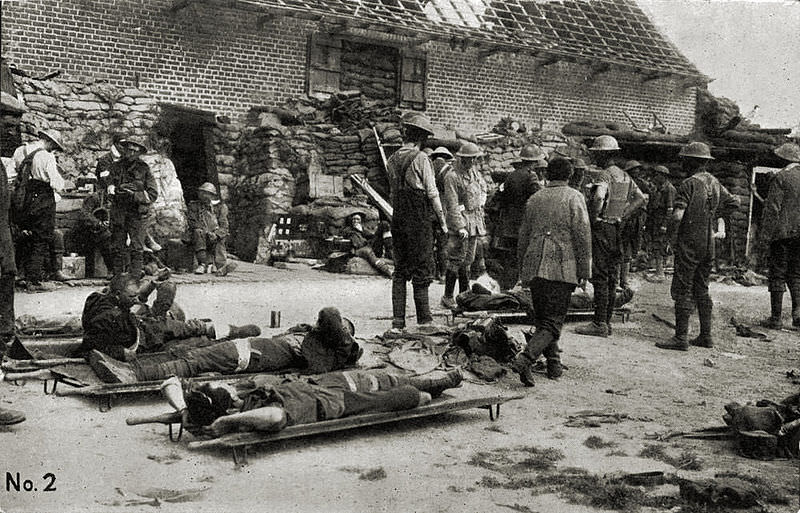
Messines Dressing Station 7th June 1917

FIELD DRESSING STATION, MESSINES 7th June 1917.

On 9th June 1917 Lieutenant: Clarence Smith JEFFRIES with a Patrol of 50 Other Ranks left our Trenches at 4.00 pm with the object of reconnoitering Potterie Farm. This Patrol came under heavy Machine Gun fire and on returning reported the position was fairly strongly held. Lieutenant: Clarence Smith JEFFRIES was Wounded in Action with 2 Other Ranks killed and 3 wounded.

Clarence was evacuated to England where he recovered from his injuries and was Promoted to Captain on the 26th of June 1917 when Captain: Ray WOLSTENHOLME was struck off strength in England and returned to France on the 27th of August from Tidworth Barracks. Clarence was marched in at Harve the next day and rejoined his until in the field on the 2nd of September 1917.

12th October 1917.

 BATTLE OF YPRES

The Approach March commenced at 6 p.m. from Cavalry Camp to the jumping off Line, the assembly Point being the Junction of Zonnebeke-Roulers Railway Line and Cemetery to the South West corner of Augustus Wood, thence to assembly Road along Roulers-Ypres Railway Line. The march was carried out without loss for about 7 Kilos, although the going was extremely difficult due to the rain and shell-holed state of the track, until Zonnenbeke Station was reached. From here to the Assembly tape the Battalion was subjected to heavy shell fire, principally 7.7's and 4.2's in many places the track had been blown up and the tape had disappeared. however in spite of this and casualties sustained, the Assembly Point was reached by 2.45 a.m. on 12th October, but some of the men were still arriving at Zero Hour. The heavy shelling of 7.7's and 4.2's continued during the Assembly and right up to Zero Hour, the greater part of which appeared to come from the South and South end of Passchendaele. Our casualties were very heavy, principally on the right flank near the cemetery and mostly occurred in "A" and "B" Companies.

The Brigade was formed up on the jumping off tape in the following order- 34th,35th and 36th Battalions. The 35th and 36th Battalions suffered heavily and were badly shot up, as the shells were passing over the 34th Battalion and were falling the the rear of the Battalions. At 5.25 a.m. our Barrage came down, but was so weak that in many cases was difficult to determine which was our Barrage and which was the enemy's. This made it hard for the men to keep up with Barrage, however the greatest obstacle met in the advance was the condition of the ground, particularly on the left flank of "C" and "D" Companies. There were many men lost altogether in the mire. The pace of the advance was slowed up owing to the assistance it was necessary to give men who had sunk into shell holes and could not extricate themselves without assistance.

In a number of cases the helpers became engulfed in the awful morass and many of the wounded had to be left where they fell. The first organised opposition met with was two concrete Pill Boxes, East of Augustus Wood and North East of Seine House. These help up the centre of the advance until Captain: Clarence Smith JEFFRIES. organised a Bombing Party and succeeded in rushing and capturing the Strong Point, taking 35 Prisoners and Four Machine Guns, 150 yards in the rear of this Dugout was a small Trench, about 50 yards long, in which were 20 or 3o of the enemy, who were accounted for as the Wave passed on. Throughout the advance to the Red Line heavy Machine Gun Fire was encountered from the direction of Belle Vue and Meetchiele on the left flank, and from Tiber and Tiber Copes on the right flank in the Railway Embankment. The position was also mopped up as the Wave went forward. On reaching the Red Line the Battalion began to dig in, but was greatly harassed by fire from Machine Guns situated on the right flank, about 200 yards from Railway Embankment. Captain: Clarence Smith JEFFRIES. again organised a Party of 2 N.C.O's Sergeant: 21 James BRUCE   Corporal: 2036 Vere "Vic" Cumming STEVENSON. and 12 men to capture this Post. During the attack, Jefferies "B" Company was held up by an enemy machine gun post. He was successful in taking four machine guns and 35 German prisoners. He once again led another attack against these trenches but was himself mortally wounded by a machine gun bullet to the stomach. Unfortunately this brave Officer was killed in the attempt. For this action we was posthumously awarded the VICTORIA CROSS

12th October 1917.

Corporal: Vere Cumming STEVENSON 34th Battalion. For conspicuous Gallantry and Devotion to Duty, Battle of YPRES (Phase 5) 12th October 1917. When all officers of his Company became casualties he organised the Company and carried the fight. He was one of the party detailed by an officer Captain: Clarence Smith JEFFRIES. V.C. to capture a strong point which yielded 4 machine guns and 35 prisoners. In an attack on the second strong point the officer had been killed. He assisted Sergeant: 21 James BRUCE. M.C. D.C.M. to organise the party and capture the post of 2 machine guns and 30 prisoners after the company had dug in on the new line. He organised a ration party and succeeded in getting the rations forward to the front line troops through a heavy barrage.

Clarence is commemorated in perpetuity by the Commonwealth War Graves Commission and is buried at the Tyne Cot Cemetery, Belgium.

Clarence Smith Jeffries Grave 

On Fame's eternal camping ground Their silent tents are spread.


Clarence Smith Jeffries 

Memorial Scroll 


VICTORIA CROSS 

London Gazette 18th December 1917. Page 13222 Position 1.

Commonwealth of Australia Gazette 18th of April 1918. Page 841 Position 3.

Family Information


Clarence was the 23 year old Manager of the Survey Department at Abermain Collieries upon his enlistment. His parents Joshua and Barbara Jeffries were married in 1894 at Newcastle, N.S.W. Marriage Cert:5256/1894. Clarence was their only child was educated at Dudley Primary School before his parents moved to Newcastle where he attended the Newcastle Collegiate and High Schools. Clarence was apprenticed as a Mining Surveyor at the Abermain Collieries where his father Joshua was the General Manager. Clarence was a noted Cricketer and a keen Horseman as he also had a keen interest in the breeding of thoroughbreds. In July 1912 Clarence enlisted with the 14th Infantry (Hunter River) Regiment as a Private and was promoted to Sergeant later that year. On the 22nd of August 1914 he received his Commission.


Uncle. Sergeant: 903 Oswald Oliver STEEL. 35th Battalion A.I.F. Died of Wounds

Clarence Smith Jeffries (1894–1917)

by J. B. Hopley

This article was published:

Clarence Smith Jeffries (1894-1917), soldier and mining surveyor, was born on 26 October 1894 at Wallsend, New South Wales, only child of Joshua Jeffries, colliery manager, and his wife Barbara, née Steel, both born at Wallsend. After attending Dudley Primary School, where he excelled at cricket, and the Newcastle Collegiate and High schools, he was apprenticed to his father as a mining engineer. A young man of high standards and ideals, he strove to excel in all he did. Jeffries had a particular interest in the study of breeding thoroughbreds, although not in racing them, and always kept fine horses.

His military service began in the militia when he was 14. He joined the 14th (Hunter River) Infantry Regiment as a private in July 1912 under the compulsory training scheme, and was promoted sergeant a year later. Commissioned second lieutenant on 22 August 1914, he was mobilized for home defence duties and instructed volunteers for the Australian Imperial Force at Newcastle and Liverpool camps. He was promoted lieutenant in July 1915. On 1 February 1916 Jeffries, then in charge of the Abermain Collieries surveying department, was appointed second lieutenant in the 34th Battalion, A.I.F., and three months later embarked for England. In August he was promoted lieutenant and in November his battalion moved to the Western Front where he spent the early months of 1917 on front-line service in the Armentières sector, France. Highly respected by those serving under him and by his superiors, his first major action was at Messines where, on 9 June, he was wounded in the thigh while leading a reconnaissance patrol. Promoted captain on 26 June, Jeffries rejoined his unit in September.

On 12 October, in the attack on Passchendaele during the third phase of the battle of Ypres, his company's advance towards its first objective was held up by two pill-boxes. He organized and led a bombing party which eliminated the obstacle and captured thirty-five prisoners and four machine-guns. He then led his company forward, under an extremely heavy enemy artillery barrage and enfilade machine-gun fire, to the objective. Later that morning the battalion's advance to its second objective was delayed by a machine-gun post. Jeffries led another party to capture the position, enabling the advance to continue, but was killed during the operation. For his service that day he was posthumously awarded the Victoria Cross, for 'most conspicuous bravery in attack'.

Jeffries was buried near Passchendaele, in the Tyne Cot military cemetery. His headstone is inscribed:

On Fame's eternal camping ground
Their silent tents are spread.

Upon his mother's death, his Victoria Cross was presented to Christ Church Cathedral, Newcastle. Elsewhere, he is commemorated by photographic portraits in the Abermain Memorial and Citizens' Club, a carved chair presented to Abermain Holy Trinity Anglican Church by his uncle and aunt, and by the Jeffries-Currey Memorial Library at Dudley Primary School where William Currey, V.C., had also been a pupil.

Select Bibliography

  • C. E. W. Bean, The A.I.F. in France, 1917 (Syd, 1933)
  • Short History of the 34th Battalion, AIF (Carlton, NSW, 1957)
  • L. Wigmore (ed), They Dared Mightily (Canb, 1963)
  • London Gazette, 14 Dec 1917
  • Reveille (Sydney), Feb 1929, May 1933
  • Newcastle Morning Herald, 17 Dec 1917, 26 June 1919
  • Sydney Morning Herald, 22 Dec 1917, 28 Apr 1954
  • Sydney Mail, 2 Jan 1918
  • war diary, 34th Battalion (Australian War Memorial)
  • private information.

Citation details

J. B. Hopley, 'Jeffries, Clarence Smith (1894–1917)', Australian Dictionary of Biography, National Centre of Biography, Australian National University, https://adb.anu.edu.au/biography/jeffries-clarence-smith-6832/text11825, published first in hardcopy 1983, accessed online 24 September 2024.

This article was published in hardcopy in Australian Dictionary of Biography, Volume 9, (Melbourne University Press), 1983

View the front pages for Volume 9

Australian Dictionaries of Biographies

Military Records 

© Commonwealth of Australia (National Archives of Australia)

Under Construction; 15 /19/2009-06/06/2017.