
35th BATTALION AIF
Private: 891 George ROBERTSON
Born: 8th September 1877. Brooktown, Wallsend, New South Wales. Australia. Birth Cert:17716/1877.
Married: 11th June 1898. Home of Mrs Harriet Williams, Minmi, New South Wales, Australia. Marriage Cert:5873/1898.
Wife: Elizabeth Robertson. nee: Williams. (1877-1926) Died at Stockton, New South Wales, Australia. Death Cert:6198/1926.
Died: 7th June 1917. Killed in Action. Messines, Belgium.
Father: Robert William Robertson. (1850-1908) Died at Kurri Kurri, New South Wales, Australia. Death Cert:5881/1908.
Mother: Christina Robertson. nee: Cairns. (1852-1932) Died at Mayfield, New South Wales, Australia. Death Cert:3330/1932.
INFORMATION
George enlisted with the AIF on the 14th December 1915 and went into camp at Broadmeadow via Newcastle where he was allocated to C Company, 35th Battalion AIF on the 26th March 1916.
Newcastle Morning Herald and Miners' Advocate (NSW : 1876 - 1954), Thursday 20 April 1916, page 5
EMBARKATION OF TROOPS. NOT TO LEAVE NEWCASTLE.
Alderman Moroney, the Mayor of Newcastle recently wrote as follows to Mr. Jensen, the Minister for the Navy, requesting that the Newcastle troops should embark at Newcastle in confirmation of my telegram to you, I desire to bring under your notice that it would be a very gratifying compliment to the residents of this city and district if you could make arrangements for the embarkation of the troops at present in camp here (especially the 35th Battalion, "Newcastle's Own") from Newcastle, on leaving for the seat of war. This city and district has subscribed very large sums of money to the funds of all patriotic objects, and are using every endeavour to raise further sums. You are no doubt aware, that, if the troops were taken to Sydney to embark, the parents and friends of those departing, would have to incur very great expense in going to Sydney to see them off, and it would be a very great burden to them to have to do this." Mr. Jensen was subsequently Interviewed by Senator Watson and Messrs. D. Watkins and M. Charlton, .Ms H.R., and yesterday Senator Watson telegraphed to the Mayor that the matter was under consideration by the Minister. Later in the day the following telegram was received by the Mayor: "Referring to your telegram to Minister for the Navy regarding embarking troops at Newcastle, it is regretted that draught of water available there precludes your wishes being acceded to." At the meeting of the Anzac Day Committee held at the Council Chambers, last evening, the Mayor, referring to the refusal of the Minister for the Navy to embark the troops at Newcastle, said it was absurd for the Minister to say that there was not sufficient draught of water. Vessels had previously left the harbour drawing 26ft of water, and no troopship was likely to draw more than that. He was by no means satisfied with the reply received from the Minister, and he would take steps on the following day to again bring the matter prominently under the notice of Mr. Jensen.
The first ANZAC Day commemorated at Newcastle on 25th April 1916 was attended by thousands of people. A Parade in the morning was followed by several church services and afterwards the 35th and 36th Battalions re-formed and returned to the Gardner Memorial in Hunter Street for wreath laying. In the evening a Concert was held in King Edward Park.
This was surely a poignant day in Newcastle, for as the citizens gathered to remember the young men who had fallen at Gallipoli, they knew that before the end of the month the men of 35th regiment (Newcastle's Own) and the 36th regiment - their sons, brothers, husbands, sweethearts and friends, would embark on their own voyage towards the perils of war.
Newcastle yesterday paid impressive tribute to the memory of the Anzac landing, and the Australians and New Zealanders who fell in that historic fight on Gallipoli. From early morning crowds thronged into the city from the suburbs and from the adjacent centres. Business was practically suspended during the forenoon, for major attention was devoted to the observances arranged by the committee, headed by the Mayor, and the Returned Soldiers' Association.
But though crowds thronged the city streets, there was no appearance of carnival, rather there was an appropriate air of quiet reverence, though the tinge of pride in the achievements of the Australians and New Zealanders was not absent. The services held in churches of all denominations after the military procession were very largely attended. A great many of the ships and other business places, as well as vehicles, were draped in black and purple, and there was also a free display of bunting, all flying at half-mast, and in which the public offices and the ships in port participated.
The procession was formed up at the junction of Porcher street and Hunter street West, and proceeding through the city, was composed of the Naval Band, Naval Contingent, Returned Soldiers. Veterans, Naval Reserves, 35th Battalion with band, 36th Battalion and band, 16th Infantry Band, and Military Cadets. It was a lengthy procession, and the marching of the sailors and soldiers excited admiration. The returned soldiers were greeted with lusty cheering. which was doubled in honour of a number not sufficiently recovered to be able to walk, and a couple of whom were blind, who were conveyed in motor cars.
The two battalions - the 35th and 36th, in training at Broadmeadow were also greeted with encouraging cheers. All the various units of both battalions were in the parade. As the procession passed the Gardner memorial to fallen soldiers in front of the Post Office, beside which were Alderman M. J. Moroney, Mayor of Newcastle, Commander Frank Gardner, the donor, senior military officers, and relatives of deceased soldiers were impressively saluted. As the procession left Hunter-street and proceeded up Watt street, contingents of men fell out, and were marched to their respective churches, whilst the remainder proceeded to the Cathedral. The soldiers attended the memorial services in large numbers, and so did the civilians.
After the church services the procession was re-formed in Hunter-street, and assembling in the neighbourhood of the Gardner memorial awaited the striking of midday. At that hour a gun was fired from Fort Scratchley, and immediately the band of the 36th Battalion played the National Anthem, all traffic was suspended, and 60 seconds silence was observed. The various units in the procession were immediately afterwards dispersed. During the forenoon proceedings a large number of wreaths were placed on the Gardner memorial, over which was spread the Union Jack and the Australian ensign. The wreaths included tributes from the Mayor and Mayoress, the Northern Branch of the New South Wales Rugby League, Returned Soldiers' Association, the ladies' committee of the Soldiers' Club, the Newcastle Police, the Newcastle Surf Club, numerous citizens and relatives of soldiers who had fallen.

Broadmeadow Station 1st May 1916
The 35th Battalion left Sydney on the 1st May 1916 bound for the United Kingdom aboard the H.M.A.T. A24 "BENALLA" with 28 Officers and 991 other ranks. The original 35th Battalion had regimental numbers between 1-1513. Compiling of Headquarters, Machine Gun Section, A Company, B Company, C Company and D Company. Arriving in England in early July, the Battalion spent the next four months in training.
7th June 1917.
THE BATTLE OF MESSINES
The 3rd Australian Divisions first major offensive was at Messines Ridge on the 7th June 1917. The Australian 3rd Division was a part of the II Anzac Corps which was allotted to the first assault. The 25th New Zealand, 3rd Australian Division with the 4th Australian Division in reserve. The 4th Division were battle hardened troops who had fought many major battles. The 3rd Australian Division were having problems getting to the "jump off" point. The day before the 9th and 10th Infantry Brigades were bombarded by German Gas-Shells around Hill 63 and Ploegsteert Wood. Many of the Aussies were not wearing gas masks, but despite this they pressed on even though they received 500 casualties.
They made it to the "jump off" point but only just with some of the men from the 9th and 10th going straight over the top without stopping. The mines went up and the attack commenced behind a protective barrage. The II Anzac Corps were attacking on the right with their objective being the southern shoulder of the ridge which included Messines, the Dover and St Yves areas as far south to the east of Ploegsteert Wood.
Major General Sir John MONASH's 3rd Division had to contend with a tricky 3 mile approach out of Ploegsteert Wood and after the German gas attack, but they were not deterred. The 9th Infantry Brigade under Brigadier General: Alexander JOBSON and the 10th Infantry Brigade under Brigadier General W R NICHOLL had just made the jumping off point but some of the men did not stop, going straight into the assault from the approach march.
Their objective lay between St Yves and the Douve. The mines at Trench 127 and Trench 12 at Factory Farm were laid to aid this task. The explosions erupted a few seconds before zero hour and created craters of 200 feet in diameter, completely obliterating the German defence line as the 9th and 10th Infantry Brigades went over the top. The mine crates forced the 9th and 10th Brigades to veer to the left and right which caused some confusion with the main assault. It is testimony to the quality of training that every man knew the ground, tasks and objectives so well.
Private: 1804 John CARROLL 33rd Battalion, rushed the enemy's trench and bayoneted four of the German occupants. He then noticed a comrade in difficulties and went to his assistance, killing another German. He then attacked single handed a German Machine Gun Team, killing all three of them and capturing the gun. He later rescued two of his comrades who had been buried alive by German Shell Fire, and in spite of heavy shelling and machine gun fire he dug them out alive and saved them from certain death. John was awarded the Victoria Cross.
The German forward zone was completely engulfed and taken by the main assault. The two supporting battalions of each brigade then passed the leading battalion to continue the advance. The men were constantly re-supplied and the ridge was taken. There were many German prisoners taken during the offensive. The 3rd Division was well ahead with the 9th Infantry Brigade pushing on beyond Grey Farm, and on the right the 10th Infantry Brigade were veering left towards Septieme Barn north of Douve.
The German resistance was heavy but was generally brushed aside by tanks and artillery before the infantry had to become too involved. The 4th Bavarian Divisions Artillery had made little impact, but as the day wore on the 3rd Division and later the 4th Australian Division received many casualties from German artillery. (70% of all casualties during WW1 were from artillery).
By 9:00am nearly 6 hours after the assault began the Germans were in disarray, but there was a major problem as the Australians received less casualties as anticipated and when ordered to dig into the ridge they had so many men, that some could not find shelter. the 35th battalion were dug in around Seaforth Farm.
The second phase of the operation was to take the Oosttaverne Line. The 3rd Australian Division would now be in reserve with the 4th Division attacking. The 9th Infantry Brigade (33-34-35-36Bn) were near Thatched Cottage facing Warneton. The river Lys was to their right and the Ploegsteert Wood was now behind them.
Once their objectives were taken the troops consolidated. A barrage to stop and counter attack was shortened and caught three battalions which had to retire. By 9:00 pm this part of the Oosttaverne Line was abandoned. At 10:45 pm General: Alexander John GODLEY ordered the 3rd and 4th Divisions to retake it. This they did by the early hours of the 8th of June.
The Battle for Messines Ridge during May-June 1917 saw 35 officers and 1,631 other ranks loose their lives.
9th Infantry Brigade Casualties.
| 33rd Battalion. AIF | 8 Officers | 382 Other ranks |
| 34th Battalion. AIF | 10 Officers | 378 Other ranks |
| 35th Battalion. AIF | 5 Officers | 431 Other ranks |
| 36th Battalion. AIF | 9 Officers | 421 Other ranks |
| 9th Machine Gun Company. AIF | 2 Officer | 17 Other ranks |
| 9th Light Trench Mortar Battery. | 1 Officer | 2 Other ranks |
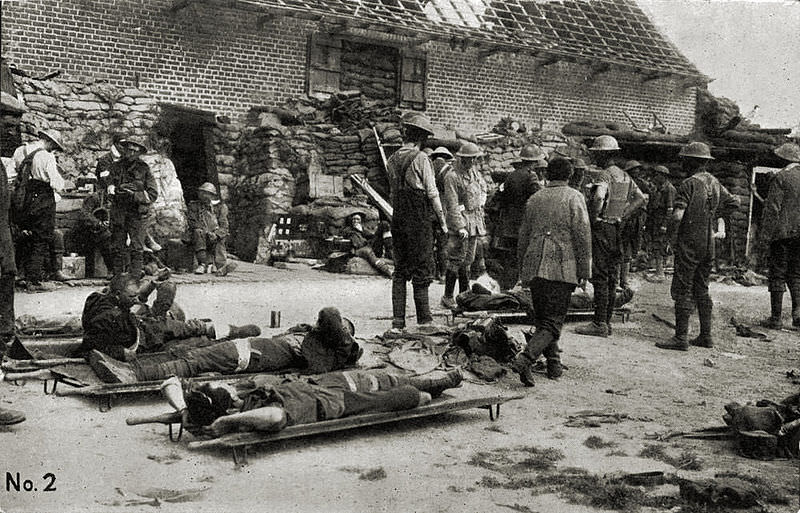
FIELD DRESSING STATION, MESSINES 7th June 1917.

Memorial Plaque: 325745 was issued to his wife Elizabeth Robertson on the 24th August 1922 of Boolaroo, New South Wales and was acquired on the 14th August 2026 and is now in the Harrower Collection 104 year later.
Family Information.
George was a 38 year old married Coal Pit Labourer from Deakon Street, Kurri Kurri, New South Wales, Australia upon his enlistment with the AIF.
Military Records


© Commonwealth of Australia (National Archives of Australia)
Under Construction: 25/07/2026-04/09/2026.