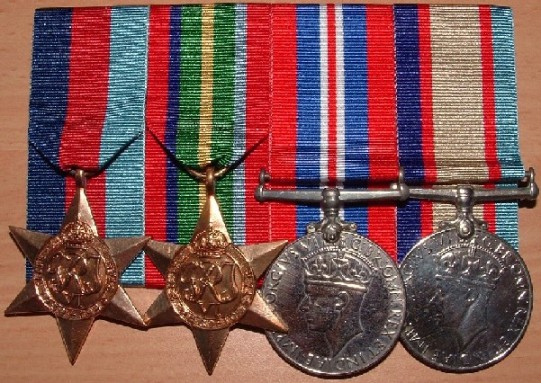
34th BATTALION A.I.F.
Lieutenant: 1291 Albert Leslie WATSON. M.C.
Born: 9th September 1895. Armidale, New South Wales, Australia. Birth Cert:29907/1895.
Married: 1925. Sydney, New South Wales, Australia. Marriage Cert:5156/1925.
Wife: Mabel Watson. nee: Cuffe. (1896-1992)
Died: 8th September 1984. Killara, New South Wales, Australia. Death Cert:
Father: Albert Penny Watson. (1870-1945)
Mother: Adeline Beatrice Watson. nee: Palmer. (1871-1943)
INFORMATION
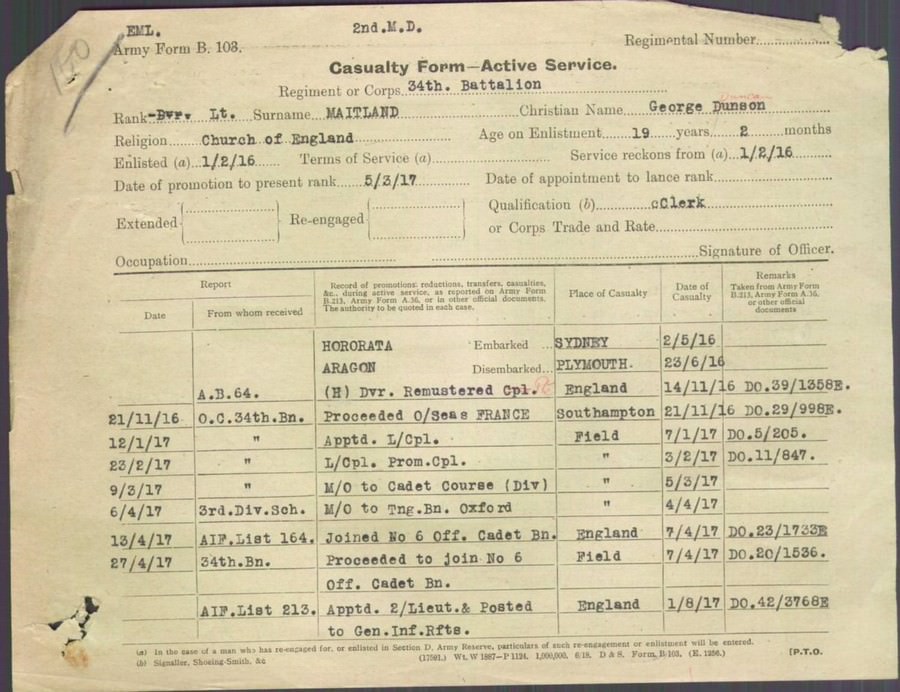
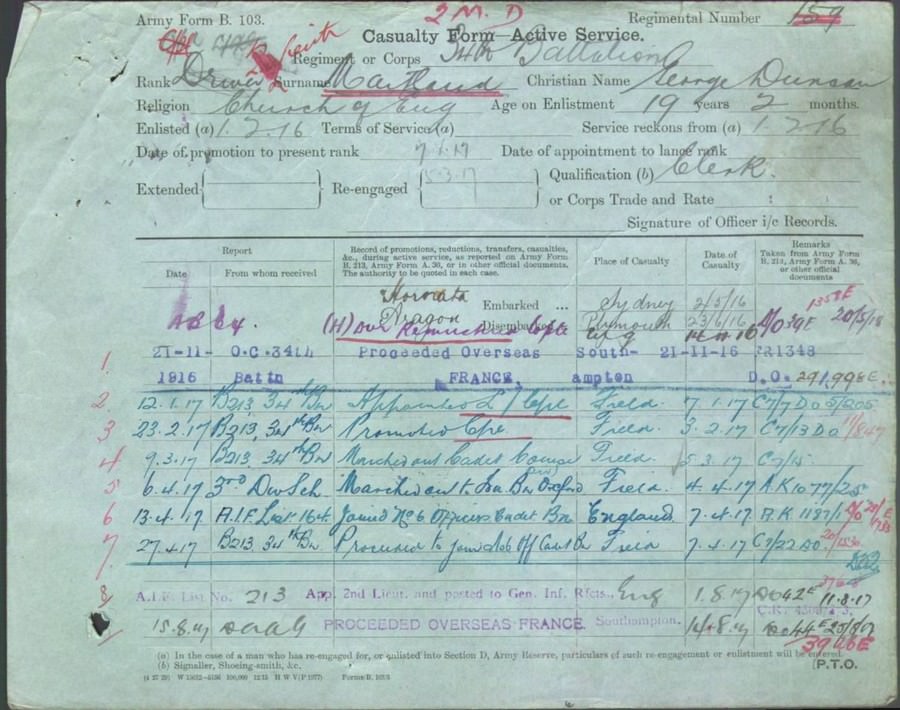
Albert Leslie Watson, enlisted with D Company 34th Battalion AIF on the 1st of February 1916 with the rank of Corporal and left Sydney on board HMAT A20 "Hororata" on the 2nd of May 1916 and sailed at 4:00 pm". Albert was a Signal Officer of the 34th Battalion.
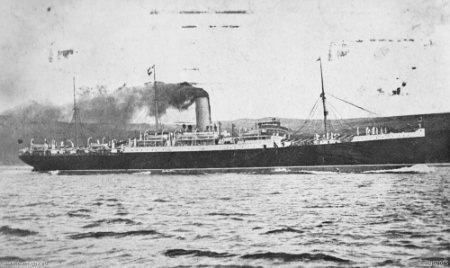
H.M.A.T. A20 "HORORATA
"The voyage to England was without any unusual incidents and a good passage throughout. The first port of call was Albany, where three days were spent. Columbo was reached on Empire Day, 24th May. Here two days were taken up coaling and taking on provisions, etc. During the stay the Battalion carried out a route march through the town. Suez was reached on 8th June, where a party of Light Horse and some details were disembarked. Arriving at Port Said on 9th, the ship coaled and proceeded to Alexandria which was reached on 11th June 1916.
Here the Battalion transferred to S.S."Aragon", E867. Some Australian Details were on board, also a number of Tommies going to England on Furlough. Devonport was reached on the 23rd June, the Battalion disembarked at Plymouth at 1:00 pm and en trained during the afternoon for Amesbury, arriving at midnight and marching to hutments at No: 1 Camp, Larkhill. Here the Battalion settled down to hard training, which included Route Marching, Trench Digging, Bomb Practice, Musketry and general Camp Routine. Later the Battalion moved to the No: 25 Camp and finished off their training, which included six days' battle practice and field work at the Bastard Trenches.
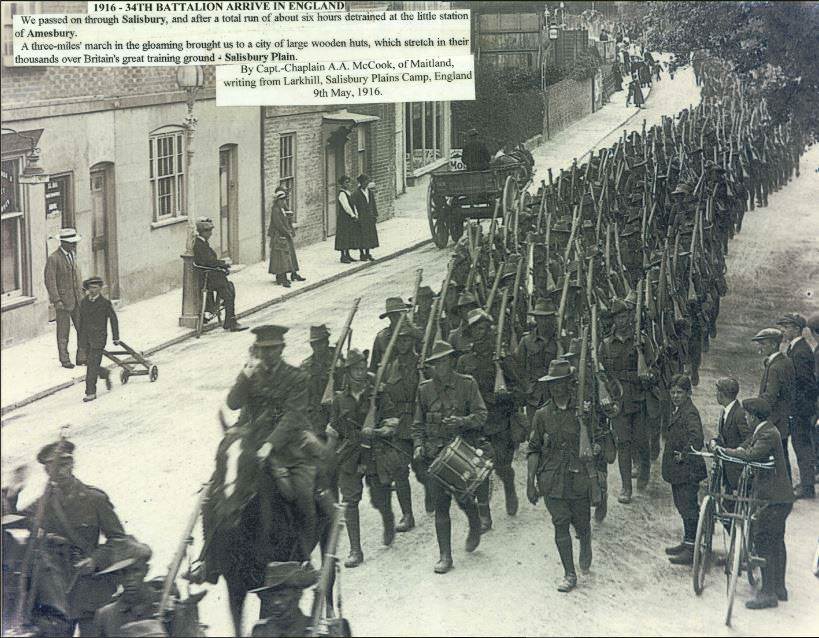
34th Battalion marching through Amesbury
12th October 1917
THE BATTLE OF PASSCHENDAELE I
At 1:30 am rain showers began. By 2:30 am it was raining lightly but steadily, by 3:30 fairly heavily. the infantry moved through the pitch dark in single file. In some battalions each man held on to the equipment of the man ahead of him; if touch was broken, those in front had to come back. The news that the line as reported by the 66th division was not held only just reached the incoming troops. Accordingly, in the right brigade (9th) the leading Company Commanders Captain: Clarence Smith JEFFRIES. V.C. and Captain: Telford Graham GILDER M.C. both of the 34th Battalion stopped their men at the entrance to Broodseinde railway cutting, and themselves went to make sure that their column might not run into the enemy.
At Keerselaarhoek Cemetery they found the tape duly laid, and met the officer of the 36th Battalion who had laid it, and by 3:00 am the time set, the 34th battalion was extended on its jumping-off position. But during the previous halt and afterwards, as it lay on the tape, the battalion was persistently shelled and suffered many casualties.
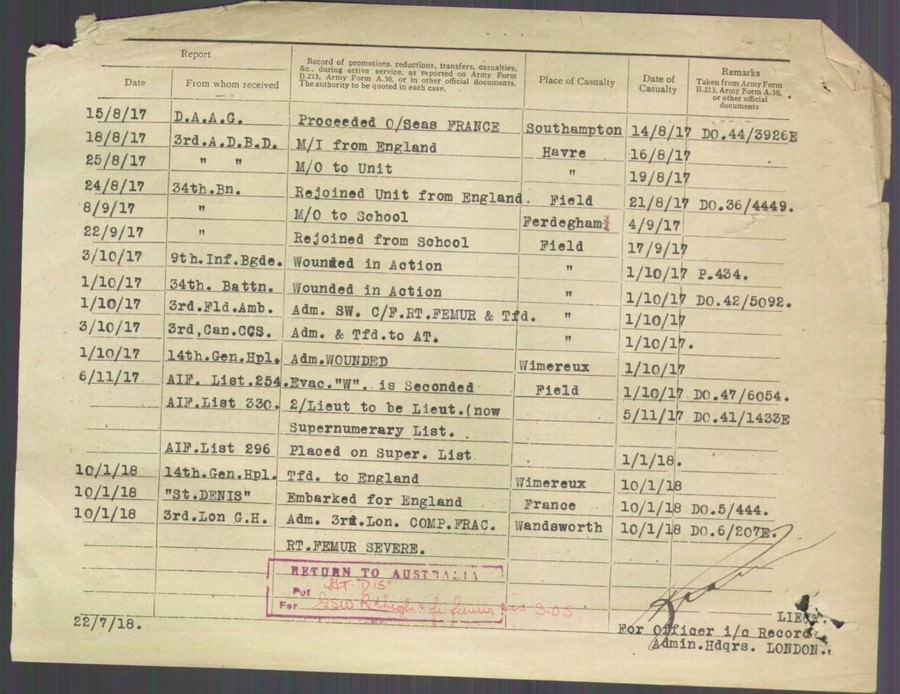
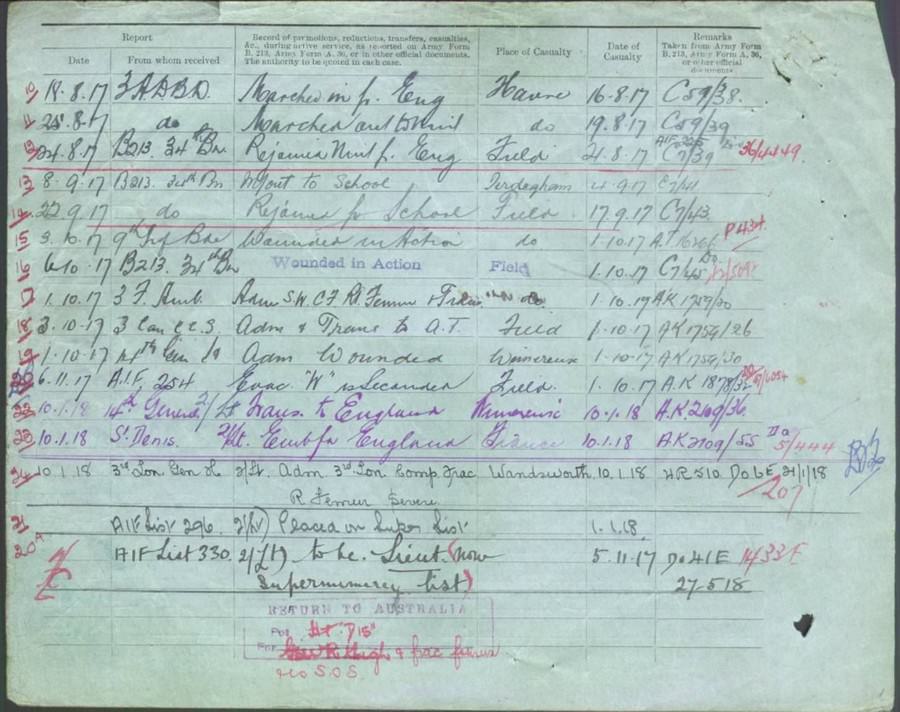
The first shell killed three signallers. Lieutenant: Albert Leslie WATSON. a signal officer of the 34th Battalion, a brave and enterprising leader who also was at the head of the column was severely wounded and all his staff hit. After establishing a forward command post Lieutenant: Thomas Fraser BRUCE 36th Battalion was also killed. Lieutenant Colonel: John Alexander MILNE. 36th Battalion supervising the assembly was knocked down by a shell but continued to command. Captain, Chaplain: Charles MURPHY was also wounded.
(BEAN; History of World war 1 Vol IV p911) Charles Edwin Woodrow BEAN
Only one Australian Division, the 3rd, was wholly employed in the days offensive. but the division was to capture Passchendaele an in spite of the depressing conditions, it was eager to achieve the distinction of doing so. One unit carried the Australian flag,to be planted in Passchendaele, and although officers and men in general were not enthusiastic concerning such "stunts" the Commander-in-Chief had been informed, and had told General: MONASH that, when this flag was planted, the news would be immediately cabled to Australia.
Some keen spirits looked on the operation simply as a dash for Passchendaele. One young company commander of Monash's reserve battalion, the 33rd, in face of a strict prohibition, led on his company as soon as the barrage fell. Starting from a line 350 yards in rear of the general alignment, the 3rd Division was out of touch with its neighbours from the outset. The heavy shelling on the tapes had made orderly disposition there almost impossible, as German Machine-Guns, undisturbed by the barrage now opened immediately, no opportunity offered of restoring proper formation.
The 9th Brigade went forward in the utmost confusion and a terrible mix up as reported by Captain: Robert Derwent DIXON D.S.O 35th Battalion at 6:40 am and "Great Confusion" was the description given by Captain: Henry Vince CARR 35th Battalion. Even on the ridge, the mud was difficult, the hope, if there ever was one, of catching up before the quick barrage finished.
The 9th Infantry Brigade's intended direction lay not along the ridge and the Passchendeale road, but diagonally across them, and parallel to the railway, which most of the brigade could not see. As the jumping-off line was practically at right angles to the ridge, the brigade tendered to advance alone the heights. The Machine-Gun fire at the start came, on the 9th Brigade's right, from the ruined house near Defy Crossing; on its center from, "Hillside Farm"; and on its left from Augustus Wood.
The pillbox opposite the center was supported from the rear by a trench in which were Germans with Machine-Guns, and here occurred a delay which threatened to wreck to whole attack. it was not until an hour after the program time that these places were rushed by the neighbouring portion of the line under Captain: Henry Vince CARR and Captain: Robert Derwent DIXON. D.S.O of the 35th Battalion. The trench contained 35 Germans and 4 Machine-Guns. Part of the line was also held up by a pillbox close to Passchendaele road near the highest point of the ridge.
Here there was practically no shelter from attack, but Captain Clarence Smith JEFFRIES. V.C. of the 34th Battalion managed to organise a party, with Sergeant: 21 James BRUCE and another N.C.O Corporal: 2036 Vere Cummings STEVENSON and a dozen men, and outflanking it, charged the place from the rear, capturing 25 Germans and 2 Machine-Guns. These actions set free the advance. The pillbox captured by Captain Clarence Smith JEFFRIES. V.C. being not far short of the first objective, the 34th Battalion dug in there.
Great loss had been uncured; the 34th Battalion had only three officers left and there were wide gaps in the line. The right flank had swung far away from the railway, along which the 4th Division was attacking, but on the left Captain: Telford Graham GILDER M.C. of the 34th Battalion who had been wounded by a Machine-Gun bullet, but was carrying on found the 10th Brigade digging in slightly to his left under Captain: LATCHFORD, 38th Battalion, and fell back seventy yards to join it.
The Advance to the second objective was to begin at 8:25, the low clouds had opened, and fleecy cirrus with patches of blue were widening overhead and the sun had come out. The 9th Brigade had been so late in reaching the first objective that, while most of the 34th Battalion dug in, the 35th Battalion, allotted for the second phase, moved straight on. Standing on the Passchendaele road, Captain: Henry Vince CARR and Captain: Robert Derwent DIXON. D.S.O of the 35th Battalion endevoured to decide where the barrage then was; at first Carr thought it may be behind them, but finally decided that it was ahead.
The confusion at the start had split the brigade into mixed parties of all battalions and many of the 34th went on with the 35th, the main body of which, about 100 in all, now advanced along the south-eastern side of the ridge in order to catch the barrage. The hour was probably a little before that for the second advance. A German Machine-Gun in the gap between the brigade's right and the railway immediately opened with deadly effect.
Major: John Bruce BUCHANAN 36th Battalion, the senior forward officer was killed. At this critical juncture Captain: Clarence Smith JEFFRIES. V.C. of the 34th Battalion, again accompanied by Sergeant: 21 James BRUCE, led out a few men from the first objective and made for the gun. it was shooting in short bursts, and he was able to work up fairly close. Seizing a moment when it was firing to the north, he and his men rushed at it from the west. It was switched round, killing him, and sending his men to the ground.
But when its fire eased they worked round it, rushed the position, seized 25 Germans and 2 Machine-Guns. This gallant and effective action Captain: Clarence Smith JEFFRIES. V.C. was posthumously awarded the Victoria Cross for removing the chief danger to the advance along the crest, but as soon as the 35th Battalion crossed to the eastern side of the hill it became the target of a number of field and heavy guns which, from the hedges and other cover in various parts of the landscape, fired over open sights.
After passing a corpse on its right, the 35th Battalion settled down on what its officers took to be the second objective, although on the extreme right they were actually short of the first. Captain: Henry Vince CARR, now the senior officer on the spot, reported; 8:35. On objective, with about 100 Captain: Robert Derwent DIXON. DSO and three officers. Casualties 25 or 30 per cent. Captain: Henry Charles Dight CADELL M.C Lieutenant: Charles Teesdale MAIN Lieutenant: Keith Maitland DAY reported killed and Lieutenant: Frank HORNE Lieutenant: Christopher Kyffin MEARS Lieutenant: Charles John HENRY were wounded. Prisoners sent back 400-500. Contact on flanks uncertain, being heavily shelled.
Three posts were established under surviving officers, right Lieutenant: Norman Beade D'ARCY M.C centre Lieutenant: Joseph Francis ADAMS left Lieutenant: Harold Sydney WYNDHAM. In this brigade the battalion for the final objective was the 36th, and a report came along that it had gone through. Actually, it had advanced with the 35th, but, on the left, penetrated to the second objective, which bad been reconnoitered during the previous halt by the commander of the company Captain Robert Austin GOLDRICK. M.C.
He went up the road towards Passchendaele. The barrage, he said afterwards was no hindrance to him, although he left the line lying as close to it as possible "or where he thought it was." He was unable to detect the intensification of the barrage for the second phase, but led his men forward at the proper hour.
As no other battalion was there, he now established the line with its left on the road 600 yards from the church, about the point reached by the 66th Division's troops on October 9th. In front of the position Captain: Robert Austin GOLDRICK. M.C. and Lieutenant E.H FLEITER (39th Battalion) found hidden in a shell hole men of the 66th Division. One had a broken arm, the other trench-feet. They took the Australians at first for Germans. When reassured,"we knew the Australians would come," they said, 'We prayed hard."
From the direction of the church, which lay straight down the highway, no fire came. two Germans ran up the road and surrendered. South-east of the village, along the Moorslede road, were the Germans who seemed "very windy," and near the road two 5.9-inch howitzers began to blaze at the troops digging in.
The 9th Brigade had taken its second objective and the 10th its first, but the position of the officers in charge of these advanced lines was full of anxiety. On the eastern slope Captain: Henry Vince CARR 35th Battalion, the senior officer in this part of the 9th Brigade's front, could see the 4th Division somewhat ahead of its right, and by 10:55 he had discovered that the 36th was on the left, but farther left than the 10th Brigade was far behind on its first objective . The German Guns ahead were sniping with dreadful accuracy. Carr on the western slope, sent back for instructions: "what am I to do?"
Word of the true situation reached headquarters slowly. As on the 9th, the first news was all encouraging. General: MONASH in the Ypres ramparts heard shortly after 7 that both brigades were "well away"; but by 8:26 he had ample evidence that the first objective was taken. At 9:25 the intelligence officer examining prisoners (Lieutenant: Frederick Morley CUTLACK Official War Correspondent) reported having heard from the wounded men that the second objective had been reached.
At 10:28 headquarters was informed of a statement of a wounded man, that the 38th Battalion had gone through. A further report that Australians had been seen at Crest Farm although quickly contradicting but probably true nevertheless. Which confirmed Monash's impression that his division was succeeding. Concerning the New Zealand brigade on his left, however, there was no word until, at 10:50, there arrived the tragic information that the New Zealand Division was stopped by the enemy alone the entire front.
Monash has already heard at 9:55 that the 10th Brigade was held up by fire from Bellevue Spur. Believing that his division was still advancing, he asked that every gun that the New Zealand Division could spare should be turned upon that ridge to suppress the fire. Meanwhile, he would order the reserve (39th) battalion of the 10th Brigade to be ready to assist in holding the ground already won. The reserve battalion the (33rd) of the 9th Brigade he was still keeping back to assist in the capture of Passchendaele.
Shortly after noon news of the true situation arrived. Lieutenant Jackson of the 40th Battalion had established at Waterfields pillbox near the Ravebeek a forward report-centre from which a series of messages, admirably accurate, was flashed by lamp to the headquarters of Lieutenant Colonel Lord of the 40th Battalion. Thus Brigadier General McNicoll of the 10th Brigade was able to inform Monash of the precise position of Giblin's Line. He added that the situation was very serious and the casualties very heave. At the same time from the front line of the 9th Brigade arrived a pigeon message, sent by Captain: Richard GADD of the 36th Battalion.
We are on the Blue Line (second objective) with composite force all three battalions, both flanks in the air.
The New Zealand Division was to make a second attempt at 3:00 pm, and Monash was of the opinion that from the 9th Brigade, well forward on the ridge, patrols might still work northward around Crest Farm. His reserve, the 33rd Battalion (9th Brigade), was accordingly ordered to attempt this at 4:30 pm and the 10th Brigade's forward line being meanwhile reinforced by its own reserve, the 39th Battalion.
These orders went out, but none of them were fulfilled. The New Zealand Division had been defeated by obstacles which no hastily renewed bombardment could have overcome. no infantry in the world could have crossed the Ravebeek mud, penetrated the dense wire, and attacked the crowded pillboxes of Bellview with the assistance of a barrage which did not even screen the advance. No blame can attach to the artillery. Its commander, according to the New Zealand official history, had reported on the previous day that his guns might be unable to give efficient support.
This magnificent division, which lost nearly 3,000 men, had been held up in almost exactly the same position as the 49th three days before-the left brigade penetrating half-way to the first objective, the right stopped almost at the start.The Germans were reinforcing. The New Zealand battalion commanders knew that their men had no chance of succeeding by renewed attack, and the order was eventually cancelled.
As for the Australians, of the two battalions that MONASH had now ordered to participate, the 39th had already to a large extent been involved in the fighting, and the 33rd, endevouring to reach its position of readiness for outflanking Passchendaele,had suffered great loss. No less than 6 of its Officers were killed or mortally wounded. Captain: Wilfred Frank HINTON in command of the forward company, Lieutenant Leonard Rockley BROWNLOW Lieutenant: Thomas Acheson ARMSTRONG Lieutenant: Albert George KILPATRICK Lieutenant William REES-REYNOLDS and Lieutenant: Norman Francis GOBLE.
By the time Lieutenant Colonels Henderson DSO 39th Battalion and MORSHEAD attempted to carry Monash's orders, they found that the attacking force of both brigades was back almost at its starting point. What had happened was as follows.
Neither Major: GIBLIN near the Ravenbeek nor Captain: Henry Vince CARR on the ridge had received their messages sent several hours earlier. The 9th Brigade's line was still being battered by the German Guns. Captain: Richard GADD 36th Battalion, whose troops were being wiped out, informed Captain: Henry Vince CARR 35th Battalion that Lieutenant Colonel: John Alexander MILNE D.S.O 36th Battalion had now come forward to Hillside Farm. CARR accordingly sent Captain: Robert Derwent DIXON. D.S.O with GADD to explain to Milne the desperate nature of their situation. Milne said that he would try to get their troops relieved after dark, but till relieved they must hold on.
(BEAN; History of Word War 1 Vol IV page 921) Charles Edwin Woodrow BEAN
Meanwhile, however, the German artillery was annihilating some parts of their line. All leaders of Carr's three posts were out of action. Lieutenant: Joseph Francis ADAMS was Killed in Action and Lieutenant: Norman Beade D'ARCY M.C and Lieutenant: Harold Sydney WYNDHAM were wounded. Of the remaining officers of the 36th Battalion, Major: John Bruce BUCHANAN and Lieutenant: Fredrick William PUTNEY had been Killed in Action and Captain: Robert Austin GOLDRICK M.C wounded. Farther back Lieutenant: Sydney COOK had been Killed in Action and Lieutenant: William WAND and Lieutenant: Herbert Reginald MAILER were wounded.
At 3 o'clock rain began to fall steadily. at 3:15 pm Captain: Richard GADD 36th Battalion, thought agreeing with Captain: Henry Vince CARR 35th Battalion that to hold on meant annihilation, refused, in view of his Colonel's orders, to retire. Carr consented to wait while Gadd again sent word to Lieutenant Colonel: John Alexander MILNE D.S.O. Carr himself at 12: 30 had sent Captain Robert Derwent DIXON. D.S.O to the headquarters of the 35th Battalion at " Seine", from which no word had been received all day.
At 3:45 pm, no reply having come from Milne, and Dixon not having returned as he had been kept at 35th Battalion headquarters awaiting the arrival of an order from brigade headquarters concerning the projected operation by the reserve battalion, Gadd agreed to withdraw and Carr sent along the line a note: The 35th Battalion will retire.
When visiting Gadd, Carr had warned the troops of the probable order to withdraw, and he now saw that the left had already begun to retire. He told men whom he passed to get back as fast as they could to the 34th Battalion (which he believed to be on the first objective). Captain: William James GORDON M.C 36th Battalion, strongly dissatisfied with the order, went straight to Lieutenant Colonel: John Alexander MILNE D.S.O urged that the forward position was tenable, and with Milne and Major: John Martin HAWKEY M.C rushed out to stop the withdrawal. But it was too late.
The 34th was not, as Captain: Henry Vince Carr 35th Battalion, believed, on the first objective. The Commander of the line, Captain: John William RICHARDSON 34th Battalion, on hearing of the extreme weakness of the force at the second objective, had reinforced it. He and his only remaining officer's Lieutenant: James Clement BURGES Lieutenant: Bruce Gray McKENZIE Lieutenant: John Abbott LONGWORTH had all been Killed in Action while organising on the first objective, and the first objective now lay empty. The retiring troops, being without orders as to the position to be taken up, streamed back past Milne's headquarters.
All that Hawkey, Gordon, Gadd, and others could then do was to lead a fraction of them forward again to the first objective, where they remained during the night. Captain: Robert Derwent DIXON. D.S.O. with Captain: John Grieve PATERSON adjutant of the 35th, went up to organise the 35th there, but could find none of it's men. When eventually re-formed the remnant of the 35th was temporarily attached as a Company to the 33rd Battalion.
9th-12th October 1917 saw the 3rd Division, 9th and 10th Infantry Brigade in action during the Battle of Passchendaele, which saw massive losses and suffering in the Australian ranks. The casualties numbered 3,199 men in 24 hours during the height battle. The 34th Battalion lost every officer that day, either killed or wounded including their Medical Officer, Major: Gother Robert Carlisle CLARKE and some of his staff were killed while dressing the wounded. The spirit of some of the wounded is illustrated by the case of Corporal: 3170 Winsleigh Alexander MURRAY 35th Battalion, (formerly a Methodist Minister from Newcastle) gave up his place in a queue waiting for stretcher bearers and was never heard of again.
The Battle of Passchendaele saw 60 Officers and 1,322 other ranks loose their lives.
9th Infantry Brigade Casualties.
| 33rd Battalion. AIF |
11 Officers |
273 Other ranks |
| 34th Battalion. AIF |
15 Officers |
323 Other ranks |
| 35th Battalion. AIF |
18 Officers |
296 Other ranks |
| 36th Battalion. AIF |
15 Officers |
383 Other ranks |
| 9th Machine Gun Company. AIF |
1 Officer |
36 Other ranks |
| 9th Light Trench Mortar Battery. |
- Officer |
11 Other ranks |
MILITARY CROSS
Lieutenant: Albert Leslie WATSON. 34th Bn AIF. As Signalling Officer his work has been of the highest order. While in the line the Battalion has not been for any length of time without direct communication to Companies, even under the most adverse circumstances. The work done in the MESSINES BATTLE of last June was of the highest order. He followed the advancing waves and established forward communication, and although most of his personnel were either killed or wounded, he supplied regular and accurate information.
London Gazette 1st January 1918. Page 52 Position 25.
Commonwealth of Australia Gazette 18th of April 1918. Page 847 Position 141.
Family Information
Albert was a Law Clerk from "Magnolia" Landsdown Street, Eastwood upon enlistment. His parents Albert Penny and Adeline Beatrice Watson were married in 1893 at Armidale, N.S.W. Marriage Cert;1819/1893 and had 5 children. Albert Leslie Watson born 1895 at Armidale, N.S.W. and died in 1984. Frank Watson born 1897 at Armidale, N.S.W. Birth cert:28969/1897 and died in 1975 in N.S.W. Death cert:10985/1975. Clifton Eric Watson born 1900 at Armidale, N.S.W. Birth Cert:961/1900 and died in 1891 at Nowra, N.S.W. Death Cert:41893/1971. Leonard Watson born 1903 at Kogarah, N.S.W. Birth Cert:21962/1903. Olive M Watson born 1904 at Kogarah, N.S.W. Birth Cert:33263/1904.
Alberts father Albert Penny Watson was born in 1870 at Tenterfied, N.S.W. Birth Cert:17665/1870 to Edward and Mary Watson and died in 1945 at Ryde, N.S.W. Death Cert:12688/1945. His mother Adeline Beatrice Cuffe was born in 1871 ar Armidale, N.S.W. Birth Cert:6326/1871 to William and Eliza Cuffe and died in 1943 at Ryde, N.S.W. Death cert:23186/1943.

Adeline Beatrice Watson. nee: Palmer. (1871-1943) - Albert Penny Watson (1870-1945) Wedding portrait 1893. Armidale, N.S.W.

Adeline Beatrice Watson. nee: Palmer. (1871-1943)
Dear David
I am currently researching my family tree and I came across your website when googling Albert Leslie Watson. I am the grand-daughter of AL Watson. I noticed that your website, which was very interesting, stated that he died in 1917. He was very lucky and survived the leg wound since the Germans returned him to his own unit. He refused to have his leg amputated and he continued with the shrapnel in the leg which was very painful especially when he was operating (he studied medicine after the war and became a surgeon).
He lived until 1984 (he died the day before his 90th birthday). I have more details if you require (eg His wife was Mabel Cuffe). On your website, the reference number was 1291 (34th Battalion). I thought I would let you know so the website can remove the details of his death as he didn't die in 1917.
Kind Regards
(Elizabeth Watson; December 2010.)
Military Records


Australian National Archives
Under Construction 18/09/2006-03/11/2013.
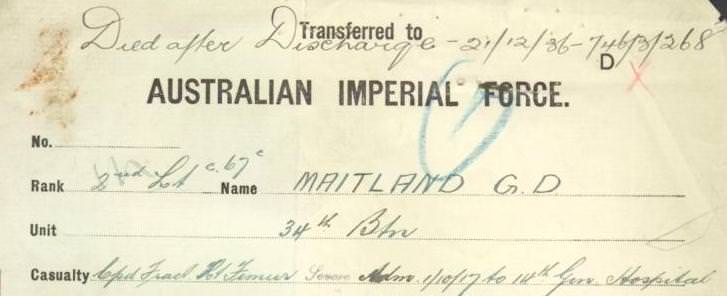
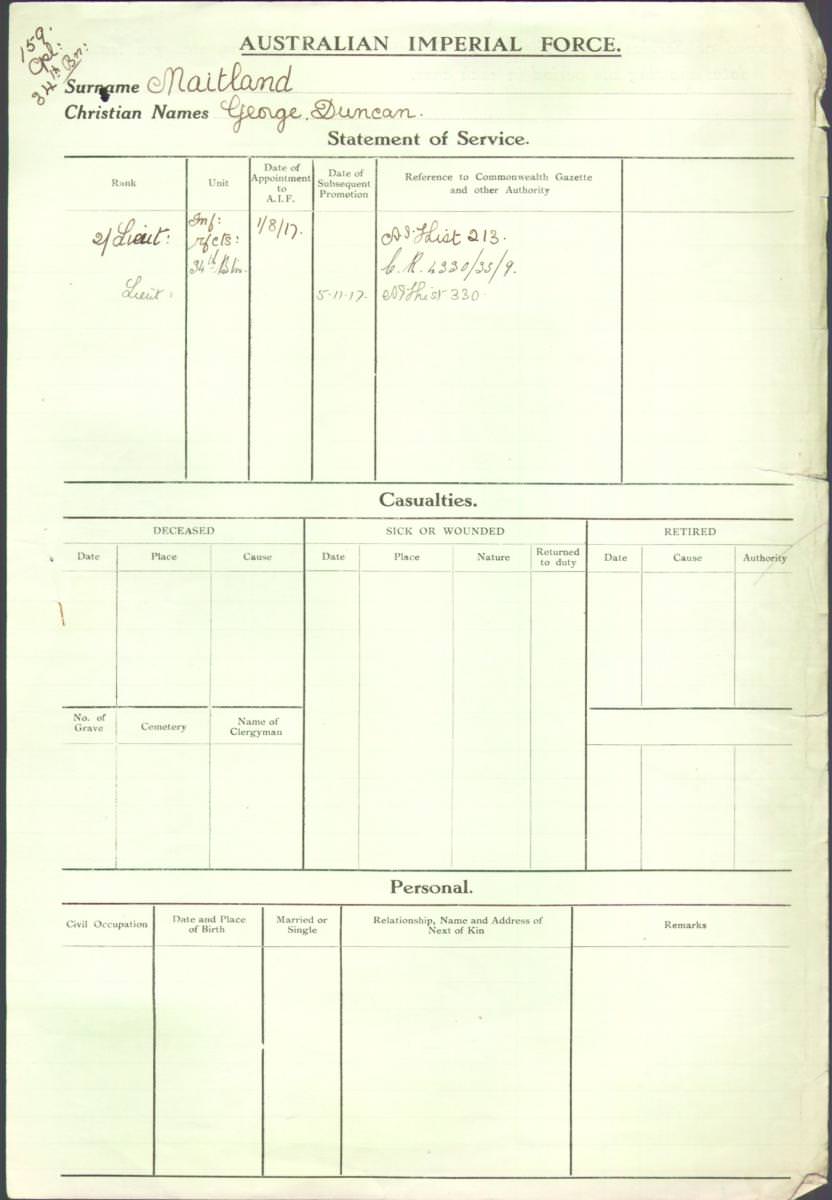
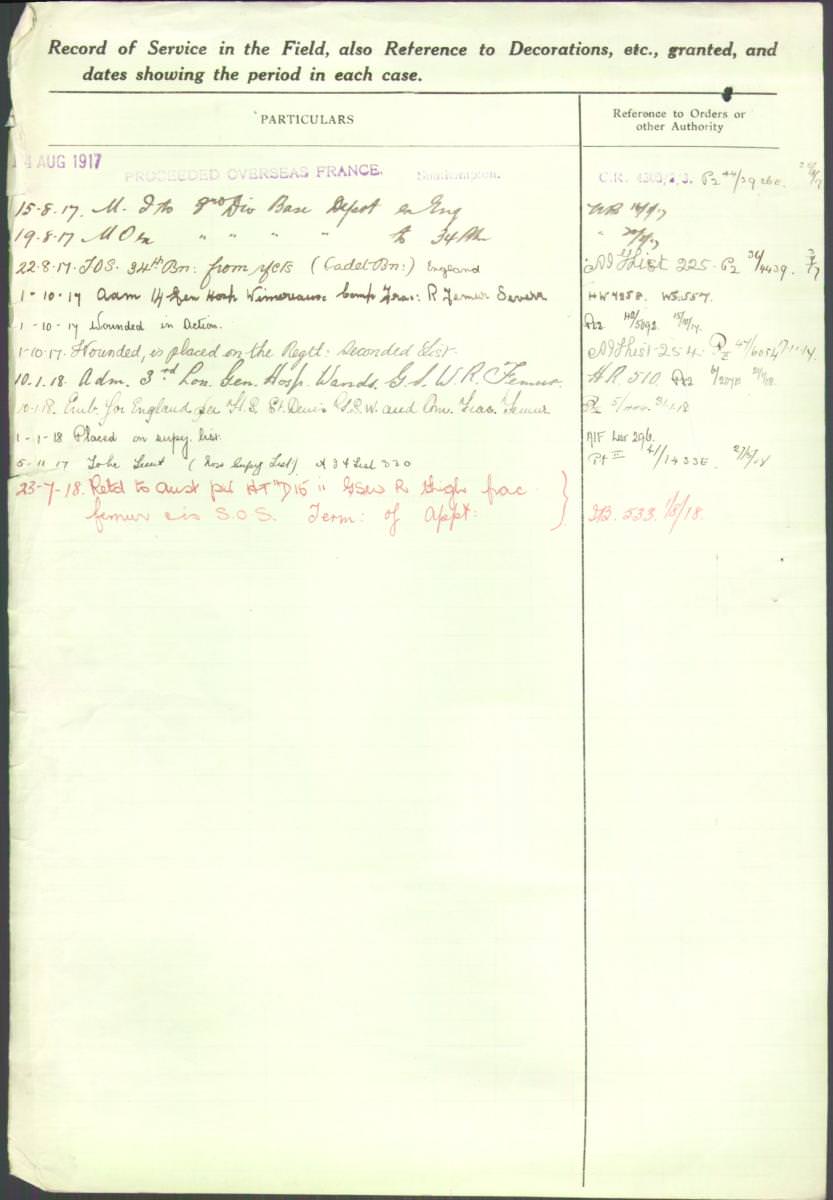
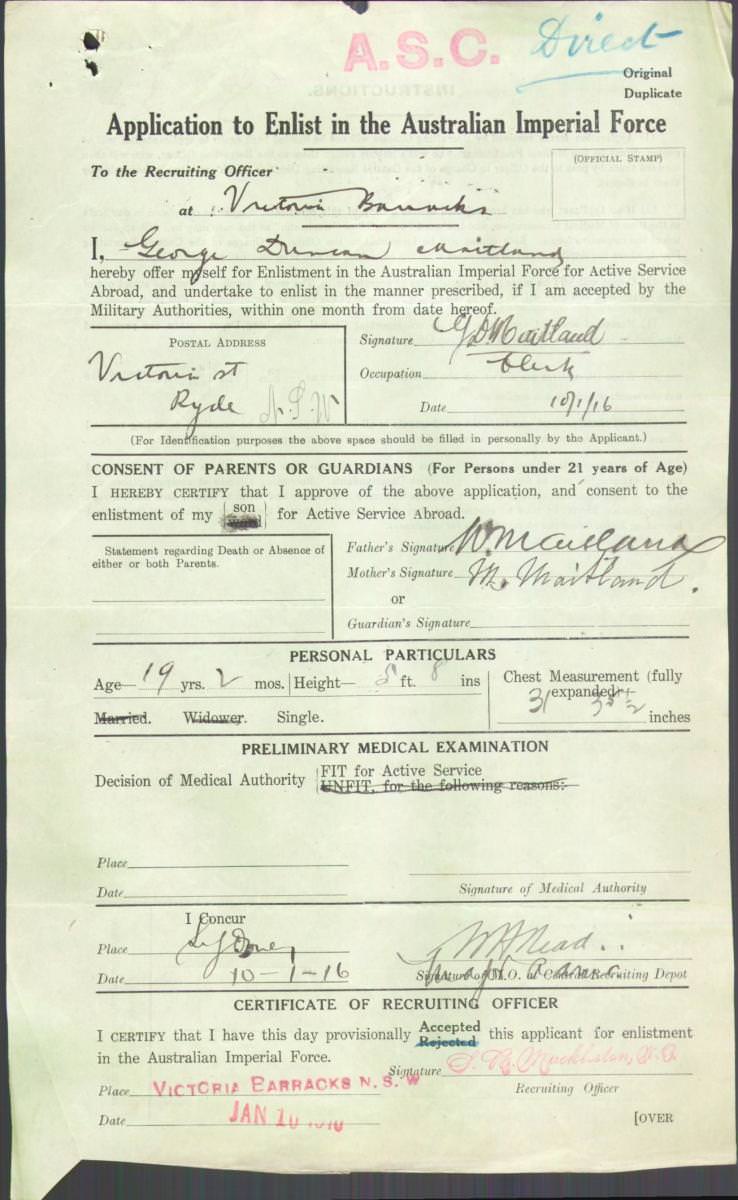
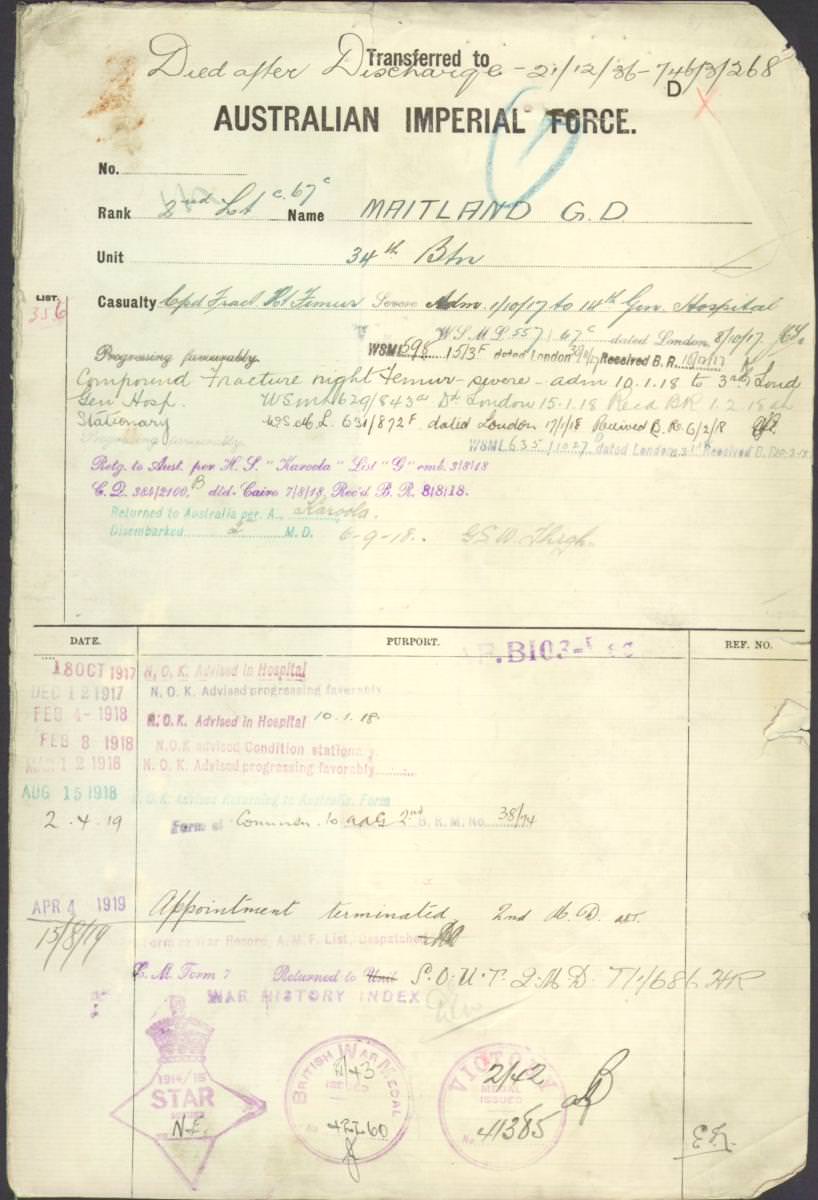

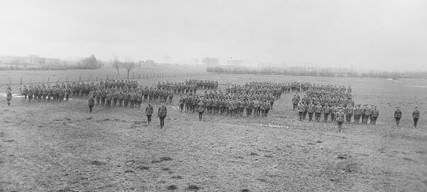 36th Battalion's last Parade before being disbanded. 30th April 1918.