
36th BATTALION - 33rd BATTALION A.I.F.
Lieutenant: 356 Leo Aubrey WILSON.
Born: 1895. Parramatta, New South Wales, Australia. Birth Cert:25685/1895.
Married: 1924. Parramatta New South Wales, Australia. Marriage Cert:17454/1924.
Wife: Mildred Maria Wilson. nee: Crothers. (1900-1959)
Died: 26th June 1951. Harris Park, New South Wales, Australia. Death Cert:18100/1951.
Father: Robert Augustine Wilson. (1842-1919)
Mother: Susannah "Susan" Wilson. nee: Gilligan. (1852-1912)
INFORMATIONLeo Aubrey Wilson enlisted with the AIF on the 16th August 1915 at at Sydney and was march in at Warwick Farm, N.S.W. where he was allocated to C Company No: 1 Depot Battalion until the 10th February 1916 where he was promoted to Acting Sergeant and transferred to B Company 36th Battalion at the Liverpool Army Camp and was an original member of the Battalion.

36th Battalion AIF om Parade at the Liverpool Army Camp
Leo embarked with the 36th Battalion on board HMAT A72 "Beltana" on the 13th May 1916 and disembarked at Devonport England on the 9th July 1917 and was marched into the 9th Training Battalion at the Durrington Army Camp.
22nd November 1916.
1: Larkhill. Troops en trained at Amesbury Station in three trains. 1st Train 7:47 am Compliment-Officers 11 and 327 others, 19 horses, 8 hand carts, 3 4 wheeled wagons and 9 bicycles. Lieutenant Colonel: James William Albert SIMPSON. Officer Commanding. A Company Lieutenant: ARNOLD. B Company Lieutenant: 3 Harry WOODHAMS. C Company Lieutenant: James Michael JULEFF.
2nd Train 9:15 am-Compliment-Officers 11 and 327 others. 20 horses, 2 two wheeled, 5 four wheeled vehicles. Major: Archibald Clifford BLACKLOW. Officer Commanding. A Company Lieutenant: Richard Henry DOYLE.
3rd Train 11:am- Compliment-Officers 10, 326 other ranks, 20 horses, 2 two wheeled, 5 four wheeled vehicles. Major: Archibald Leeson PRINCE. Officer Commanding. B Company Lieutenant: 1376 William James GORDON.
22nd November 1916
Embarked "Caesarea" 24 Officers, 811 others. Embarked "African Prince" 8 Officers 168 others, 59 horses, 15 four wheeled vehicles, 12 two wheeled vehicles and 9 bicycles. Total 32 Officers, others 979 left Southampton 6:00 pm. 1 Officer 75 others detailed as sentries and boat guard. 1 Sergeant, 1 Corporal and 20 detailed as Firing Party. 5 Sanitary Police and 10 men as Sanitary Party.
23rd November 1916.
Arrived at La Havre 1:40 am. Disembarked 7:25 am. Marched via town to No:1 Rest Camp arrived 11:40 am. Remained at Rest Camp, Le Harve, till 6:30 am 24th November 1916.
24th November 1916.
36th Battalion, less 8 Officers 250 Other Ranks marched via town to point 3 Railway Station, Le Harve at 8:00 am. En trained and left Le Harve at 10:30 am. Proceeded via Montcrolier Buchy, Abbeville 6:10 am. 10 hours late via Boulogne Calais and Bailleul. Arrived at Bailleul at 4:25 pm 25th November 1916.
25th November 1916.
De trained at Bailleul marched to billets at Merris district. Arrived at billets 10:45 pm. Quartered in 12 billets. Headquarters at Hameur Farm.
26th November 1916.
4 Officers 100 men "A" Company arrived at Merris at 8:30 am. Remainder of Battalion arrived at Merris 4:00 pm. Hostile aircraft shelled overhead 2:15 pm.
27th November 1916.
8 N.C.O's detailed to attend Gas School for 4 days. All Officers instructed in Box Respirator by Divisional Gas Officer. General: Alexander John GODLEY and General: Sir John MONASH visited billets at Hameur Farm at 2:30 pm. Captain: John Martin HAWKEY. and 1 N.C.O. per Company visited forward billets at Armentiers.
28th November 1916.
Battalion left for Armentieres in 16 Motor Lorries. Whole Battalion reported in billets at Armentieres at 5:30 pm. Headquarters established at 6:00 pm Rue De Strasburg.
29th November 1916.
Whole Battalion still in billets-supply Working Parties Only.
30th November 1916.
Visited the front line on left sector of defences at Armentiers.
22nd January 1917.
Armenteries. Enemy started light shelling at 10:00 am. At 2:00 pm locality 16 & 17 was heavily bombarded also locality 14 which ended in a box barrage being put on at 4:10 pm and an attack by the enemy from Pimple Salient. They entered our trenches but were only in 10 minutes. Our casualties 11 killed, 36 wounded, 4 missing. It is quite possible the 4 missing have been buried by Minnies.
Killed in Action; Lance Sergeant: 11 Francis Anthony ANGELINETTA. (A Company) - Corporal: 937 John Jack WILDRIDGE (A Company) - Private: 172 Charles SLOCOMBE. (A Company) Private: 183 Denis Alfred STINSON. (A Company)
Wounded in Action; Private: 33 Ralph Albert ASH.
Missing in Action; later confirmed Killed in Action; Private: 180 William Lionel STALKER. (A Company) - Private: 1706 Andrew WILLIAMS. (A Company)
Informant; Private: 176 Oscar Norman SMITH "On the 22nd January 1917 at Houplines, Armentieres the German bombarded out trenches heavily before raiding them Private: 180 William Lionel STALKER and another Private: 1706 Andrew WILLIAMS were missing for several days after the bombardment. We then found their bodies buried in a shelter and frozen in the ground and up to the time of my being wounded on the 6th of February their bodies had not been but out owing to the frost. There can be no doubt at all as to the identity of these men. I am surprised they have not been reported killed.
17th February 1917
On the night of 17th-18th February last. Lieutenant: Clarence William BODDY 36th Bn when on patrol in NO MAN'S LAND, crawled close up to a Machine Gun emplacement in the enemy wire when the Gun therein suddenly Opened fire. Sergeant: 731 Gordon Mott COX who was hit and their presence became known to the enemy who thereupon opened up a concentrated fire on them. Lieutenant BODDY who was carrying a demolition charge which was hit by a bullet without causing it to explode, thereupon crawled backwards to within about six yards of the gun, with the charge under him, fired it and he and the Sergeant both dashed away and sheltered in a crater. The charge exploded and the gun at once ceased fire and it is probable that it was destroyed. Corps, Divisional, and Brigade Commanders desire to congratulate Lieutenant BODDY on his successful and hazardous enterprise.
(36th Battalion War Diary)
Leo was admitted to the No:4 Stationary Hospital on the 14th March and spent the next month convalescing and re joined his unit on the 11th April 1917.
7th June 1917.
THE BATTLE OF MESSINES
The 3rd Australian Divisions first major offensive was at Messines Ridge on the 7th June 1917. The Australian 3rd Division was a part of the II Anzac Corps which was allotted to the first assault. The 25th New Zealand, 3rd Australian Division with the 4th Australian Division in reserve. The 4th Division were battle hardened troops who had fought many major battles. The 3rd Australian Division were having problems getting to the "jump off" point. The day before the 9th and 10th Infantry Brigades were bombarded by German Gas-Shells around Hill 63 and Ploegsteert Wood. Many of the Aussies were not wearing gas masks, but despite this they pressed on even though they received 500 casualties.
They made it to the "jump off" point but only just with some of the men from the 9th and 10th going straight over the top without stopping. The mines went up and the attack commenced behind a protective barrage. The II Anzac Corps were attacking on the right with their objective being the southern shoulder of the ridge which included Messines, the Dover and St Yves areas as far south to the east of Ploegsteert Wood.
Major General Sir John MONASH's 3rd Division had to contend with a tricky 3 mile approach out of Ploegsteert Wood and after the German gas attack, but they were not deterred. The 9th Infantry Brigade under Brigadier General: Alexander JOBSON and the 10th Infantry Brigade under Brigadier General W R NICHOLL had just made the jumping off point but some of the men did not stop, going straight into the assault from the approach march.
Their objective lay between St Yves and the Douve. The mines at Trench 127 and Trench 12 at Factory Farm were laid to aid this task. The explosions erupted a few seconds before zero hour and created craters of 200 feet in diameter, completely obliterating the German defense line as the 9th and 10th Infantry Brigades went over the top. The mine crates forced the 9th and 10th Brigades to veer to the left and right which caused some confusion with the main assault. It is testimony to the quality of training that every man knew the ground, tasks and objectives so well.
Private: 1804 John CARROLL 33rd Battalion, rushed the enemy's trench and bayoneted four of the German occupants. He then noticed a comrade in difficulties and went to his assistance, killing another German. He then attacked single handed a German Machine Gun Team, killing all three of them and capturing the gun. He later rescued two of his comrades who had been buried alive by German Shell Fire, and in spite of heavy shelling and machine gun fire he dug them out alive and saved them from certain death. John was awarded the Victoria Cross.
The German forward zone was completely engulfed and taken by the main assault. The two supporting battalions of each brigade then passed the leading battalion to continue the advance. The men were constantly re-supplied and the ridge was taken. There were many German prisoners taken during the offensive. The 3rd Division was well ahead with the 9th Infantry Brigade pushing on beyond Grey Farm, and on the right the 10th Infantry Brigade were veering left towards Septieme Barn north of Douve.
The German resistance was heavy but was generally brushed aside by tanks and artillery before the infantry had to become too involved.The 4th Bavarian Divisions Artillery had made little impact, but as the day wore on the 3rd Division and later the 4th Australian Division received many casualties from German artillery. (70% of all casualties during WW1 were from artillery).
By 9:00am nearly 6 hours after the assault began the Germans were in disarray, but there was a major problem as the Australians received less casualties as anticipated and when ordered to dig into the ridge they had so many men, that some could not find shelter. the 35th battalion were dug in around Seaforth Farm.
The second phase of the operation was to take the Oosttaverne Line. The 3rd Australian Division would now be in reserve with the 4th Division attacking. The 9th Infantry Brigade (33-34-35-36Bn) were near Thatched Cottage facing Warneton. The river Lys was to their right and the Ploegsteert Wood was now behind them.
Once their objectives were taken the troops consolidated. A barrage to stop and counter attack was shortened and caught three battalions which had to retire. By 9:00 pm this part of the Oosttaverne Line was abandoned. At 10:45 pm General: Alexander John GODLEY ordered the 3rd and 4th Divisions to retake it. This they did by the early hours of the 8th of June.
The Battle for Messines Ridge during May-June 1917 saw 35 officers and 1,631 other ranks loose their lives.
9th Infantry Brigade Casualties.
| 33rd Battalion. AIF |
8 Officers |
382 Other ranks |
| 34th Battalion. AIF |
10 Officers |
378 Other ranks |
| 35th Battalion. AIF |
5 Officers |
431 Other ranks |
| 36th Battalion. AIF |
9 Officers |
421 Other ranks |
| 9th Machine Gun Company. AIF |
2 Officer |
17 Other ranks |
| 9th Light Trench Mortar Battery. |
1 Officer |
2 Other ranks |
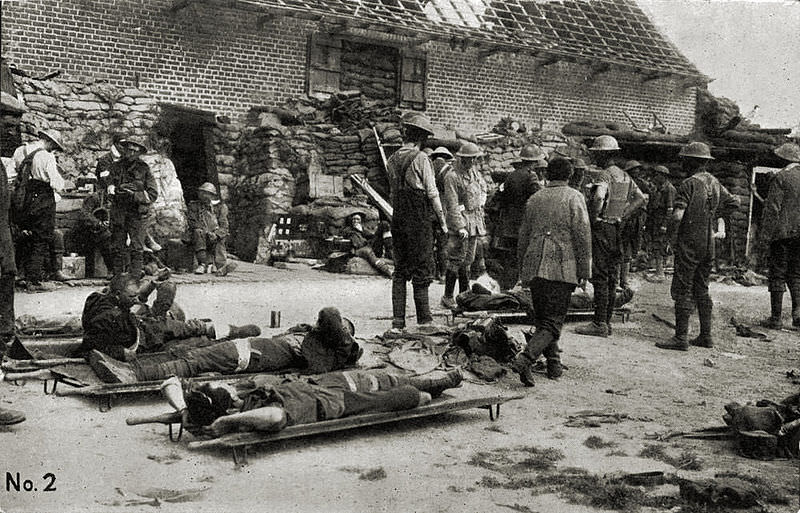
FIELD DRESSING STATION, MESSINES 7th June 1917.
12th July 1917.
MESSINES Relieved 41st Battalion in Sector u.11.b to u-5-b as per Bn 0.0.47 d/9/7/17 and Intelligence summary d/127/17. Enemy Shelled road south of MESSINES and caught tail of relief Killing two. Two men killed and others wounded. Trenches found to be in very bad condition. They had been very badly sited no attention having been paid to conformation of ground. The first principles of trench siding had not been observed and no attention paid to drainage. Communication trenches were straight, shallow and through not having been duck boarded when dug had become quite impassable in places an account of mud. Front Line had rifle on us field of fire and both it and the Support line were crude observation from WARNETON from whence they were directly exploded in places.
(33rd Battalion War Diary)
On the 14th august 1917 Leo was promoted to Warrant Officer II and was marched out to Corps School and on the 25th September Detached to attend Cadet Training in England. At completion of his training he was promoted to 2nd Lieutenant on the 31st January 1918 and proceeded overseas for France via Southampton on the 3rd June 1918. Leo was transferred to the 33rd Battalion AIF on the 1st September 1918 when the 36th Battalion was disbanded. Leo embarked from England on the 3rd May 1919 and was discharged from the AIF on the 10th August 1919.
Family InformationLeo was a single 20 year old compositor from Parramatta, N.S.W. upon his enlistment. He served for 2 years with the Senior Cadets and 2 years with the 20th Infantry Militia. Leo was buried at the Rookwood Cemetery. Section11 row 21.
Military Records


 © Commonwealth of Australia (National Archives of Australia)
Under Construction; 10/11/2007-30/10/2021.


