Lieutenant: 417 Leslie George FAINT. MC

33rd BATTALION AIF

Lieutenant: 417 Leslie George FAINT. MC


Born: 15th February 1894. Uralla, New South Wales, Australia. Birth Cert:33982/1894.

Married: 1925. Wallerawang, New South Wales, Australia. Marriage Cert:7583/1925. 

Wife: Gladys Vivian Faint. nee: Turner. (1898-1967)

Died: 20th November 1977. Inverell, New South Wales, Australia. 


Father: Alexander Faint. (1866-1932) Died at Armidale, N.S.W. 

Mother: Ellen Faith. nee: Pearce. (1868-1940) Died at Armidale, N.S.W. 


INFORMATION

Leslie George Faint enlisted with the AIF on the 4th January 1916 and was still serving with the 5th Australian Light Horse upon his enlistment. He was allocated to B Company at the Rutherford Army Camp on the 2nd of February and promoted to platoon Sergeant on the 4th May 1916.

Armidale War Memorial Fountain

Family Information

Grave of Leslie George Faint (1894-1977) Inverell Cemetery: Row: 1 Lot:10

Military Records

World War 2 Records

© Commonwealth of Australia (National Archives of Australia)

Under Construction: 21/06/2022-09/03/2023.

Lieutenant: 2559 Robert Horner FLETCHER. M.C.

Robert Horner Fletcher

33rd BATTALION AIF.

 Lieutenant: 2559 Robert Horner FLETCHER. M.C.


Born: 19th October 1896. Armidale, New South Wales, Australia. Birth Cert:28368/1896.

Died: 17th March 1935. Lismore, New South Wales, Australia. Death Cert:4832/1935.


Father: Alleine Fletcher.

Mother: Sarah A Fletcher. nee:.


INFORMATION
Robert Horner Fletcher enlisted with 5th Reinforcements, 33rd Battalion AIF on the 12th May 1916 and left Sydney on board the "Port Napier" on the 17th September 1916 and disembarked at Devonport, England on the 29th January 1917 and was marched to the Durrington Army Camp at Larks Hill where he commenced training with the 9th Training Battalion util he proceeded overseas on the 28th of February 1917.

6th December 1917.

Informant; Lieutenant: 2559 Robert Horner FLETCHER 33rd Battalion. I was on duty in the new front line opposite St Yves on the morning of the 11th of June 1917. >Captain: Charles Henry LINKLATER was C Company Commander and at about 12:30 am went forward to a post at Thatched Cot, 500 yards in front of our line to await the reports from a party under Lieutenant: 1263 Edwin Charles Pond THOMAS of A Company which had been sent forward another 400 yards to occupy Fuze Cot. At about 1:00 am no word from the party having reached Thatched Cot. Captain: LINKLATER went forward with his runner Private: 950 William Stanley SMITH to try and get in touch with the party. They did not reach Fuze cot. Two runners had been sent back by Lieutenant: THOMAS at about midnight of the 10th-11th June but did not reach Thatched Cot until about 3:45 am, when they stated that they lost their direction and had encountered a German Post. They lay in a shell hole thirty yards from the post to await daylight and while lying there they saw two figures approaching from the direction from which they themselves had come.

When these two figures were about 20 yards from the post they were challenged in English and two shots were fired. Then bombs were thrown from the German Post and the figures disappeared. By the light of a very light the runners saw about ten Germans apparently searching where they had last seen the two figures. There was nobody out from the lines at the time but the two runners, Captain: LINKLATER and his runner Private: SMITH Inquiries made by 2nd/Lieutenant: Richard Henry BLOMFIELD C Company of 33rd Battalion showed that Captain: LINKLATER'S name appeared on the German Death List of August 7th.

Note: Private: 950 William Stanley SMITH- MISSING. 7/12.6.1917. Captain: LINKLATER appears on German Death List of 7.8.1917 with no further evidence to report death in Germany.

3rd L.S. General Hospital Wandsworth, England.

Robert Horner Fletcher's Medals and Badges.

Armidale War Memorial
Family Information
Robert was a 19 year old Student from Armidale, N.S.W. upon enlistment. His parents Alleine and Sarah Fletcher were married and had at least 3 children. Alleine Flethcher born 1895 at Armidale, N.S.W. Birth Cert:1156/1895. Robert Horner Fletcher born 1896 at Armidale, N.S.W. Birth Cert:28368/1895 and died in 1935 at Lismore, N.S.W. Death Cert:4832/1935. Marianne H Fletcher born 1900 at Armidale, N.S.W. Birth Cert:926/1900.

Military Records
World War 1 Records
World War 1 Records
World War 1 Records
World War 1 Records
World War 1 Records
World War 1 Records
World War 1 Records
World War 1 Records
World War 1 Records
World War 1 Records
World War 1 Records
World War 1 Records
World War 1 Records
World War 1 Records
World War 1 Records
World War 1 Records
World War 1 Records
World War 1 Records
© Commonwealth of Australia (National Archives of Australia)

Under Construction; 08/06/2009-31/10/2016.


Lieutenant: Alfred Gordon FARLEIGH. MC MID

33rd BATTALION - 34th BATTALION AIF.

Lieutenant: Alfred Gordon FARLEIGH. MC  MID


Born: 26th February 1885. Petersham, New South Wales, Australia. Birth Cert: 6229/1885.

Died: 22nd August 1918. Killed in Action. Bray Sur, Somme, Picardie, France.


Father: Edward Manicom Farleigh. (1837-01/10/1909) Died at Rockdale via Sydney, N.S.W.

Mother: Elizabeth Farleigh. nee: Gibson. (1841-26/06/1939) Died at her home. "Cairnsfoot" Loftus Street, Arncliffe, N.S.W. 


INFORMATION
Alfred Gordon Farleigh enlisted with AIF on the 1st February 1916 and was allocated to A Company 33rd Battalion AIF with the rank of Lieutenant. 


7th March 1918

MILITARY CROSS
For conspicuous gallantry on the night of 4/5th March 1918, during raid on enemy trenches in the vicinity of WARNETON. This Officer was in charge of a party of Right Assault which penetrated to farthest limit of area raided. Owing to strong enemy opposition at point of entry, and in order to avoid delay, he led his party over the top and entered the enemy communication trench in rear on point of entry. With great dash he led his party to final objective, fighting all the way. On reaching his objective his party killed the occupants, scoured fortifications and a machine gun, and then destroyed a dugout. On returning to the front line he took charge of a blocking party on the right flank. Right through the operation this Officer was most courageous and determined.

Strength of Raiding Party-15 Officers, 300 other ranks.

London Gazette. 13th May 1918, page 5706, position 6.

Commonwealth, Australian Gazette. 24th October 1918, page 2054, position 1.

MENTIONED in DISPATCHES
For services rendered from September 22nd 1917 to 24/25th February 1918.

London Gazette. 31st December 1918, page 15228, position 9.

Commonwealth, Australian Gazette. 23rd May 1919, page 879, position 93.

Lieutenant Colonel: Walter Arnold LeRoy FRY. OBE. VD.

Major: Harry Lambert Edward Dixon WHEELER.

Captain: 717 Benjamin Greenup BRODIE.

22nd August 1918.

3:45 am. Evacuated to Reserve Position in K.12.d., k.18.a and b. Enemy started to shell our lines with all calibres. 6:00 am. Three prisoners arrived and stated that the enemy expected out attack and were standing to since midnight. Identifications were normal and forwarded on to Brigade. 7:30 am O.K. received from front line. English troops on the Left Flank. 8:00 am Weather clear and hot. Prisoners 2 Officers and 40 Other Ranks put on stretcher carrying. Enemy artillery fire still very active. All objectives gained and troops on left in position. 9:00 am Artillery slackening and then temporarily ceased. Planes over our lines machine gunning. Men feeling effects of gas, severe abdominal pains.

7:00 pm. Order received from Brigade to move up as Imperial Troops were retiring on our Left Flank. 7:10 pm. Message received from 33rd Battalion asking for assistance and "C" Coy were sent along, "A" and "D" Coy' moved forward to Forward Support Line and got in touch with "B" Coy. The C.O. went forward to original Jumping Off tape but could not get any information. 9:00 pm "B", "C" and "D" Coys arrived at 33rd. Forward Battalion Headquarters then went forward to reconnoitre, got in touch with the Coys who had got in position. 10:30 pm Guides went back to Battalion Headquarters and Limbers came up with hot meals. Situation obscure as and retired to first objective. Our Left Flank 500 yards in the air "C" Coy linked up with our Support Coy on Left and Front Line on Right forming a Front Line.

Alfred was Killed in Action on the 22nd August 1918 at Bray Sur, Somme, Picardie, France and is remembered with honour and is commemorated in perpetuity by the Commonwealth War Graves Commission at the Bray Military Cemetery.

Bray Military Cemetery

Family Information
Alfred was a single 29 year old Tannery Manager at the Ulladulla Tannery and live at "Cairnsfoot" Loftus Street, Arncliffe upon enlistment. Alfred served with the Australian Light Horse and was a Lieutenant with the 24th Infantry prior to his enlistment with the AIF

Edward and Eliza Farleigh had 3 children, 2 boys and 1 girl. Alice May Farleigh born 1880 at Newtown, NSW. Birth Cert:5590/1880. Arthur Manican Farleigh born 1883 at Petersham, NSW. Birth Cert: 5874/1883. Alfred Gordon Farleigh born 1885 at Petersham, NSW. Birth Cert: 6229/1885.

Brother Alfred Gordon Farleigh. Lodge 94 Prince Alfred. 

(Photo courtesy of Scott Arthur of Kotara, N.S.W)

Military Records
Australian National Archives

Under Construction; 13/10/2008-02/08/2023.


Lieutenant: William Thomas EWING. M.C.

36th - 33rd BATTALION AIF

Lieutenant: 746 William Thomas EWING. M.C.


Born: 23rd February 1893. Glen Innes, New South Wales, Australia. Birth Cert: 14169/1893.

Married: 1920. Glen Innes, New South Wales, Australia. Marriage Cert: 1916/1920.

Wife: Mary J A Ewing. nee: Hutton.

Died: 1st May 1973. Kogarah, New South Wales, Australia. Death Cert: 52569/1973.


Father: William Blackstocks Ewing.

Mother: Ann Ewing. nee: Gould.

Married: 1891. Glen Innes, New South Wales, Australia. Marriage Cert: 3988/1891.


INFORMATION
William Thomas Ewing enlisted with C Company 33rd Battalion AIF on the 31st January 1916 and was an original member of the Battalion and embarked onboard HMAT A72 "Beltana" on the 13th May 1916 with the rank of Sergeant.

(BEAN; History of World War 1 Vol V page 344)

28/08/1917.

MILITARY CROSS
"For conspicuous gallantry and devotion to duty. At a critical moment, when a heavy enemy barrage had disorganised his platoon which was forming up for the assault, he rallied his men and reformed them, by his coolness and gallant conduct turning a precarious situation into a completely successful enterprise."

London Gazette Supplement: 25th August 1918. No: 302515.

Wounded in Action 4th April 1918.


Glen Innes Memorial

No.746 William Thomas EWING was a 22 years and 11 month old Farmer from Glen Innes in NSW when he enlisted in the AIF on the 31st of January 1916.
On the 21st of February he was allocated to the newly raised 36th Battalion AIF. Note - the 36th Battalion was raised at Broadmeadow Camp, in Newcastle, New South Wales in February of 1916. The bulk of the Battalion's recruits had been enlisted as a result of a recruiting drive conducted amongst the rifle clubs of New South Wales by the Minister for Public Information in the New South Wales government, Ambrose Carmichael. Thus, the battalion became known as "Carmichael's thousand" and also “the Rifle clubs thousand”.
He embarked as a Sergeant in “C” Company of the 36th BATTALION AIF aboard the HMAT (A72) “Beltana” which sailed from Sydney on the 13th of May 1916. Its route was via Capetown and Dakar, arriving at Devonport in England on the 9th of July. Upon arrival in England the Battalion travelled by train, via Exeter, to the village of Amesbury in Wiltshire, where they unloaded and then marched the several miles to the AIF Camps at Larkhill. On arrival the 36th Battalion was allocated to the No.4 Camp and the men were then given four days Disembarkation-Leave prior to commencing their training in England.
The Battalion now became part of the 9th Infantry Brigade (33rd, 34th, 35th, and 36th Infantry Battalions, 9th Machine-Gun Company, and the 9th Light Trench Mortar Battery),of the newly raised 3rd Australian Division (9th, 10th, and 11th Infantry Brigades). It would spend the next 4 months training hard on Salisbury Plain to learn all the methods of fighting Trench-Warfare.
The 9th Brigade trained and practiced in Musketry, bayonet fighting, the digging of trenches, received their weapons, equipment and field-kitchens, attended various specialist courses, practiced route-marching, improving their fitness, practised trench raids and attacks while coordinating with aircraft and Artillery, culminating in a week in October spent in trenches under active service conditions. They voted in the ‘Conscription Referendum’, were reviewed by His Majesty the King on Salisbury Plain, and then completed a final Divisional Route-March of 18 miles. Selected personnel had attended various Promotion and Officer Training Courses, in preparation for the Casualties and losses that were inevitable.
On the 22nd of November 1916 the 36th Battalion proceeded from England to France, as part of the 9th Brigades deployment onto the Western-Front. On arrival the Brigade marched to the Sanvic Rest Camp (located at Bléville, several miles NNW of Le Havre). On the 23rd/24th the Brigade moved by train from Le Havre to Bailleul, in cattle-trucks that were marked “Hommes (people) 40, Chevaux (horses) 8”. On the 26th the 36th Battalion marched from Bailleul to billets in the village of Merris. On the 29th the 36th Battalion moved from Merris to the ‘D’ Battalion area at the village of Armentieres. At 5 p.m. on the 29th of November 1916 the G.O.C. of the 9th Infantry Brigade assumed control of the Armentieres Sector.
On the 21st of March 1917 he was promoted to Warrant Officer Class 2 and into the position of Company Sergeant Major.
On the 6th of April 1917 he was commissioned a 2nd-Lieutenant in the AIF. He was with the Battalion for the attack on ‘MESSINES’ on the 7th of June 1917.
On the 10th of June the 36th Battalion was given orders to capture the 'La Potterie' System of Trenches. It was decided by the C.O. 36th Battalion that the task could be accomplished with 5 Officers and 200 men. At Zero hour (i.e.11 p.m. the assaulting force left the trenches and was then subjected to an enemy Artillery barrage that disorganised the attack. Due to the Leadership of Lieutenant EWING and the other Officers the attacking force was successfully reorganised and successfully achieved its Objective.. For his Leadership and his actions, he was nominated for a Bravery Award.

Extract from a Report on the Operations carried out by the 36th Battalion: 2nd - 13th June 1917.

The extract explains the action on 10th of June 1917 (attack & capture of the 'La Potterie' system of trenches) for which Lieutenant EWING was awarded the M.C.

On the 18th of July he reported sick and was admitted to hospital with ‘Otitis Media’. He rejoined the Battalion from hospital on the 7th of August.
On the 25th of August 1917 the ‘London Gazette’ reported the award of the MILITARY CROSS. The Citation for the M.C. read: “For conspicuous gallantry and devotion to duty. At a critical moment, when a heavy enemy barrage had disorganized his platoon, which was forming up for the assault, he rallied his men and reformed them, by his coolness and gallant conduct turning a precarious situation into a completely successful enterprise.”
Glen Innes Examiner (NSW 1908 - 1954) Thu 8 Nov 1917
Glen Innes Examiner (NSW 1908 - 1954) Mon 13 May 1918
On the 30th of August he was promoted to the rank of Lieutenant and the following day was seconded for duty with the 9th Training-Battalion in England. He marched in to the Training-Battalion on the 3rd of September. In January 1918 he was on a ‘Bombing Course’ at Lyndhurst.
On the 1st of March 1918 he deployed across to France and marched into the Australian Infantry Base Depot at Rouelles. He rejoined the 36th Battalion on the 10th.
In late March of 1918 the 9th Infantry Brigade was rushed south to ‘the Somme’, in response to a huge new German Offensive (known by the Germans as Operation Michael), and the Brigade was used as a mobile formation, being thrown into the line wherever strengthening was needed. The 9th Brigade finally ended up at the village of Villers-Bretonneux.
William Thomas EWING was with the 36th Battalion for the “1ST BATTLE OF VILLERS-BRETONNEUX” on the 4th of April 1918, when the 9th Australian Brigade, and a few tired elements of the British 5th Army, were instrumental in stopping the German advance towards the key City of Amiens. The 36th Battalion had carried out a heroic ‘Forlorn Hope’ Counter-Attack in order to stop the Germans, and the Brigade then held the Germans despite counter-attacks.
At some point during this Battle on the 4th of April he was WOUNDED-IN-ACTION, receiving a wound in the neck. He was admitted to the 43rd Field Ambulance and transferred to the 5th Casualty Clearing Station. He was then transported by Ambulance-Train to a hospital on the coast. On the 6th of April he was invalided across to England where he was admitted to the 3rd London General Hospital at Wandsworth.
Note - Due to the combination of recent heavy losses of men in the Brigade and the lack of sufficient Reinforcements arriving from Australia, the decision was taken to reduce the 9th Infantry Brigade to three Infantry Battalions. Since the 36th Battalion had lost most of its Senior Officers, the decision was made to sacrifice “Carmichael’s Thousand”. On the 30th of May 1918 the 36th Battalion was officially disbanded and its men used to reinforce the other three Battalions within the 9th Brigade. William Thomas EWING was taken-on-strength by the 33rd BATTALION AIF.
On the 2nd of May 1918 he was released from hospital and marched in to the Overseas Training Brigade. On the 13th of May he proceeded back across to France, marching in to the Australian Intermediate Base Depot at Rouelles. On the 18th of May he marched out to the front and joined the 33rd Battalion on the 20th of May.
On the 8th of June 1918 he attended the 4th Army Musketry School, rejoining the Battalion on the 1st of July.
He was with the 33rd Battalion for the ‘AUGUST OFFENSIVE’, the ‘ADDVANCE TO BOUCHAVESNES’, and the final ‘ADVANCE TO THE HINDENBURG LINE’. On the 2nd of October the Australian Infantry was withdrawn from frontline duties, by Order of the Australian Prime-Minister.
On the 5th of September he was seconded for duty with the Australian Corp School. He remained at the Corp School for the Armistice, some UK Leave (15th – 31st December 1918), until he resumed Regimental Duty on the 21st of January 1919. He had been performing the role of Adjutant for Australian Soldiers in France.
In May of 1919 he returned to Australia, arriving on the 23rd of July. On the 7th of December 1919, his appointment as an Officer in the AIF was terminated.
Note- William Thomas EWING went on to join the Police Force - eventually became an Inspector and the foremost expert in finger-printing in Australia.
Photograph of William Thomas EWING that was printed in the Truth (Sydney, NSW : 1894 - 1954) Sun 23 Jun 1935, during the famous "Shark Arm Case".
William Thomas EWING passed away on the 1st of May 1973 at Kogarah in NSW.
Woronora Memorial Garden
(Bill Durant; May 2020)

FAMILY INFORMATION
William was a Station Overseer from Reddestone Creek via Glen Innes prior to enlistment. William served with the 5th Australian Light Horse at Glen Innes for 4 years. William and Ann Ewing had 4 children, 2 boys and 2 girls. William Thomas Ewing born 1983 at Glen Innes, N.S.W. Birth Cert: 14169/1893 and died 1973 at Kogarah, N.S.W. Death Cert:52569/1973. Annie I Ewing born 1895 at Glen Innes, N.S.W. Birth Cert:3370/1895. David Ewing born 1897 at Glen Innes, N.S.W. Birth Cert:21624/1897. Morria Ewing born 1901 at Glen Innes, N.S.W. Birth Cert:22107/1901.

Military Records
© Commonwealth of Australia (National Archives of Australia)

Under Construction; 02/11/2006-01/06/2025.


Private 726 George CARTWRIGHT. V.C.

33rd BATTALION AIF

Private 726 George CARTWRIGHT. VC ED


Born: 9th of December 1894. South Kensington, London, England.

Married: 25th June 1921. Chatswood, New South Wales, Australia. Marriage Cert:12174/1921.

Wife: Elsie Cartwright. nee: Broker. (1896-1968)

Died: 2nd of February 1978. Epping, New South Wales, Australia. Death Cert:3110/1978.


Father: William Edward Cartwright.

Mother: Elizabeth Emma Cartwright. nee: Stracey.


INFORMATION
George Cartwright proceeded to the camp at Narrabri where he formally enlisted enlisted with the C Company 33rd Battalion AIF on the 9th of December 1915 and left Sydney on board HMAT A74 "Marathon" on the 4th of May 1916.

33rd Battalion AIF. Larkhill 1916

George won the Victoria Cross whilst serving with the 33rd Battalion near Peronne in August 1918. On the 31st of August 1918 at Road Wood, south west of Bouchavesnes, near Pernonne, France.

VICTORIA CROSS
For the most conspicuous bravery on the morning of 31st August 1918, during the attack on Road Wood, south-west of Bouchavenes, near Perone. When two companies were held up by machine gun from the south western edge of the wood, without hesitation Private Cartwright moved against the gun in a most deliberate manner under intense fire, He shot three of the of the team and, having bombed the post, captured the gun and nine enemy. His gallant deed had a most inspiring effect on the whole line, which immediately rushed forward. Throughout the operation Private Cartwright displayed wonderful dash, grim determination and courage of the highest order.

London Gazette 14th December 1918. Page 14779 Position 2.

Commonwealth of Australia Gazette 23rd of May 1919. Page 886 Position 2.

George Received his Victoria Cross from King George V at Buckingham on the 8th March 1919.

His commanding officer, Lieutenant Colonel Leslie Morshead, who, in the Second World War was to rise to he rank of Lieutenant General and to be knighted, described how Cartwright had shot the three machine-gunners after advancing and firing his rifle from the shoulder with obvious calm and careful aim "in the face of the most withering fire". He added that, immediately following Cartwright's actions:- "the whole battalion stood up, vociferously cheered him and renewed the attack with the greatest of vigour and determination". He concluded:-To have cleaned such a stronghold as Road Wood with so few men seems incredible. Two days later we actually counted 120 dead Germans in the Road Wood".

Whilst Cartwright was unscathed in this subsequent action he was again Wounded in Action on the 30th September, when he received Severe Gun-Shot Wounds to the head and Left Arm. He was evacuated to England and was not released from Hospital until the 10th of January 1919.

George Received his Victoria Cross from King George V at Buckingham on the 8th March 1919. On the 31st of March 1919 he embarked on board the "Khyber" and disembarked in Sydney on the 14th May 1919 and was discharged from the AIF on the 1st July 1919.

George Cartwright VC Ribon Bar
October 2009. Status International, Sydney, New South Wales. I was the under bidder and unable to secure for the Harrower Collection.

Lot: 9682 Reserve: A$1500 (US$1313) (€897) (£824) Estimate: A$2000 (US$1750) (€1196) (£1098) Description: 1918 Victoria Cross. The original Ribbon Colour Bar & miniature bronze VC Device of 726 Private George Cartwright, VC, 33rd Infantry Battalion, AIF. Born 09.12.1894 South Kensington, London, resident at Inverell, NSW, on enl 19.12.1915. 'C' Coy, 33rd Bn AIF. To France 26.11.1916. Wounded in Action 09.06.1917, WIA (2nd occasion) 19.04.1918, WIA (3rd occasion) 02.10.1918. Awarded Victoria Cross per LG 14.12.1918, pg 14779 for 31 Aug 1918 (CG#61 23.05.1919). Citation reads: "For most conspicuous bravery and devotion to duty on the morning of the 31st August, 1918, during the attack on Road Wood, south west of Bouchavesnes, near Peronne. When two companies were held up by machine gun fire, from the south western edge of the wood, without hesitation, Private Cartwright moved against the gun in a most deliberate manner under intense fire. He shot three of the team, and having bombed the post, captured the gun and nine enemy. This gallant deed had a most inspiring effect on the whole line, which immediately rushed forward. Throughout the operation Private Cartwright displayed wonderful dash, grim determination, and courage of the highest order." Returned to Australia & disch 31.03.1919, re-enl (Merrylands, NSW) 05.03.1940. Captain with 1st Aust INF BTN, disch 10.05.1946. Died Sydney 1978. Medals in Imperial War Museum, London. This is the original ribbon & device worn on his uniform upon return from overseas and before the issue of his Campaign and Coronation Medals. It was given by him to a 'lady admirer' c/1919-1920. Provenance by descent. Together with an original newspaper clipping of award to Cartwright and small box which it has been stored. With copies of full archive file and some research. As worn with stitched on brooch fitting to reverse - device attached via thread holes at 9 and 3 o'clock. gVF. Extremely scarce. (P)

Bid number: A13403

George Cartwright VC
George Cartwright. V.C.
George was Commemorated and his ashes were scattered in the Garden of Remembrance, Rookwood, Cemetery, Sydney, New South Wales, Australia.

Photos of George Cartwright are in the possession of The Australian War Memorial

Family/Military Information
George arrived in Australia from England in 1912 and worked as a labourer on a sheep station in the Elsmore district in Northern New South Wales upon joining the AIF at Inverell. After returning from World War 1 George worked as a motor mechanic and on the 25th of June 1921 he married Elsie Brooker (born at Ballarat, Victoria) at the Saint Stephen's Anglican Church at Chatswood, N.S.W. they had a daughter Norma who was to pre-decease him and a son Albert and lived at Merrylands and susequently Regents Park.

George was active with the Citizens Military Forces and enlisted with the 3rd Battalion where he rose to the rank of Sergeant and on the 17th November 1930, after the Battalion was linked with the 4th Battalion to form the 4th/3rd Battalion, he was promoted to Warrant Officer. At the time, although a non smoker, he was a storeman with cigarette manufacturer, W.D. & H.O. Wills Limited. He rose to the rank of Captain. George opened the Other Rank's Club at Singleton Barracks in 1968 which was renamed the Cartwright Club in his honour. (J.J. Atkinson)

Military Records
World War 1 Records
World War 1 Records
World War 1 Records
World War 1 Records
World War 1 Records
World War 1 Records
World War 1 Records
World War 1 Records
World War 1 Records
World War 1 Records
World War 1 Records
World War 1 Records
World War 1 Records
World War 1 Records
World War 1 Records
World War 1 Records
World War 1 Records
World War 1 Records
World War 1 Records
World War 1 Records
World War 1 Records
World War 1 Records
World War 1 Records
World War 1 Records
World War 1 Records
World War 1 Records
World War 1 Records
World War 1 Records
World War 1 Records
World War 1 Records
World War 1 Records
World War 1 Records
World War 1 Records
World War 1 Records
World War 1 Records
© Commonwealth of Australia (National Archives of Australia)

Under Construction. 23/02/20060-16/06/2016.


Private: 1270 Harold Hayward UNVERHAU.

Rising Sun

33rd BATTALION - 3rd BATTALION AIF

Private: 1270 Harold Hayward UNVERHAU.


Born: 7th September 1893. Armidale, New South Wales, Australia. 

Died: 5th October 1917. Belgium.


Father: Gottlap Charles Unverhau (circa 1860-1923) Died at Armidale, N.S.W. Death Cert:16747/1923.

Mother: Eliza J Unverhau. nee:. (circa 1860-1925) Died at Armidale, N.S.W. Death Cert:6485/1925.


INFORMATION
Harold Hayward Unverhau enlisted with the AIF on the 14th January 1915 at Armidale, N.S.W. but was rejected as Medically Unfit but re enlisted on the 20th January 1916 with the 33rd Battalion AIF.

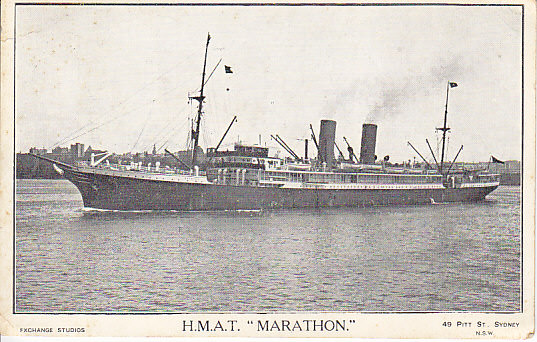
HMAT A74 Marathon

A SOUVENIR OF H.M.A.T. MARATHON. THE NORTHERN BATTALION'S TROOPSHIP.

Mrs. C. Unverhau, of "Glenwood" Uralla, forwards us a souvenir of the Marathon's voyage, which she has just received from her son, Private: 1270 Harold Hayman UNVERHAU who is a member of the Northern Battalion. The title page contains a photograph of the ship and a statement of the troops on board. The rest of the letterpress is as follows: Perhaps one of the prettiest, and most affecting sights in the world is an Australian ship's good-bye, especially if the vessel be a transport. The devotion of relatives and friends is amazing. Besides undergoing the discomfort and inconvenience of a long journey to the port of embarkation, they also cheerfully endure the tedium of uncertainty and waiting about incidental to the dispatch of' troops. In this case the anxiety of attachment, saw some taking up a position of advantage a day previous.

Friends assemble on the quay with rolls of colored paper ribbons, one end of which is thrown to the departing one on board and the other retained by a friend ashore. As the vessel moves away; the rolls are unwound till hundreds of bright-hued streamers are suspended like a fairy-chain between the ship and shore till the whole length runs out or snaps asunder through strain. The "Marathon's" departure was particularly auspicious. Every soldier on the ship and every person ashore seemed connected by a rainbow. A thousand strands, irradiated in the morning sun. Not content with that, motor launches filled with well-wishers must needs follow her up some distance when under weigh. Within an hour of sailing the stormy winds were blowing and the ship—one of the most steady and reliable that ever left the docks—a-tossing. Sea legs and sea stomachs would have fetched any price. Misled by the alert appearance and uniform, unfortunately no one had anticipated ,the demand. The disappearing lights of Bondi synchronised with the dwindling spirits of the 33rd, now at a very low ebb indeed.

It was, nobody's fault that the voyage was a little tedious through being unduly long, accentuated a good deal by intermittent bad weather. To enumerate a few is to commence a really long list. Besides the daily parades for drill, etc., when the weather held fine, there were boxing bouts and sports, relieved by band performances and deck concerts . Some of the days, with calm sea and warm, radiant sunshine, were wholly delightful ; while cool moonlight evenings provided ideal conditions for pianofortes and vocal selections. Ports of call, too, gave opportunity to enlarge experience and profit by observation, though in several instances it was a case of distance lending enchantment to the view— one cannot see much on the deck of a steamer half a mile from an object on shore, which strangeness, of course, only heightens interest and foments desire to approach closer. Yet despite all drawbacks every man on the ship got the benefit of a passing acquaintanceship with towns and countries other than his own—a direct contrast, say, in comparing Central Africa with the Commonwealth or, to come nearer home, Western with Eastern Australia, and again his own with the Colony of South Africa.

16th September 1916 transferred to the 3rd Battalion AIF. Menin Gate Memorial, Ypres, Flanders, Belgium

11th November 1917.

Informant: Corporal: S RIGNEY. 10th Battalion A.I.F. ""Has possession of the Identity Disk, Paybook and other effects of Pte Unverhau who was killed about 6th of October 1917. Cpl Rigney asks for information as to what he should do with these.

Note wrote to Cpl Rigney either bring these here or sent them to H.Q.

Menin Gate War Memorial

Family Information
Harold was a single 22 year old Farmer from "Glenwood" Uralla, N.S.W. upon enlistment. Raymond Charles Unverhau born 1896 at Uralla, N.S.W. Birth Cert:17129/1896 married Winifred Devine at Armidale, N.S.W. 8775/1924 and died 1943 at Sutherland, N.S.W. Death Cert:5885/1943.

Uralla Cemetery
Military Records
World War 1 Records
World War 1 Records
World War 1 Records
World War 1 Records
World War 1 Records
World War 1 Records
World War 1 Records
World War 1 Records
World War 1 Records
World War 1 Records
World War 1 Records
World War 1 Records
World War 1 Records
World War 1 Records
World War 1 Records
World War 1 Records
World War 1 Records
World War 1 Records
World War 1 Records
World War 1 Records
World War 1 Records
World War 1 Records
World War 1 Records
World War 1 Records
World War 1 Records
World War 1 Records
World War 1 Records
World War 1 Records
World War 1 Records
World War 1 Records
World War 1 Records
World War 1 Records
World War 1 Records
World War 1 Records
World War 1 Records
World War 1 Records
World War 1 Records
World War 1 Records
World War 1 Records
World War 1 Records
World War 1 Records
World War 1 Records
World War 1 Records
© Commonwealth of Australia (National Archives of Australia)

Under Construction: 31/10/2016-06/05/2018.


Private: 14 John AYRE. “Jack”

35th BATTALION A.I.F.

Private: 14 John AYRE. "Jack"


Born: 1894. Tamworth, New South Wales, Australia. Birth Cert:32569/1894.

Died: 1st of June 1917. Died of Accidental Injuries at Ploegsteert Wood, Belgium.


Father: Henry Ayre. (1849-1917)

Mother: Florence E Ayre. nee:.

Step Mother: Sarah Ayre. nee. (1861-1948)


INFORMATION
John Ayre enlisted with A Company 35th Battalion AIF on the 9th of December 1915 and was an original member of the Battalion. He left Sydney on board HMAT A24 "Benalla" on the 1st of May 1916. John served with the 9th Light Trench Mortar Battery and died from accidental injuries on the 1st of June 1917 when an ammunition dump exploded at Ploegsteert Wood, Belgium.

7th August 1917.

Informant; Private: 107 Francis William Joseph HARVEY. A Company, No: 1 Platoon. 35th Battalion. Private: 14 John AYRE was in A Company No:3 Platoon. He came from N.S.W. I had known him for about 2 months 2 years and knew him well, and was a personnel friend. His christian name was Jack and his number was 14. I saw his grave between Regent Street and the Strand in PLOEGSTEERT WOOD. There was a cross with his name and battalion.

Australian Camp, ROUELLES.

15th August 1917

Informant; Private: 36 William McIntosh BROWN I was told by Lewis Gunner Private: 67 Cooper Taylor EYRE 35th AIF A Coy, No:1 Platoon, who is I think, wounded that he was with Private: 14 John AYRE when he was killed. He gave no details. Ayre's name was Jack and his No: 14.

No:11 Convalescent Camp, BUCHY, ROUEN.

29th August 1917.

Informant; Private: 67 Cooper Taylor EYRE, A Company No: 1 Platoon 35th Battalion. A.I.F. Private: 14 John AYRE was killed by an explosion in an ammunition dump, which was caused by a pin coming out when unloading shells. There were several of them killed and he was among st the number. I I did not see the casualty, but I saw his grave at Pount-de-Nippe, and it was marked by a cross bearing his number, name, and unit. 3rd Australian Auxiliary Hospital, Dartfrord, England.

1st September 1917.

Informant; Private: 210 Frederick John STAPLETON, A Company 35th Battalion. I saw Private: 14 John AYRE's body in the graveyard, waiting to be buried and later saw his grave. It had a cross erected over it bearing his name, number and battalion. The cemetery is at PLUG-St-WOOD, near ARMENTIERES, and easily traceable. We came over together on the "Benalla" and knew each other quite well.

No:3 Command Depot, EURDCOTT, England.

3rd September 1917.

Informant; Corporal: 244 Richard WILLIAMS A Company No:4 Platoon, Private: 14 John AYRE of the 9th Brigade, Light Trench Mortar Battery, was killed at Hill 163 and buried in ARMENTIERES Cemetery. He had originally been in the 35th Battalion, A Company and I think the No:2 Platoon.

Australian Camp, ROUELLES.

4th October 1917.

Informant; Corporal: 1647 Ernest Albert FRASER, 9th Light Trench Mortar Battery. I saw Private: 14 John AYRE killed at PLOEGSTEERT WOOD by an explosion, death was instantaneous. He was buried at the rear of PLOEGSTEERT WOOD. I did not see his grave. I knew him well, he was attached to the 9th L.T.M. Battery.

3rd Australian Auxillary Hospital, DARTFORD, England.

STRAND MILITARY WAR CEMETERY
John is remembered with honour and is commemorated in perpetuity by the Commonwealth War Graves Commission and is buried at the Strand Military Cemetery, Ploegsteert, Belgium.

Family Information
John was a single 22 year old Railway Shunter from 20 Johns Street, Tighes Hill, New South Wales prior to enlistment.

Tamworth Cemetery

 Military Records

Australian National Archives

(Studio Photo, Tamworth Historical Society.)

Under Construction; 27/07/2006-04/10/2018.


Captain: Charles John DOIG. M.C.

36th BATTALION - 33rd BATTALION A.I.F.

Captain: Charles John DOIG. M.C.


Born: 25th March 1887. North Sydney, New South Wales, Australia. 

Died: 1st October 1918. Killed in Action. Bony, Hindenburg Line.


Father: Alexander Evans Doig.

Mother: Agnes Eadie Doig. nee: Torrance. (1854-1928) died at Chatswood, N.S.W. Death Cert:7590/1928.


INFORMATION
Charles John Doig enlisted on the 15th of November 1915 and was transferred to D Company, 36th Battalion AIF with the rank of 2nd Lieutenant, and left Sydney on board HMAT A72 "Beltana" on the 13th of May 1916.

Red Cross Report. 

The Battalion was about to advance on Le Catelet on the afternoon of 1.10.18 and just after moving across the Bellicourt Tunnell immediately East of Bony the enemy opened up a sharp barrage of 42 and 45s. During this barrage Lieutenant:547 Harold Innes SPENCER MM was killed outright by a fragment of a shell which burst close by. Captain: Charles John DOIG MC was killed at the same time and both were buried together on the Hindenburg Line at 62B (WIANCOURT SHEET) A15.a95. A suitable cross erected by our pioneer section. 

11th March 1919

Informant; Lieutenant Colonel: Leslie James MORSHEAD Commanding Officer 33rd Battalion Headquarters. This Officer was in charge of D Company, 33rd Battalion, and on 1-10-1918 after crossing the HINDENBERG LINE near BRAY and prior to making and advance on LE CHATELET, he was sitting in a shell hole explaining the proposed operation when a enemy 6" shell fell close by and a fragment struck him in the head. Death was instantaneous. He was buried by Chaplain: BURKITT of this Battalion, the C.O. Adjutant, and other Officers attending the funeral. a suitable cross was erected by us. He was buried at WIANCCURT.

A.I.F. Headquarters 13-3-18.

17th March 1919

Informant: Private: 3400 Cecil Ernest WALSH B Company 33rd Battalion AIF. On the 1/10/1918 the Battalion was through the HINDENBURG LINE, advancing on BEAUREVOIR. About 4:00 pm before they reached the village the Huns opened up a "Whiz-bang" and machine gun barrage on them and Captain: Charles John DOIG. M.C was killed outright by a "Whiz-bang" while he was in reserves for the moment. Informant further ahead and was wounded and while being carried out he passed the Captain lying dead on the roadside. One of Informant's Strecher bearers named Jim Finlay pointed the Captain out to him. Informant came straight away to England, but was later told that BEAUREVOIR was captured after darkness set in. According to Informant Captain DOIG was a well liked Officer.

"Horton" Penkivil Street, Willoughby, N.S.W.

24th May 1919.

Informant; Lance Corporal: 1410 Lindsay IRVING 33rd Battalion, Transport Section. During the afternoon of October 1st 1918. Captain: Charles John DOIG was hit by a shell on the head, killing him instantly at BONEY in the front of the HINDENBURG LINE. He would be buried on the field near where he fell. This information was obtained by hearing the men's statements at the unit. I think Lieutenant Colonel: Leslie James MORSHEAD 33rd Battalion, who was at Tidworth and was in the stunt may be able to give more information.

Ward 5, 3rd Australian Auxiliary Hospital.

25th April 1919.

Informant; Private: 2938 Francis James LLOYD D Company 33rd Battalion AIF states that they both belonged to D Company of which Captain: Charles John DOIG. MC was the Commanding Officer. On 1/10/18 the Battalion was in action at BONEY on the HINDENBURG LINE. They hopped over at 3:00 pm and an hour later the Captain was killed outright by a shell fragment while taking cover under a bank, he was hit in the head. Informant was about 3 yards away and saw the Captain Killed. He was buried near BONEY, but Informant was not present but was given the details by one of his mate Private: 3420 William Albert KAYLOCK who helped bury the Captain. According to informant Captain DOIG was a very popular Officer indeed.

Victoria Barracks, Sydney.

3rd May 1916

Informant: Private: 2553 William DEVLIN 33rd Battalion AIF. Informant states that they both belonged to D Company, of which Captain: Charles John DOIG was Commanding Officer. On the 1st October 1918 the Battalion was in action on the Hindenberg Line. About half and hour before the hop over, which took place at 5:00 am, the Captain was killed outright by a shell while kneeling down in the act of taking cover from the heavy bombardment. Informant was about 5 yards away, and saw the Captain fall, in fact was wounded by the same shell. When informant was taken away the Captain had not been moved. Informant added that the Captain was and exceedingly well liked officer, being one of the best O.C's the Battalion had, and all the boys thought the world of him.

Victoria Barracks, Sydney, N.S.W.

Family Information
Charles was a 28 year old single Commercial Traveller from 29 East Crescent, McMahons Point, N.S.W upon enlistment. Charles served with the rank of Captain with N.S.W. Scottish Rifles prior to WW1. Charles was educated at Sydney Grammar School. His Parents Alexander and Agnes Doig had at least 3 children. Charles John Doig was born in 1887 but no record of his birth is registered in N.S.W. although he stated on his enlistment papers that he was born in South Sydney, N.S.W and died in 1918 during WW1. Alisa Doig born 1888 at St-Leonards, N.S.W. Birth Cert:13478/1888. Allan Torrance Doig born 1896 at St-Leonards, N.S.W. Birth Cert:34483/1896 and died in 1918 during WW1. His brother Allan enlisted with the 17th Battalion.

Lieutenant: Allan Torrance DOIG. M.C. served with the 17th Battalion and Died of Wounds on the 27th of June 1918 as a Prisoner of War.

Military Records
World War 1 Records
World War 1 Records
World War 1 Records
World War 1 Records
World War 1 Records
World War 1 Records
World War 1 Records
World War 1 Records
World War 1 Records
World War 1 Records
World War 1 Records
World War 1 Records
World War 1 Records
World War 1 Records
World War 1 Records
World War 1 Records
World War 1 Records
World War 1 Records
World War 1 Records
World War 1 Records
World War 1 Records
World War 1 Records
World War 1 Records
World War 1 Records
World War 1 Records
World War 1 Records
World War 1 Records
World War 1 Records
World War 1 Records
World War 1 Records
World War 1 Records
World War 1 Records
World War 1 Records
World War 1 Records
World War 1 Records
World War 1 Records
World War 1 Records
World War 1 Records
World War 1 Records
World War 1 Records
World War 1 Records
World War 1 Records
World War 1 Records
World War 1 Records
World War 1 Records
World War 1 Records
World War 1 Records
World War 1 Records
World War 1 Records
World War 1 Records
World War 1 Records
World War 1 Records
World War 1 Records
World War 1 Records
World War 1 Records
World War 1 Records
World War 1 Records
World War 1 Records
World War 1 Records
World War 1 Records
World War 1 Records
World War 1 Records
World War 1 Records
World War 1 Records
World War 1 Records
World War 1 Records
World War 1 Records
World War 1 Records
World War 1 Records
World War 1 Records
World War 1 Records
© Commonwealth of Australia (National Archives of Australia)

(Photo Supplied by Arthur Scott)

Under construction; 23/09/2008-05/12/2025.